
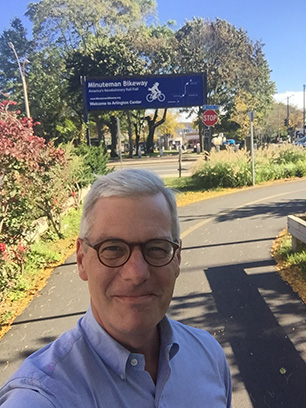
The other day I was perambulating the Minuteman Bike Path near the NEMA office when I came upon an elderly woman perched in a lawn chair, engaged in a bit of plein air water-coloring. The hibiscus she painted was a riot of bold reds and deep greens, and as I approached she looked up and smiled. “Look at those leaves,” she instructed, pointing at the plant. “I never knew Arlington had such interesting leaves.”
Her name, she informed me, was Lillian Christmas, an auspicious sobriquet if there ever was one, and she declared proudly that she was 87 years old. Lillian is one of those people whose life story is always close at hand and soon she was regaling me with her tale. One of ten children, she grew up in Cambridge. She once was a marathon runner. She loved to paint when she was young, but pursued a career as an executive assistant (“For some very important people in Boston”) and hadn’t picked up a brush again until she retired.
Lillian asked what I did for work and when I told her, her eyes lit up. “Museums! I love museums,” she exclaimed. She recalled how, 75 years ago on her way home from school, one of her favorite things to do was sneak into the Harvard art museums and see the paintings. “I always had my sketch book with me so I could learn from the masters,” she said. “I still carry around a sketchbook. It’s a good habit.”
It struck me that Lillian has been around for much of NEMA’s 100-year history, and that she has possibly witnessed many changes in the museum world. She might have noticed, for example, how the number of museums exploded in the years after World War II, especially in the early ‘60s and around the 1976 U.S. Bicentennial. She might have noticed how women have made many gains in museum leadership, yet still lag behind men in salary and benefits. She might have noticed phenomena like crowdsourcing and Pokémon GO, relatively short-term fads (in my opinion) that impacted the field for a time, and longer-term trends such as museums becoming more community oriented, customer focused, technology savvy, and experience driven.
These last trends are important because in many ways they are reshaping the definition of “museum” altogether. Back when NEMA was founded in 1918, museums were still defined by their collections. Art museums collected art. History museums collected artifacts. Science museums collected specimens. As Lillian’s story attests, people visited museums to see the collection, to be educated and inspired, not to be entertained by an “experience.”
There is some concern in museum circles today that the prominence of the collection has been minimized, that it has been devalued in the quest for community connection and experiential learning. And there is some justification for that concern, when we see museums scaling back collection care funds in order to pay for elaborate facilities or monetizing the collection to pay for deficits. Today the degree of disagreement over collection care standards reflects varying perspectives on what a collection means to a museum.
Our upcoming centennial conference, with the theme “Museums on the Move,” is a perfect time to re-examine these issues in the context of the field’s next 100 years, whether in formal sessions and ad hoc conversation. This is one of the things of which I’m most proud here at NEMA: our ability to convene museum professionals and do the difficult work of finding solutions to the field’s biggest challenges.
I for one think museums should redouble their efforts to safeguard and celebrate their collections as the backbone of all they do. After all, a museum’s collection is a reflection of its cultural heritage, a touchstone of its community’s history and aspirations. In their quest for relevance, museums must find strategic ways to make those collections relevant to their communities in the present and future as well.
Over the course of the past century museums evolved in many directions, but the collections themselves remain as important to our region's cultural life as ever -- arguably more so in this era of fake news and alternative facts since objects and archives are anchors of reality. Accordingly, museums and their supporters should commit to sustaining their collections through funds and best practices, making them fully in service to the public good and to people like Lillian Christmas, who carry sketch books and find lifelong inspiration in their favorite museums.

Dan Yaeger