
Florence Griswold Museum: The Garden Gang
Sheila Wertheimer, Landscape Historian and Designer, Florence Griswold Museum
In 1987, I taught an Historic Garden Design course at the Florence Griswold Museum. At that time, the museum property was solely the beautiful Florence Griswold House and the Huntley Brown House, a small colonial house which had been moved to the property twenty to thirty years previously by the then owner. The houses stood on only two acres of land. The formally designed shrub borders of the Florence Griswold House were well maintained; however, the gardens of the Huntley Brown House were in need of care. Close to the Huntley Brown House stood a rectangular plot, surrounded by a wooden split-rail fence. It had once been used as a vegetable garden. This was thought to be the perfect base for the students of the course to collectively design a garden using perennials and roses of the period during when the Griswold family were in residence.
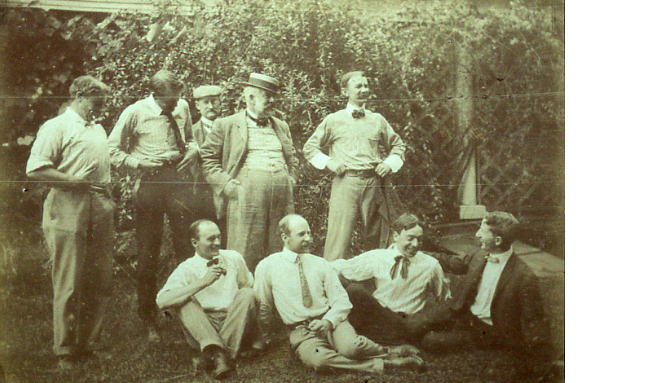
In 1840, Robert Griswold, a sea captain, bought the house for his bride, Helen. Their four children were born and raised on the beautiful eleven-acre property. In 1852, with steam replacing sails, Robert retired to manage the farm and to plant his perennial gardens. He died 1879, leaving Helen and her three daughters with the house (the Griswold son, Robert Junior, had died years previously at the age of seventeen). Robert left very little money. In order to pay the bills, the women opened a school for girls, which they successfully ran for thirteen years until Helen’s death. Sometime after her death, Florence was left alone to manage the property when her sister, Louise, died and sister, Helen Adele, was institutionalized. To meet the costs of running her beloved home, Florence began taking in paying guests. It was 1899, a time when a number of American artists were returning from Europe after spending time painting with the French Impressionist artists. The artists were searching for a countryside similar to where they had painted in France and the Netherlands; somewhere with beautiful, reflected light. Henry Ward Ranger came along and thought the beautiful Griswold property to be ideal, as it sat idyllically on the Lieutenant River. He was soon joined by his fellow artists. Miss Florence welcomed them, opening up the barns and sheds as studios and adding more bedrooms in the attic. She thoroughly enjoyed the challenges of running an Artists' Colony, and came call the artists “her boys”. The artists eventually became known as the Lyme Impressionists of the American Impressionists. In 1925, Miss Florence agreed to sell an acre of land to the artists on which to build a gallery to exhibit and sell their works of art. She became the manager.
Through the years, Miss Florence had continued to maintain her father’s perennial gardens, with artists and friends often helping. In 1937, Miss Florence died. A short time prior to her death, she had to sell her beloved property in order to pay off her debts. It was put up for auction. The then elderly artists bid on it but lost to a Judge Marsh who kept a number of acres by the river for himself, splitting and selling the remainder of the property into three parcels, allowing Miss Florence to remain in her house on a fourth parcel until she died. After her death, the house and 1 ½ acres of land were bought by a number of artists and friends who formed the Florence Griswold Society. It became the home of the Old Lyme Historical Society and the Florence Griswold Museum.
Keeping this site history in mind, the History Garden Design course was completed with a planting plan. As part of the course, the students helped plant the garden. Once planted, the question was “Who would take care of the gardens.” I asked the students to help, and some volunteered. I set aside time to meet on Friday mornings from 9:00 to 11:00, ending the morning with coffee and donuts. Other museum members began to join the group. Soon, the volunteers were also taking on the tasks of caring for the Huntley Brown foundation borders, along with the driveway border. It had become an established volunteer group at the museum, and it was time for the group to have a name. One day, someone called the group "the gang." The immediate reaction was, “That’s it, the Garden Gang” A title was set. T-shirts were printed with "Garden Gang" on the back and the museum logo on the front. All proudly wore the new t-shirts and enjoyed being recognized as the Garden Gang.
From 1990 to 2000, changes came about at the Florence Griswold Museum affecting the Garden Gang, giving them more work to do. The first piece of land to be bought was the parcel sitting on Hall’s Road. The land connected with the Huntley Brown House land. The family of artist William Chadwick had hoped to donate his studio to the museum and with the newly retrieved open space, the studio could be moved and set in place close to a small cluster of tall, narrow conifers on the property. The Garden Gang planted perennials and wild flowers around the studio.
In 1998 Marshfield, the house built by Judge Marsh, was up for sale. After much fundraising, the Florence Griswold Museum was able to buy the house and the beautiful land along with it. It had spectacular views of the Lieutenant. With help from the Krieble family, new art galleries were built attached to Marshfield. With the building of the galleries and a new parking area built to the south of Huntley Brown House, new walks were designed to run through the initial perennial garden planted by the Garden Gang in 1989. The gardens had to be quickly transplanted into a newly prepared border in front of the Huntley Brown House. It was March, but warm enough to dig up the perennials. The plants were placed under an apple tree ready to be planted the following day. Overnight the temperature dropped and the ground froze. The I worried about the survival of the perennials, however, within three days the temperature went up enough to thaw the ground. The perennials were quickly planted, with not one plant lost.
In 1999, an archeological survey of a designated Historic Tract was done by Professor Harold Juli and his students from Connecticut College. The Historic Tract sits north of the barns, running west from the Boston Post Road to the Lieutenant River. The walks of the old perennial gardens were found, so, too, the foundations of the barn and the well. A second barn was still standing but in a state of disrepair. A third barn came down very many years in the past, the space now taken up by a wall of the Krieble Gallery. Knowing where the garden walks were originally set and by using an aerial photograph of 1929, I could draw a plan outlining the gardens and walks. By using old snapshot photographs and artists’ paintings of the old gardens, a planting plan could be drawn. Perennial plants and shrubs available prior to 1937, the year of Miss Florence’s death, were used in the planting plan. The perennials were bought from a number of nurseries growing heritage plants.
During the spring of 2005, the Garden Gang planted the restored gardens. With so many gardens to care for, the Garden Gang divided into four groups: Miss Florence’s Gardens, the Vegetable Garden, Rose Gardens and the Brevilliere Garden at Huntley Brown House. (Soon after that first garden was planted it had been named the Brevillier Garden, honoring Bunny Brevellier, a Board Member who had assisted in financing those gardens. Bunny was a tremendous support to me.) Friday mornings now begin at 8:00 and end at 11:30 with coffee and donuts in the Rafal Landscape Center, the renovated barn. The season begins when the temperature is at 60 degrees, usually early April.

Apart from taking care of the gardens, the Garden Gang runs a plant sale in late May. This is at the beginning of Garden Fest which lasts for a month of talks and activities relating to gardens, and ends with an elegant Garden Fest Luncheon under the tent behind the Krieble Gallery. Attended by 200 guests, one table is set for the Garden Gang wearing summer finery and lovely hats: a splendid celebration. The same day, in the Krieble Gallery, there is always an exhibit of floral arrangements, each one based on a painting in the current exhibit. Usually five members of the Garden Gang participate, along with invited flower arrangers. Gardening continues on through the summer and fall, coming to an end in early November, when the gardens are put to rest for the winter months.
The Garden Gang enjoys two other events through the season. In August, there is the summer picnic, held at the home of one of the Garden Gang members. Each member brings her brown bag lunch, and some donate bottles of wine and water. The last gathering is a luncheon in November, celebrating a successful season of gardening. It is a time to wear best outfits and enjoy the company of good friends. Many Garden Gang members continue to meet to knit each Friday through the winter months. After the gardens are bedded down, there is one more task for some of the members to enjoy: decorating five fresh green wreaths for the barns and doors of the Miss Florence’s house, along with three 4’ artificial wreaths which are redesigned each year to hang in the peaks of the Krieble Gallery.
Presently, there are thirty-one Garden Gang members, including a number in their eighties and two who are ninety-two and are still in the gardens every Friday. At present one man comes in spring time just to prune the shrubs and small trees, as a number of the Garden Gang tackle the pruning in late March. New members of the Garden Gang are often brought in by a current Garden Gang member. Others might have observed the GG working and asked if they could join. The Florence Griswold Museum website also invites volunteers to join. There have been as many as forty-one members of the GG, but recently six members retired in their mid - eighties, and two members moved to the warmer climes of the Southern States. Still, our thirty-one members are able to get a great deal of work done each Friday.
Throughout the development of the gardens, the former Museum Director, Jeffrey Andersen, gave me tremendous support. He also came out most Fridays to visit the Garden Gang. Jeff recently retired and has been replaced by Rebekah Beaulieu, who is also lending support. The museum Facilities Manager, Ted Gaffney, brings the truck each Friday where we put the clippings to be taken to the compost. He is always a great help to me, in many ways. This active support by museum staff in turn supports the many efforts of the Garden Gang.