
Tollhouse Toils and Triumphs: Experiencing All the Angles of Creating a New Museum
By Lydia Harris and Susan Bailey, Rocks Village Memorial Association
What do you do with an empty 10’ x 12’ replica of a historic toll house sited in a historic district, an obsession with researching local history, and a new museum studies certificate? Answer: Create a museum.
The Rocks Village Toll House
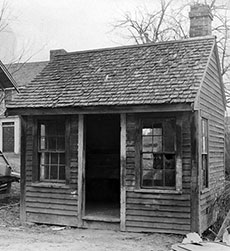
The year was 1928. The little village on the shores of the Merrimack River, known for its 900’ bridge spanning the river and named for its long-gone rocks, was quiet. A stranger drove into town, poked around, and inquired if he could buy a little cobbler’s shack he had spotted in a resident’s back yard. The sale was quickly made for $200, and off the little shack went to the Henry Ford Greenville Museum in Dearborn, Michigan. And why did Henry Ford have an interest in a cobbler’s shop? Because it was the original toll house built in 1828, used for collecting tolls to cross the bridge. It doubled as a cobbler’s shack back then, since the toll keeper would make shoes by hand while waiting for the next persons, horses, sheep, or wagons to request a crossing.
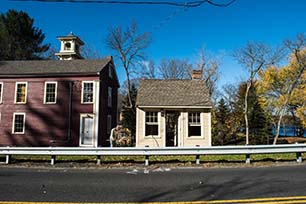
Moving ahead to 2013, the Rocks Village Memorial Association, Inc. (RVMA), a non-profit organization responsible for the Rocks Village Historic District (RVHD), obtained the original plans from The Greenville Museum in order to create a replica. Local businesses donated supplies and the Whittier Tech carpentry students built the replica, working off the original plans. Villagers and friends donated through a “Window Through History” fundraising campaign.
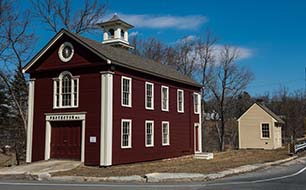
The historic village already sported a handsome two-story handtub house (HTH) used for fighting fires in the 1800’s and located next to the toll house replica. The bridge itself was something of a local attraction since it had been restored to its late 1800’s iron configuration maintaining its hand-operated center swing span. The streets of the village were lined with historic houses and in 1976, the Rocks Village Historic District was established. Even though many residents had put a great deal of effort into restoring their historic homes through the years, remarkably little was known about the histories of those houses, or of the people who had lived and worked in them. The poet John Greenleaf Whittier, who lived two miles from the village in the early 1800’s, had written much prose and poetry about the village. According to Whittier and others, this had not been an ordinary sleepy village. Stories from that time spoke of witches and countesses, and mysteries, murders, and mayhem!
These snippets of history fascinated two of the village residents who began looking into the history of the village more deeply. They discovered that the rocks for which the village is named prevented most boats and their cargo from traveling farther upriver. That meant that many traders would stop at the village while unloading or loading their cargo into wagons for transport to the much bigger town of Haverhill. The village turned into a major crossroads for commerce and industry, a bustling hub of inns and taverns, shoemakers and comb makers, blacksmiths, traders, physicians, and of course the toll keeper in his little house.
This is where the toll house story ends until 2016.
The Researchers
Seemingly bewitched, the two villagers spent many a snowy winter month “chasing witches”, trying to verify some of the more lurid stories, and researching families, businesses, houses, deeds, probates, and archives. Starting in 2016 and continuing today, over 500 deeds, 75 probates, six cemeteries, five archives/libraries, multiple depositions, and six descendants were researched/interviewed to pull together the history of 59 families, 39 houses, two taverns, many artisan workshops, one or two witches, a bridge, a ferry, a HTH and a toll house. Traveling as far away as New Sharon, Maine and connecting descendants from California to Australia, they organized the information onto a web site to share with neighbors and anyone else who might be interested.
Historic New England became involved in the spring of 2016 to help develop and run a historic walking tour. Sarah Jaworski worked with the two researchers to develop an hour-long tour that began at the HTH and continued past several historic houses. Sarah worked with the discovered information to describe what life was like from the early 1700s to the current day. The tour acted as a starting point to engage members of the community in the village history that had been gathered, but there was much more information to share.
Yet the toll house building stood empty.
The Museum
So there it all was, a charming building in the midst of a historic district, pages and pages of local historic data, and two obsessed researchers (one a Museum Studies Certificate graduate from Tufts University and the other an artist). The next logical step: create a museum.
So when the Essex National Heritage Area Partnership Grant application opened in 2017, the RVMA successfully applied for funds to create a museum in the toll house to include exhibition panels, artifacts, and children’s programs. In an attempt to avoid being just another historic house museum, the researchers set up the exhibition panels to focus on specific topics of interest. The topics included women (artists, real-estate owners, authors, and yes witches), slavery (Prince and Peter) and abolitionists (John Greenleaf Whittier and others), makers of Rocks Village (shipbuilding, blacksmiths, shoemakers, etc.), transport (by land and river), physicians, historic houses, the HTH and of course the toll house itself. The summary panels provided a means to distill a lode of historical data into an easily understood format to give visitors a feeling for what life was like in the past for this small dynamic village.
In June 2018, the small museum opened its doors.
Running the Museum
Once the doors were opened, bigger challenges revealed themselves. They included low number of visitors, extremely limited parking, limited heat, lack of bathrooms, traffic noise, neighbor’s concerns with activity at the site, and of course the size of the building. A maximum of only about six to eight visitors at a time turned out to be practical. There was also the issue of safety regarding the river and a shortage of volunteers willing to be on hand.
Now, a little more than a year after opening, some solutions are being put in place.
Short Term Solutions
Encouraging Visitors
Outreach has included local newspapers, libraries, Haverhill’s community calendar, Essex County Creates’ calendar, radio spots, Essex Heritage Area newsletters, Trails and Sails, and a mailing list. Opening in conjunction with other events centered at the HTH such as walking tours, open houses, cleanup day, art shows, and yard sales helped to increase the number of visitors. For example, during the latest yard sale, over 90 visitors in one day signed the guest book whereas the typical number of visitors is about 20. Another solution has been to invite school groups to come during the week when a van or bus can be parked in front of the building. At least 15 students have been engaged this way.
Seasonal Limitations for Opening
Not unlike many historic building museums, heat limitation and access to the building in winter prevents opening from November to March. Having the web page up and active, with continued informational updates, has helped keep visitors engaged. In fact, several descendants of families of the area have established contact this way and have come to visit.
Available Volunteers
The RVMA is an all-volunteer 501c3 organization made up of four officers and five additional board members. Additionally, there are three to four other neighbors and friends who donate considerable time in the areas of carpentry, landscaping, historical research, and tax preparation. The challenge is to have volunteers available to act as interpreters, handle logistics, safety, and security, especially in the summer months. Although community service hours have been offered to local high school students, no actual volunteers surfaced from this outreach.
Extremely Limited Parking
Partnering with the Merrimac Childcare center that is about a tenth of a mile away, in the historic district and part of the walking tour, has expanded parking on weekends from only two or three spaces at the toll house site to about 15 spaces. For larger events, the nearby Kimball Farm has graciously supplied parking with tractor-pulled wagon rides to the site.
Lack of Bathroom Facilities
Adding heat and plumbing to the building is not in the foreseeable future. Being upfront about not having bathrooms at the site and directing visitors to several businesses and municipal buildings close by has worked so far. “Porta Potties” are employed for larger events and it is not unheard of for a neighbor to open their house in an emergency.
Traffic
Rocks Village has always been a crossroads and it continues to be today. The HTH and toll house lie at the entrance to the bridge where two heavily traveled roads come together. Along with traffic noise, safety issues are an ever-present problem especially for people with limited mobility and children crossing the streets to access the site. In a joint effort to slow motorists, the city installed the posts for the “Entering and Leaving Rocks Village Historic District” signs that the RVMA had painted.
Concerns from the Neighbors
Along with the HTH and the Toll House Museum, the RVHD encompasses 28 private homes. Some neighbors have voiced the concern of increased activity, traffic, and noise from the site when it is an active museum. With this concern in mind, the times when the site is open and the size of the groups of people allowed in at one time are limited.
Limitation of Number of Concurrent Visitors
A 10’ by 12’ building with three usable walls for exhibition boards and a few shelves for artifacts limits the number of people that can be inside at one time. With an average time of 20 minutes to read all the information inside, encouraging visitors to tour the HTH and taking a stroll down to the river has eased waiting time and engaged visitors in other ways.
The Toll House Museum is now positioned to grow.
What’s Next?
The next chapter of this story is to directly address some of the more immediate challenges.
To encourage more visitors, the plan is to create more programming in order to extend the visiting time at the site and to engage more school groups. These efforts will include incorporating Native American stories into the museum by partnering with the Massachusetts Center for Native American Awareness, Inc., working with nearby John Greenleaf Whittier Birthplace and East Parish Meeting House, and developing exhibition panels in the HTH. One hopeful outcome of this partnering may be to encourage people to spend the day, enjoy a picnic lunch at the table near the river, and visit other local historic sites.
Now that the HTH restoration is complete, there will be more opportunities to host activities rain or shine for larger groups who will be encouraged to visit the museum as well. Proposed activities include holding lecture series, music nights, and crafting days.
In an effort to understand what would motivate different groups to volunteer, a concerted effort for engaging volunteers from all generations will be looked at in the coming year.
A traffic subcommittee has been formed to come up with ideas to address speeding vehicles and to work with the city to implement them. Some suggestions are: speed bumps, adding stop signs, increased police presence, and narrowing the road with sidewalks. So far, the city has not been forthcoming with any of these traffic-calming devices due to budget constraints, and work on this effort will continue.
The Rocks Village Toll House Museum has been a volunteer effort to establish a center of knowledge relating to life in the East Parish of Haverhill, Massachusetts. Now that the museum is operational, it is receiving praise from many quarters. Much work lies ahead to fully realize its potential. Local residents who appreciate being part of the restoration of their beautiful and unique historic village continue to enthusiastically support the toll house museum.