Evolving Dialogue
By Allyson Bachta, Jan Crocker, Amy Munslow, John Sarrouf, and Karen Ross
Origin of Civic Conversations Project
The goal of the Edward M. Kennedy Institute for the United States Senate is to provide a platform for students to understand and participate in the democratic process. Over the years, our education programs have grown in popularity as thousands of students become “Senators” each year to tackle major policy issues, from immigration reform to climate policy to gun safety laws. In the run up to the 2016 election, teachers began to report an increasingly divisive political culture that was posing difficulties as they prepared for their place-based learning experiences, especially our popular immigration policy simulation. The charged political atmosphere was creating a challenge for teachers trying to teach about policy, democracy, and civic issues. Student conversation seemed to parallel the national conversation, with students having difficulty listening to each other’s experiences and sharing their own. Some teachers even reported that preparing for the immigration policy simulation was too risky to tackle in class.
Enter Civic Conversations: a project to infuse civic dialogue in the classroom. We conceived of a project to support a growing group of educators and partners as they learn, work, and use dialogue to contribute to a positive school culture and provide students the opportunity to build skills for civic life.
Seeking Funding and Building a Team
The Kennedy Institute sought funding for a research and development project. Both the Leonard Annenberg Civics Award and the Institute for Museum and Library Services funded the three year project to study and support dialogue in the classroom environment and help educators tackle issues like immigration reform. We set about planning a multi-year study and implementation of dialogic practices in middle school and high school classrooms. It was important to have broad input from a diverse group of educators, non-profit partners and community members to influence our approach, and for all of us to learn from an established group experienced in leading dialogue and deliberation around contentious social issues. Essential Partners, in Cambridge became our training partner. The Students in Action program at the national organization, Multiplying Good joined us as a national partner.
Evaluator Karen Ross of UMass Boston and Allyson Bachta provided their valuable expertise in helping us work toward achieving our projected goals: to create a community of practice of teachers working with dialogue, to develop skills and confidence in a cohort of educators, and to create some training modules or materials to be tested with Multiplying Good’s national project advisors. Our goal is not only to provide high-quality, impactful training in classroom dialogue, but also to create a community that any teacher can join to learn more about infusing dialogue into their everyday classroom practices.
A First Step: The Design Team of Educators
We started this project by engaging a group of educators to serve as an extended focus group or “Design Team,” orienting us in the daily challenges and needs of the audience we serve. The educators of the design group came from a range of school environments in the greater Boston area, including the Academy of the Pacific Rim Charter School, Hansom Middle School, Bridgewater State University, Boston Latin School, The Codman Academy, and BC High. We decided to facilitate an educator-led, open-ended training and design structure, preparing for future training sessions that will be closely aligned with classroom needs.
Notes from the Design Team Process
Interviewing the design group participants and post training session surveys showed us a discrepancy between expectations and the value of the experience. We learned we needed to be more specific in defining dialogue and communicating not only the steps in the process, but the total curriculum for the Summer Institute.
Some of the feedback included:
- “I pictured the design group meetings more about people getting together and sharing rather than learning and sharing”
- “It was well-structured, well-planned, and well-run.”
- “I’m still unclear on what the final product is that we were creating.”
- “It gave us a realistic sense of what would be required to implement this in a classroom setting.”
To ensure we were on the right track as we planned the curriculum for the Summer Institute, we invited two of the participants of the design group to stay with us as advisors.
Dialogue Training: Summer Institute 2020
The next step was to give an open invitation to educators to apply to participate in a teacher training institute during the summer of 2020. This led us to find 10 dedicated teachers from fields of history, English, civics, and emotional development and learning. Some applied as teams from the same schools. All of the educators came to us in hopes of enhancing student dialogue skills like listening, connecting, and sharing across differences. In the end we had teachers from Bigelow Middle School, Edward M. Kennedy Academy of Health Careers, Saugus High School, O’Maley Innovation Middle School, Academy of the Pacific Rim Charter School, Salem High School, and three coordinators from the Students in Action Program at Multiplying Good.
Facing Challenges and Going Virtual
While we had originally planned a multi-day training institute complete with lodging, shared meals, and community-building activities, COVID-19 disrupted both the Kennedy Institute and the school systems. This created a need to deliver our training in a virtual format, while still allowing for teachers to build community together. It became important to figure out how educators were teaching in a new environment, and tailor our program to what their needs would be in the fall as best as could be predicted in July of last year. We learned a lot about the ups and downs of teaching with Zoom, classroom attendance, and organizational support behind the teachers. We delved into the issues the educators wanted to address and what topics were important for students to discuss.
It was important to all of us that our program would not only support the social-emotional needs of the students, but increase student engagement in the content area when thoughtfully pre-planned. The training program we developed for the Summer Institute aimed to see dialogue as an integral component of our educators’ classrooms, in order for students to integrate its components into their ways of conversing and understanding each other. Our training curriculum positioned dialogue as a classroom tool that would blend sustainability of conversation with and between students while meeting professional obligations to each educator’s school, district, and certifications by working within the system already provided to them.
Our team of John Sarrouf, Co-Executive Director of Essential Partners, Allyson Bachta, Facilitator, Amy Munslow, Education Manager at the Kennedy Institute, and Jan Crocker, Senior Exhibit and Content Developer, also at the Kennedy Institute brought years of experience in dialogue and traditional classroom education to neatly develop this weekly intensive training program. Emphasizing these links, as well as the idea that dialogue is a way of being together, were essential points throughout the training. John and Allyson used a co-teaching model filled with examples and activities to carry in their classroom as well as guiding everyone into dialogue as a tool to establish a community of practice among our group of educators. By coaching teachers to create something practical with which they could effectively demonstrate their competency, they are more likely to increase in confidence to continue building their repertoire, successfully incorporate dialogue into their classrooms, and sustain the practice over the long term in a way that expands its circle of influence.
Notes from the Summer Institute
The group of participants were an eager and enthusiastic group of learners, ready to think through their own teaching practices and how dialogue could be infused in everything from building classroom expectations, to connecting as a school community, to content teaching. The sessions expanded all our thinking. Each session included an opportunity to connect as a group with a “connecting question,” learning dialogic theory, modeling dialogue strategies, and workshopping of individual dialogue-based lesson plans. Everyone talked about what they learned and what they could carry back to their classrooms.
Teachers had immediate ideas of ways to apply strategies like “Questions of Persuasion and Understanding” and “Connecting Questions.” They discussed dialogic themes and problem-solved as a group for potential challenges. We also discussed teaching via Zoom and all the challenges and opportunities it provides. We shared our knowledge, trials at using dialogue, and asked others for help in problem solving. We decided to use Slack, an online communication and sharing tool, to help build a community within our group and collect helpful resources that teachers could refer back to throughout the year.
The Kennedy Institute participants, Jan and Amy, used our time during the Summer Institute to consider our initial challenge at the beginning of this project: providing educators with thoughtful dialogue-based resources to tackle difficult conversations in the classroom. As we participated in the Institute and learned more about dialogic pedagogy, our thinking evolved. Instead of creating a resource specifically targeted around the topic of immigration reform, we decided to build a lesson around democratic values. We learned that when people talk about politics, sometimes what they are really talking about are values. We also learned about the importance of reflecting on your own values and how those values are shaped and influenced over time. Our lesson, currently in the testing phase along with the teacher-created lesson plans, reflects these insights and will hopefully support educators as they prepare for conversations about politics and civic issues at the Kennedy Institute.
Beyond the Summer Institute: Testing, Coaching and Community
The Summer Institute supported each teacher as they developed a customized lesson plan, utilizing dialogue strategies and applying their learning to a unit or lesson in their regular curriculum. Teachers selected a topic of their choice and created a lesson to teach and share with other members of the Summer Institute. Each educator has also been able to share the lesson plan they are working with so that the rest of the educator cohort can experiment with all the lesson plans. As of this writing, the project is still in process. Currently, educators are receiving personalized feedback and coaching not only on their lesson plan, but about how to apply dialogue strategies in the classroom during a challenging and uncertain time. These virtual coaching sessions have been a great way to continue connecting, learning, and building a community of practice with the educators.
Another aspect of the project that is only in the initial stages of development is testing dialogic tools with after school groups on a national level. Working with Multiplying Good’s Students in Action program in different demographic regions gives us more feedback on approaches that may be effective in increasing the use of dialogue in civic engagement.
Next Steps: Evaluation
All the lesson plan trials in the classroom and the materials developed for and with Multiplying Good will be evaluated by Karen Ross who has been conducting evaluation throughout the project. Having evaluation integral to the project allows the Kennedy Institute to learn what works well for an organization doing teacher training and project-based learning. The data we collect will be disseminated at conferences and in professional publications to further champion the effectiveness of dialogue in today’s civic discourse.
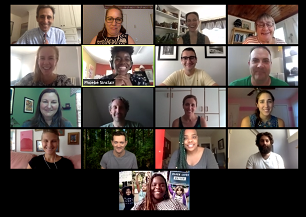
Summer Institute Photo: (L to R)
Top row: John Sarrouf, Allyson Bachta, Karen Ross, Jan Crocker
Second row: Amy Munslow, Phoebe Sinclair, Damian Aufiero, David Jones
Third Row: Emily Schultz, Kevin Fontanella, Megan Agola, Nichole Behuniak
Fourth Row: Sarah Koppelkam, Andrew Swan, Jessica Vann, Gabriel Avruch
Bottom: Janai Smith
Allyson Bachta, Training Facilitator and University of Massachusetts, Boston
McCormack Graduate School of Policy and Global Studies, Global Governance and Human Security, PhD Student
Jan Crocker, Senior Exhibit and Content Developer and Project Manager, Edward M. Kennedy Institute for the United States Senate
Amy Munslow, Education Manager, Edward M. Kennedy Institute for the United States Senate
Karen Ross,Ph.D, Project Evaluator and Assistant Professor, Department of Conflict Resolution, Human Security and Global Governance; McCormack Graduate School
John Sarrouf, Training Facilitator and Co-Executive Director and Director of Program Development at Essential Partners