Rediscovering Abby Kelley Foster
By Abigail Epplett
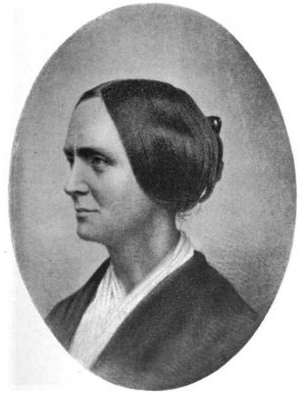
When considering the ongoing push for women’s rights, racial equality, and overall equity of opportunity in the United States, the name “Abby Kelley Foster” is never on a top ten list. She is rarely mentioned in mainstream history books despite aiding William Lloyd Garrison as a chief fundraiser in the American Anti-Slavery Society, lecturing beside Frederick Douglass during his early career, and discovering the talents of Lucy Stone. Perhaps her extremist views for the 19th century, which advocated for women’s roles in government, interracial marriage, and—most horrifying—bathing every day, found her written out of the records. Her tendency to lead from behind, rather than taking up the spotlight, also contributed to this lack of recognition.
This past summer, I had the opportunity to work in collaboration with Blackstone River Valley National Historical Park (BRVNHP) and the non-profit organization Blackstone Heritage Corridor, Inc. (BHC) to create an online exhibit and a pair of pop-up posters commemorating the life of Abby Kelley Foster— I’ll call her “AK” from now on. AK is one of the region’s figureheads and the choice to highlight her life was the result of two factors.
First of all, AK lived in the Blackstone Valley when not traveling the country delivering lectures. Many of the places that she frequented are highlighted as tour stops by the National Park Service and appear on the National Register of Historic Places. An online or temporary exhibit of local historical sites might encourage residents and tourists to visit in person.
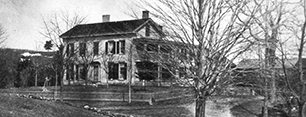
Most prominent of these locations is Mechanics Hall in Worcester, where her portrait hangs in the main hall. She organized the first two National Women’s Rights Conventions to be held there in 1850 and 1851, as she had been unable to attend the local convention at Seneca Falls in 1848. Another highlight is her family home, Liberty Farm, which served as a stop on the Underground Railroad. Nearby is Hopedale Community, a former Christian socialist utopia that stood for abolition, women’s rights, and universal education. The final stop on the proposed tour is Uxbridge Friends Meeting House, a Quaker religious building, which AK attended sporadically before being disowned for her radical activities.
The second important factor is that AK closely meets the demographics of our average visitors. As you have likely assumed, AK was white, middle class, and highly educated, especially compared to other women of her era. Her early forays into abolition required her to balance managing a Female Anti-Slavery Society chapter in Lynn while working as a schoolteacher to pay her student loans. This struggle feels familiar to statistically average visitors. Like them, AK was not elite enough to have everything she ever wanted. However, also like many of them, she did receive an excellent education at a Quaker boarding school, now called the Moses Brown School in Providence. She was privileged to have a good job and a high salary, especially for a recent female graduate in the 19th century.
Without establishing such a connection to the visitor’s experiences, revealing the inequalities of race, gender, and disability can be difficult, and even unsuccessful. The need to establish this connection is highlighted in the popular book on museum education, The Museum Experience, by John Falk and Lynn Dierking. The authors note that visitors who patronize museums, parks, and other informal educational settings always come from a specific sociocultural context. This means that the visitors’ demographics— such as their nationality, race, ethnicity, or native language— play a major role in how comfortable they feel in an environment, and how they are able to learn there. If the visitors’ sociocultural contexts do not align with those of the setting, they will feel out of place and unwanted even if they agree with the messages or outcomes presented by the setting. Using the life of AK as a lens for understanding her time period, along with showing how her work influenced current human rights movements, creates a sense of familiarity for visitors who might otherwise be uneasy discussing issues of gender and race.
The National Park Service, like many museums, has historically struggled to create these connections between social justice, equity, and the daily lived experiences of visitors. In its earliest days, establishing these connections were non-priorities. NPS sites were marketed towards young, white, affluent men—the Teddy Roosevelts of their generation—and their employees were taken exclusively from the same demographic.
Clearly, ideals have changed since the establishment of NPS in 1916, but an image problem remains. Today’s NPS acknowledges that the majority of visitors to the parks continue to be part of the white, middle and upper class, and highly educated demographic. A study conducted by NPS in 2014, “Linking the 2010 Census to National Park Visitors”, revealed that 95% of its visitors were white, compared to 72% of the general population, as recorded in the 2010 Census. A third of visitors had a household income of $100,000 or more, compared to less than a quarter of the general population. Around two thirds of visitors held college degrees, compared to one-third of the general population.
The employee statistics are similar. According to a July 5 article on the National Parks Traveler website, 79% of full time NPS employees are white. Anecdotally, the fifty years strong Volunteers-In-Parks program also has a majority-white base. This in particular creates a two-fold issue. While NPS wants to share a more inclusive picture of history, its staff and volunteers may be hesitant to talk about what they perceive not to be their story. Recruiting more “diverse” volunteers is equally difficult. Who wants to belong to a club where no one is like them?
AK was anything but hesitant. She did not care if she was the only woman on a business committee, the only white person in a “Colored” streetcar, or the only mother to leave her daughter at home with her husband during lecture tours. She saw beyond her privileges to fight for universal equality in a time when the presence of speakers promoting racial equality sparked riots, and speaking to a mix-gender audience was considered “promiscuous”.
At the same time, it’s unfair to ask everyone to be an “Abby Kelleyite”, the popular term for AK’s 19th century fanbase. She possessed the outgoing, persuasive, and yet sweet personality to continue lecturing before rioting crowds while eggs and vegetables were launched at the stage. I would have volunteered as a writer for her newspaper, The Anti-Slavery Bugle, and stayed home.
Since most people, myself included, cannot be an Abby Kelleyite, what can we do instead? For me, I have spread AK’s story through exhibits, programming, and articles. In October, I hope to join a collaboration between BHC and the Worcester Historical Museum, which holds many of the Foster family letters and documents, in a virtual celebration of the 170th anniversary of the first National Women’s Rights Convention in Worcester. I am also creating a program for staff and residents at Abby’s House, a women’s shelter in Worcester named after AK, to inspire them with her message and encourage them to work through the difficulties in their own lives. Additionally, we are looking into the potential for creating a curriculum that brings AK into the classroom for public schools in the Blackstone River Valley.
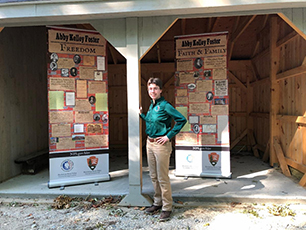
Abigail Epplett in front of the pop-up exhibit.
When evaluating this constantly evolving project, there are several markers of success that emphasize strengthening the connection between history and the present. The ultimate goal, of course, is to make the name “Abby Kelley Foster” as recognizable as Harriet Beecher Stowe, Susan B. Anthony, and Sojourner Truth. But there are many steps along the way to achieving this goal. First of all, we must enable the people of the Blackstone Valley to understand their history, which is linked both to AK’s story and to current ideological divisions. They must become Abby Kelleyite ambassadors if her story is to be made known outside of the area. Secondly, there is also the potential to build off the original exhibit to encompass more stories about social justice, from the Underground Railroad and egalitarian utopian societies of AK’s time to local activists in modern movements. Being able to connect with other organizations throughout the area to share both this exhibit and their stories would be another marker of success.
Ultimately, rediscovering Abby Kelley Foster means not only embracing her “ultraradical” ideology and total commitment to her cause, but also continually evaluating how social justice and equity are presented to an often homogenous audience. No harm comes from being described as beautiful and maidenly by your enemies, as reporters for the New York Herald called AK, even as they criticized her beliefs and belittled her for stepping away from women’s rolesin the home. An exhibit or program can and should astonish dissenters with its elegance, even with its extremist nature, as long as the message is clear. New Abby Kelleyites are out there, waiting to be discovered. Will your work be what reaches them?