
A New Mission and Vision for the Connecticut River Museum
By Verena Harfst, Trustee of the Connecticut River Museum, Co-Chair of the Strategic Planning Committee, and Chair of the Education and Public Programs Committee
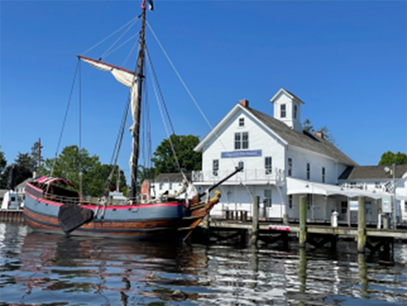
The Connecticut River Museum is located on the foot of Main Street in Essex, CT, in a beautiful location on the riverfront. The private non-profit institution is fully accredited by the American Alliance of Museums. It offers a wide range of educational programs for schools and the general public, tells the history of the Connecticut River in its permanent and temporary exhibits and at special events, collects and protects manuscripts, books, art and artifacts connected with the region, and maintains public access to its landmark buildings, wharf, and park. The museum also operates two vessels that allow people of all ages to learn about and enjoy the River from the water. The museum welcomes some 25,000 visitors from all 50 states and many foreign countries each year.
1. The Challenge
Our previous 5-year strategic plan expired in 2019, and so, in the spring of 2021, after recruiting a new Executive Director and with the worst of the Covid lock-down seemingly behind us, the Board of Trustees of the Connecticut River Museum (CRM) decided to embark on a new strategic plan.
How much the world had changed since 2013 when CRM had last adopted such a plan! Covid 19 demonstrated how deeply vulnerable the museum community, its operations, and its revenues were to a global pandemic. “Fridays for Future” was giving environmental challenges to the Connecticut River a new urgency. “Black Lives Matter” posed the question: “How can we become more diverse and inclusive in every aspect of our institution?” Would the Nation’s deeper political divide affect our dealings with each other, and how would the museum remain relevant with new technologies, such as smartphones and social media, now so ubiquitous? Where did the museum fit in this context, having been founded in 1974 by enthusiastic local residents on the premises of the historic Steamboat Dock in Essex, and with its recent acquisition of Onrust, the recreation of a 17th century Dutch vessel?
2. The Strategic Planning Process
From the outset, there was consensus among trustees and the executive director that the strategic planning process should be as representative and inclusive as possible both within the organization and with regard to its external constituencies. Thus, all trustees and all full and part time staff actively participated in the process as a team-building exercise. Over the course of six months, four half-day full board/staff retreats took place, the first and last with all staff, and the two intermediate ones with senior staff. The museum hired an experienced, non-profit professional as a facilitator. She conducted anonymized interviews with all staff members on their views of the museum, its strengths, and weaknesses, and how they saw its future. An eight-member strategic planning committee comprising two Trustees as co-chairs plus the director, the facilitator, the board chair, and two additional Trustees, planned the retreats and guided the overall process. The co-chairs, the director, and the facilitator formed a steering group to drive the day-to-day process, ensure flexibility, and maintain momentum.
For outside input, the strategic planning committee cast a wide net that preceded the first retreat of board and staff. Committee members conducted personal interviews with key donors, asked all museum members to respond to a detailed questionnaire via email, and gave CRM visitors and attendees of numerous outdoor summer concerts the opportunity to express their views. The input from these multiple sources allowed CRM to identify diverse constituencies and learn their views of the museum and its services.
The first retreat with staff and trustees laid the groundwork for the strategic planning process. It began with an appeal from the steering group to envision a strategic plan centered on fostering a “culture of innovation.” In a rapidly changing world, the message was that any strategic plan needed the capacity to adapt flexibly and creatively to new and evolving circumstances. Ideally then, strategies adopted today should be dynamic enough to succeed in a wide variety of circumstances, encouraging well-defined experiments and tolerating occasional failures in the greater interest of ongoing innovation and adaptation. Under no circumstances should the plan gather dust on a shelf.
This appeal was followed by reports about CRM’s financial performance over the past five years, the state of its campus and waterfront, an evaluation and account of all stakeholder responses, and an analysis of major museum trends across the country. The group next analyzed the museum’s strengths, weaknesses, opportunities, and threats (SWOT), as well as external political, environmental, economic, social, and technological forces affecting its operations (PEST). The first retreat ended with a brainstorming of all these elements relating to a new mission, vision, and values statement. The resulting values statement embraced both the institutional values of the museum and the personal values of its leadership. It was ultimately adopted by the board as part of the strategic plan and published separately on CRM’s website.
The strategic planning committee drafted a first version of the mission, vision and values statements and identified critical questions to be addressed in the next stages of the strategic planning process. All CRM committees, including education and programs, collections and exhibits, finance and governance, were asked to address the strategic questions relevant to their respective areas and to present their priority goals, strategies, and measurable objectives at the following meeting with board and staff. At the second and third retreats, the museum’s mission, vision, and values were finalized, and goals and strategies became the focus. With the occasional help of break-out sessions to discuss major topics in smaller groups, five central goals emerged: (1) celebrate river history and inspire stewardship; (2) strengthen our position as a desirable destination and welcoming venue for learning, enjoyment, and community gatherings; (3) recruit, hire, and assign engaged, qualified people who share our vision and values as CRM implements new ideas, initiatives, and programs; (4) enhance and encourage the culture of philanthropy that has long supported CRM and sustain current operations and future growth through skillful stewardship of available assets; (5) foster responsible innovation that enables creative and effective response to ever-changing challenges and possibilities. Each goal is followed by a list of strategies on how to achieve it. The Strategic Plan is published on the museum’s website: https://ctrivermuseum.org/strategicplan/
At its fourth and last retreat, the full board and all staff reviewed the draft strategic plan as well as an implementation grid prepared by staff. As an internal administrative tool not intended for publication or formal board approval, the implementation grid details how staff intends to implement the five major goals over a period of several years. The grid also identifies staffing and financial requirements.
The board unanimously adopted the strategic plan in mid-March 2022. Recognizing that its underlying assumptions could change considerably in just a few years, the plan’s timeline is flexible and intended to cover three to five years. In addition, the board recognizes that the plan is a living, dynamic document in need of ongoing review by staff and trustees. To that end and with the help of a pro bono consultant, the museum is also establishing additional evaluation tools to monitor progress against plans and vet the quality of programs. This should help CRM to correct its course wisely along the way.
3. New Mission, Vision, and Values
From its beginnings, the museum has celebrated the Connecticut River, its history, beauty, and the crucial role it plays for the region. The new mission zeros in on some of the challenges we face as a society in the 21st century. It is also more concise than the previous one, with a narrower purpose and greater emphasis on how to achieve its aspirations, making it a results-oriented mission statement: “To deepen appreciation of the River’s history and to inspire its stewardship by providing unique educational and recreational experiences to diverse audiences." The new vision is that “generations of stewards will appreciate and care for our rivers. The previous mission read: “To lead in the study, preservation and celebration of the cultural and natural heritage of the Connecticut River and its valley.”
The mission recognizes that many audiences will appreciate the River most if they can experience it through a combination of education and recreation. For example, boat tours on the museum’s two vessels Onrust and RiverQuest create fun experiences and inspire interest in the River’s history and environment at the same time; summer concerts on the lawn draw crowds that would not necessarily learn otherwise about the museum and engage with it.
One new element of the mission and vision is the museum’s embrace of the concept of stewardship arising from climate change. CRM recognizes that as an institution devoted to the Connecticut River, it bears a special responsibility to address the ecological challenges of the waterway and its environs. CRM’s educational programs and exhibitions are to raise support among its constituencies for sustainable development of the Connecticut River, and also for rivers throughout the country. As a history museum, CRM’s comparative advantage in promoting stewardship — its unique selling point — lies in its ability to explore the environmental history of the river. This history has experienced numerous dramatic cycles caused by human intervention. The museum’s focus on this history provides a clear path to encourage a deeper understanding of the difference human intervention can make — for better or for worse — and to inspire future generations with surprising, engaging and delighting programs, exhibits, and activities.
In this respect, CRM also recognizes the importance of leading by example, that is, of embracing stewardship in the museum’s own operations. As an actor immediately adjoining this beautiful waterway, CRM commits itself to reducing its ecological footprint and to supporting third party efforts to help fight invasive species and pollution in the river. Likewise, the museum will work on an updated “Disaster, Mitigation, and Recovery Plan'' to help protect against the heightened danger of flooding and storm damage caused by climate change, as well as possible future pandemics and cyber-attacks aimed at its digital assets.
Another important new element of CRM’s mission and strategic plan is its focus on diversity, equity, inclusion, and belonging for all visitors, staff, and constituencies to feel welcome. The museum aims to attract visitors from the widest possible range of communities along the river and beyond. Its educational programs for children are to be accessible to all students in the region, including those at underserved schools. Diversity also extends to the stories the museum tells. As stated in the strategic plan, programs, exhibitions and collections should reflect the experiences and cultural diversity of all those, past and present, who have lived on or near the river. Finally, diversity is an expectation the plan affirms internally: CRM strives for its board, staff and volunteers to evolve in a diverse and inclusive way. It seeks to foster cultural competence among staff and trustees and a sense of belonging among visitors and various constituencies.
The strategic plan also addresses other challenges and opportunities whose treatment will determine the fate of the museum in years to come. One such challenge concerns new technologies. The Covid-19 pandemic has already required the museum to rethink the ways in which it reaches audiences with its educational programs for children and adults. Almost overnight, the Museum, like so many other institutions of its kind, embraced Zoom to deliver its programs under Covid conditions. And indeed, audiences of all ages adapted quickly to this new tool. Now, CRM is poised to take the next steps. While the amazing and unique pieces in its collections will always remain the core of the museum’s offerings, interactive tools and multimedia presentations have great potential to help explain the significance of CRM’s collections as well as to enhance and enrich storytelling in engaging ways. This is especially so given the limitations of the museum’s exhibition space. Accordingly, one strategy featured in the plan is to celebrate the history of the river and inspire stewardship by means of “user friendly interactive learning experiences using up-to-date interactive technologies.” The plan also specifies that the museum commits to anticipating its technological needs and emerging trends and to develop products that will best support programs and operations. Embedded in this commitment is the recognition that new technologies are not an end in themselves, but rather a useful tool to respond flexibly to the diverse and changing expectations of different audiences.
The last element of CRM’s values statement that may be of particular interest to readers of this publication is the commitment of the museum’s leadership to fulfill their respective tasks with integrity, honesty, enthusiasm, and respect for one another. This pledge can be read in part as a response to the divisiveness and polarization that have come to afflict our society as a whole. The museum and its campus are an integral part of the small and lovely river community of the town of Essex. In this capacity, it considers it a privilege to act as a community center and a destination welcoming the community at large. CRM seeks collaboration with other organizations, groups, and communities that share its values and encourage academic institutions, such as universities and research centers, to use its archives and collections for academic study and scholarship. And it is committed to engaging with local partners of all kinds, including businesses, for mutual benefit, for example by highlighting local products and artifacts in the museum’s gift shop. “Being a good neighbor”, as this last section of the values statement is entitled, may be a small contribution to a much larger challenge, but it, too, can help bring about a better future.