How Historic House Museums are Adapting to Stay Relevant
By Aileen Novick, Project Manager, Hempsted House, Erin Malueg, Collections Manager, Connecticut Landmarks, and Brayden Paynter, Program Associate, International Sites of Conscience
In our session, “Why Should I Care? Historic House Museums as Sites of Conscience, Engaging Visitors with Difficult Histories” Connecticut Landmarks (CTL) sought to share the lessons we have learned through the process of research, reinterpretation, and work with International Coalition of Sites of Conscience to help our organization remain relevant to the public.
The International Coalition of Sites of Conscience
The International Coalition of Sites of Conscience (ICSC) is a dynamic global network of museums (230 members in 55 countries), historic sites and memory initiatives that inspire millions of people each year to explore the parallels between past and present, build bridges of understanding, and take action on pressing social issues. Members commit to interpreting history through memory projects, engaging in programs that stimulate dialogue and promote humanitarian values, and encouraging opportunities for the public to take action.
ICSC employs dialogue as an interpretive strategy to enable visitors to access larger historical and humanities themes. It applies this framework to enduring social issues addressed by historic sites and museums to foster an exchange of ideas anchored in scholarship. As trusted educational and community spaces containing human and visceral connections to the past, museums and historic sites are ideal venues for fostering dialogue and civic engagement.
Goals of our Session
Our conference session format was predicated on the same beliefs that inform ICSC’s work with the public. The first was that some of the most important information about a subject is held by our audiences. The second was that we are looking to learn and build relationships together with our audiences. To the first belief, we chose to build a session that would inform colleagues about the efforts at CTL, but also allow CTL to learn from a room of engaged and experienced professionals. To the second belief, making the kind of change CTL is pursuing involves building many long-term relationships. We sought to create a program where both CTL and attendees would be able to identify and meet people they want to continue working with after the end of the session.
How did we get started?
CTL was in search of methods to express the difficult stories residing at our properties; a history of northern slavery; the colonial speculation of Native American lands; an individual who was hung as the first spy of the American Revolution; a gay restoration architect of the mid-20th century and use them to address contemporary social justice issues. For example, how does the history of Connecticut slavery affect our society today? How can we take action to make our society more equitable today? These are not conversations our staff could successfully engage in without training. These are difficult topics, and while we want to engage all of our visitors in these conversations, we want to be sure that we are doing it well. By using the methods of ICSC, we have begun the process of training site staff in the ways to introduce, encourage, and facilitate discussion of these topics.
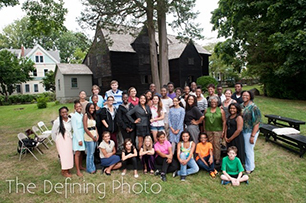
Students and staff, Writer's Block Ink at Hempsted Houses
Research
Through our audience research, we have found visitors seek experiences that are narrative and speak to the human experience. Conducting further audience research with teenagers, we turned a few of our historic house museums into learning laboratories to see what historical stories would engage teens and make them want to learn more about our sites. We found that young people wanted to know less about the objects and wallpaper and more about how the sites’ stories were relevant to their own lives. Therefore, we needed to find points of intersection between contemporary interests and the themes that our properties represent.
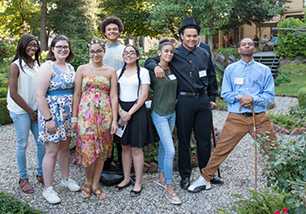 Youth Employment Program Students
Gathering this information from our audience has informed the path of our scholarly research, especially at our Hempsted Houses in New London, Connecticut, where we are able to share powerful stories of northern slavery with the public. Our new research provides stories about the Hempsted family’s connections to slavery from colonial times, through the Revolution, and on to westward settlement. Along with primary documents about Adam Jackson, the 27-year-old enslaved African-American who was purchased by Joshua Hempsted; we now show visitors a runaway ad placed by Sheriff Joshua Hempsted in 1803 for Dinah, an enslaved woman at the house. We have stories of Revolutionary War Hempsteds who held onto slavery as well as stories of Hempsted abolitionists in the 1830s and 1840s who found New London to be a community that still very much supported the system of slavery.
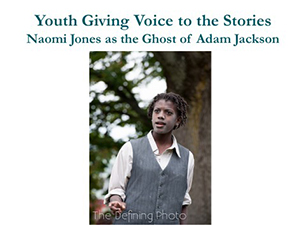
Of particular interest to the teens, was the life of Adam Jackson, who reimagined Adam’s life and wrestled with the property’s key themes—freedom and equality with a focus on slavery—by producing three original theatrical productions and site interpretations. This work has contributed to increased community pride in and understanding of the property’s history and increased school program, site and special event attendance, particularly by particularly youth and neighborhood residents.
New Property in Need of Interpretation
However, not all of CLT’s properties have an interpretation in place. The Palmer-Warner House located in East Haddam, Connecticut it is the newest property to CTL. The house, constructed in 1738, was home to the Warners, a family of skilled blacksmiths, who resided there for over 100 years. In addition to this rich colonial history, the house provides a more contemporary story for us to tell. CTL is preparing to open the house as the first designated LGBTQ historic site in Connecticut.
The property was the home of preservation architect Frederic Palmer and his partner Howard Metzger. Palmer served as a Trustee and Structures Committee Chairman for CTL (formerly Antiquarian & Landmarks Society) from 1944 until his death in 1971. CTL is looking to tell the story of the life Howard and Frederic in rural Connecticut, where they lived as a quietly gay couple before and during the civil rights movement. We will be working with an advisory council (which will include LGBTQ individuals and local community individuals) and scholarly panel to ensure we are cognizant of all of the interrelated stories that can be told at this property.
Connecticut Landmarks looks to actively engage visitors in sharing their experiences. We’re working to catalog the property’s extensive object and archival collections and research the house’s gay history in preparation for sharing it with visitors. We seek to be a setting to share multiple viewpoints, encourage visitors to share and document their own history, and foster conversations around inclusion, individuality, privacy, and privilege. We want to empower visitors to think about what they can do to effect change in the world. During this process, we are using ICSC’s methodology to inform our interpretation by developing themes to engage visitors when the house is open to the public, such as the idea of family/community and its creation, service (during WWII), the preservation movement in America, and intersectionality.
Session Feedback
During the session, we posed three key questions to engage the audience in discussion about what has challenged us in this process and to see how others are tackling these issues at their institutions.
What ideas does your organization have to draw in diverse audiences?
Many organizations are still working to attract audiences that are more diverse. Individuals were able to talk about structural barriers to visitation and expanding audiences (i.e. finances, transportation, etc.) or about intellectual barriers (not seeing themselves represented, not telling relevant stories, etc.). One of the biggest challenges was linking the two together and working with an audience around both kinds of barriers simultaneously.
Ways this might be accomplished:
• Outreach to local community members
• Collaboration with groups that are talking about relevant issues with teen groups or adults.
• Offering people exhibits and discussions about relevant topics at your site
• Co-curating exhibits with local community members
Questions to gauge your relevance:
• Is your museum inclusive of the groups you are hoping to reach?
• Are the signage and tours in the languages spoken by members of your community?
• Can you reduce or eliminate the admission fee to members of your city/town?
• Are you able to apply for funds to be a free site?
How are your organizations trying to engage with contemporary issues such as those of race or LGBTQ?
Represented organizations engaging in contemporary issues have focused primarily on the issue of race and are most comfortable either serving as historical experts about past injustices or as a forum for people to talk about contemporary issues. The biggest and most interesting struggle that emerged was the challenge of how to link the two to have the history inform the forum that we create.
Some of the examples brought up during the discussion included:
• Contemporary art exhibits that relate to race to get people talking about what they see in the art and in an indirect way race as well
• Community panel discussions relating to immigration reform
• Exhibitions relating to the enslaved individuals who lived and worked on the property
• Providing a facility for ESL or citizenship classes to take place
• Using the voices of the descendants of enslaved individuals to tell the story of their ancestors
How do we pay for this work?
The increasingly challenging local, statewide and national fundraising environment, which cultural organizations face, forces our institutions to seek new solutions. Therefore discussion participants felt it is necessary to:
• Relentlessly build endowment
• Think more broadly about your Affinity Communities. Look more broadly for project donors; think beyond your local/statewide/regional community
• Focus your fundraising efforts by targeting fundraising efforts for hyper-local initiatives hyper-locally
Next Steps
CTL will continue to implement and hone Sites of Conscience practices to make our properties more relevant to the public we are serving and to bring in audiences we are not yet reaching. We will create provocative programming and exhibits that exemplify the ways that history can serve as a bridge to encourage discussion of contemporary topics. CTL is working with ICSC to achieve our goal of becoming vital participants in our communities. To achieve this, ICSC is drawing on the expertise of its global membership to help the staff of Connecticut Landmarks develop public dialogue skills and expand their understanding of the roles historic sites can play in their communities.
(Photo: Hempsted Houses, Connecticut Landmarks)