
Five Steps to Building an Exhibit (that’s way over your head and beyond your capability) by Utilizing Volunteers!
By Wendell Berthelsen, Director of Operations, Aviation Museum of NH
After a career of working with unionized reports followed by a transition into the museum industry/non-profits, learning how to treat volunteer staff has been a challenge and a rewarding learning experience. I’ve found that many skills and talents lurk where one would never guess. This is a story of a lofty idea, passion and the ultimate in volunteerism. The project spanned two full years, with a core team of three volunteers along with final touches by regular museum docents. It necessitated finding skills and talents from an unknown pool and from unlikely sources.

Step One: Start with a wild idea!
Sometimes it just takes a ride down the street and the wild idea hits. With our current membership and museum guests trending towards an older demographic, our aviation museum was shifting its thinking towards attracting a younger audience. For those who are not aware, this is a problem for aviation in the near future: few pilots and/or aviation workers in the pipeline. Driving past a hangar at the Manchester-Boston Regional Airport there lies an airplane fuselage, without wheels, wings or an engine. Wouldn’t it be fun to have a cockpit for our guests to sit in, especially the youngsters! But, being Director of Operations, and not being a pilot or airplane mechanic, how crazy is that going to be to implement? The wild idea takes hold. Utilizing a contact who worked at the facility, we got a sneak peek at it. To put it bluntly, the airplane was gutted, but had I not acted on the dream, the fuselage would have ended up in the scrap pile.
This was great, wild idea, but how would a “hunk of junk” end up as an exhibit and how could we possibly fund the project? Who would work on it, where could the work be done and who would have the expertise to make it happen? That’s where the labor of love commenced and would continue over the next two years.
Step Two: Form a team of volunteers, mixing in those who are also willing to donate material and labor
How is one to begin to search for and assemble a highly specialized and skilled team of volunteers? The formation of the team started by spreading the word about a possible cockpit exhibit for kids to sit in and to be a pilot for a moment. Of course, that was preceded by negotiations to gain ownership of the fuselage, which presented its own challenges.

One thing leads to another. First, a museum member (not a pre-existing volunteer) steps up, after hearing about the exhibit we would like to build. It turns out that he is a pilot and even better yet, he owns a machine shop relatively close by the museum. He recommends a retired Aircraft and Powerplant Mechanic (referred to as an A&P), who is also a museum member (not a pre-existing volunteer either). A call to a former museum docent, looking for possible help, leads to another museum member (a third new volunteer). As luck would have it, he is also an A&P. Now we have something! Three “project volunteers”, outside of our regular staff of volunteers, whom I have never worked with before, who say that they will do whatever it takes to make it happen! What a challenge…someone who knows just a little about airplanes assembling a team to work on an airplane!
Step Three: Develop a far-fetched plan
Not knowing any of the three volunteers to any degree, it was time for the far-fetched plan. My first thought was to arrange a meeting to view the fuselage and look for a lot of input.
The first meeting did not go well. Now several months into negotiations to acquire ownership and verbal permission to proceed, I met with the team at the site to gain their insight; however, the plane had disappeared! It had been assigned for an Emergency Preparedness Drill at the airport; it was to be burned! How embarrassing! After a little investigation we found the fuselage and arranged to reach a compromise which also solved one of our problems.
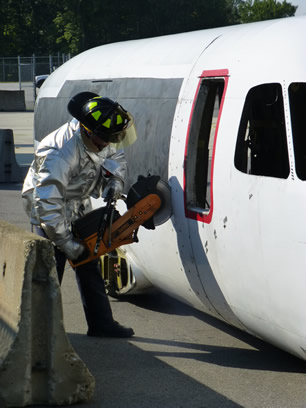
How could we cut the cockpit from the fuselage? Because the Manchester –Boston Regional Airport Fire Dept. had never cut into an aircraft, they decided, as part of a training exercise, to cut off the 15-20’ cockpit. This is a heavy duty undertaking as you can imagine: the plane has to be rotated to cut all the way around! The training exercise pays off for both the airport and the museum, making this a far less cumbersome logistical issue.
How do we transport it? The volunteer’s machine shop has a truck and suitable trailer, a huge savings as opposed to renting the equipment.
Now what? The cockpit is transported to the machine shop and placed in an inside garage bay for winter work. Indoor garage/workspace was not available at the museum, so this was another giant savings.
All well and good…but now what? There was free reign at the machine shop for the team…sheet metal, fabrication equipment, welding and shop labor. This allowed us to install a carriage system on wheels, a metal floor and a new metal bulkhead to close in the large opening of the cockpit. Best of all, the volunteer who owned the shop encouraged and demanded that Director of Ops get dirty and make his own parts. To have someone open up their shop for an undertaking like this is phenomenal!
Cockpit Necessities to make an Exhibit? The A&P mechanics scoured hangars and sought parts from their associates such as pilot’s seats, foot pedals, yokes, instruments to populate the instrument panels, new windows, radios and much more…anything you see and hear in a cockpit.
How’s it get a fresh coat of paint? Another friend of a volunteer, whose father operated a local airport, stepped up. Once again, no charge, but it did involve days of sanding by the team.
Step Four: Balance volunteers' time and expertise/build the exhibit
So how does one develop a working relationship with unknown, very talented volunteers and at a location outside the unusual museum setting? Very carefully, but man was it fun! I found that my schedule was no longer a determining factor in the work sessions…just be there. These work sessions were often early in the morning and sometimes several days a week.
There were several critical factors in keeping tasks on target and keeping the volunteers happy: be there on time or early, spend whatever time was necessary for that day, have materials ready for the day’s tasks and buy coffee or lunch when the coffee truck came by. Another consideration to recognize was that as much as our regular museum volunteers wanted to participate at the shop, there was a huge safety concern, which prohibited their participation.
Most importantly, don’t be discouraged if no one shows up for a work session. This didn’t happen too often. Also, be understanding if the volunteers forget to bring a critical part.
Once the cockpit was delivered to the museum, several of the regular volunteers did work on the finishing touches.
Step Five: Recognition for All and What a Success
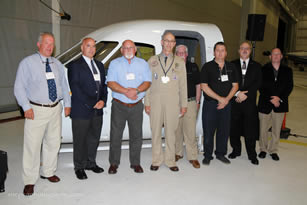
All of the volunteers that worked on the cockpit were recognized in one fashion or another, for their part, whether they made a small contribution or a major one.
Recognition on the exhibit: All volunteers had their names placed on the cockpit, outside the entry door. This was especially appreciated by the regular museum volunteers, who always like to see their names attached to their work!
Recognition at our 2015 Annual Gala: The Cockpit Exhibit was officially unveiled at our annual gala in a hangar at the Portsmouth NH Airport. This was no easy undertaking either, as the cockpit was transported from the museum to the gala (via trailer), a distance of almost 50 miles and back. This gave us the opportunity to honor all of the participants in front of a gathering of our members and their guests, while publicly thanking them.
Other recognition: The project was chronicled with pictures and videos on a daily basis. These images have been compiled into a slideshow of the progress and used in many PR efforts. The key contributors were given photo albums, custom created on a photo website, with individualized thank you messages by museum staff and the Board president. Other contributors received custom created thank you cards, also printed by photo websites.
The cockpit took just over 2 years from first sight to the unveiling. It seemed like it might never come to completion, but even the volunteers kept the finish line within view. The exhibit has filled an incredible need at the museum, helping us to attract youngsters and other guests. It is a huge hit with all our visitors, especially when the Manchester Tower conversations are broadcast into the cockpit.
Passion, hard work, teamwork and volunteerism all came together to make a perfect storm!