
Meet your colleagues in museums around New England! It’s often too easy for colleagues to feel isolated in their own institutions—we hope this feature will help close the gap. We also hope that it reinforces your own joy in your work and encourages you to recognize your own positive impacts.
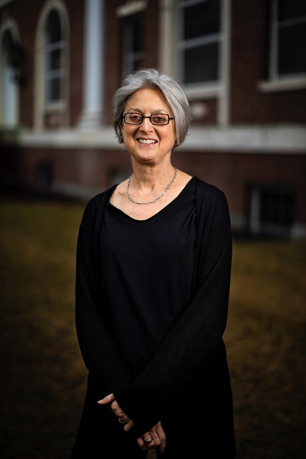
Janie Cohen is currently the director of the Fleming Museum of Art at the University of Vermont in Burlington. Last November, Janie was elected as the president of NEMA's board of directors.
How did you start out in the museum field, and how did you get to where you are now?
I knew early on that I wanted to go into the museum field. I had a wonderful invitation to spend a year living with family friends in Amsterdam after graduating from college. With their help, I looked into possible internships in museums there and wound up with an internship at the Rijksmuseum. I did print cataloging work along with some translation for the Education department. Most importantly, I formed professional relationships that have been important to me throughout my career. And I was able to look at Rembrandt’s prints and drawings on my lunch hour!
After returning to the States I received an MA from NYU’s Institute of Fine Arts. While there I had the opportunity to gain further experience in collections work at the National Academy Museum (then called the National Academy of Design), the Serge Sabarsky Gallery (whose collection is now housed at the Neue Galerie), and, finally, at the Brooklyn Museum through a New York State Council on the Arts internship. I then moved to Boston, where I headed a traveling exhibitions program for the New England Foundation for the Arts, working with curators throughout New England and touring their exhibitions nationally.
I left NEFA to curate and faced an amazing and scary decision between an entry-level curatorial position at the Boston ICA, or taking a leap of faith and going out on my own as an independent curator (it was the 1980s and the arts economy was booming). After much thought and consultation, I took the leap and had a wonderful 4 years of freelance curating, based in Boston, organizing contemporary exhibitions and projects on the east coast and in Europe.
While it was very exciting and rewarding work, I began to long for a collection to work with a community to curate for. Having grown up in Madison, Wisconsin, where my family was associated with the university, I ideally wanted to work in an academic museum.
25 years ago this fall I was hired as curator at the Robert Hull Fleming Museum at the University of Vermont. I held that position until 2002, when I was named director, the position that I still hold. I have had other opportunities along the way, but I am immeasurably grateful for this long – and ongoing – relationship with the Fleming and UVM; there are so many advantages of longevity within a community and an institution, particularly in a university museum. The relationships continually deepen and the opportunities keep growing.
Tell us a bit about your museum and what makes it unique.
The Fleming Museum of Art (new name as of two years ago) is a wonderful, small museum on the UVM campus, nestled between the Green Mountains and Lake Champlain. Designed by McKim, Mead & White, the museum was opened in 1931 by UVM to serve the community as well as the academy. It is unusual in this aspect of its mission, articulated from the get-go: the Fleming offered art classes and a variety of public programs, including Saturday morning cartoons, which in those pre-TV days attracted 300 – 400 kids every weekend. We maintain strong ties to the greater Burlington community today.
Our collection is both global and eclectic: While the focus of the collection is fine art and anthropological artifacts, it also includes decorative art, furniture, clothing, and material cultural. We have found the breadth of the collection to be a significant educational asset. For the past ten years, students in Anthropology, Art History, and Honors College courses have been curating thematic exhibitions that draw across cultures and time periods, on subjects such as food, sexuality and gender, power, and identity. Further, I interpret our educational mandate as carrying with it an imperative to innovate, to take risks in content and in format. An example of this is a recent exhibition we mounted on Picasso’s creative process in painting Demoiselles d’Avignon, about which I had just published an article. Since the painting never leaves MoMA, we took the opportunity to explore the topic through a range of new visual and audio technologies – working with artists who used them – to create an environment that was as evocative as it was educational.
Is there a project you're working on that you're particularly excited about?
Yes, it’s actually a curatorial project. I am organizing an exhibition titled Sargent to Basquiat: UVM Alumni Collect, which will open this coming fall. We have a constellation of spectacular collections among our alumni. It will be accompanied by a catalogue that features essays by alumni art historians and others in the art world. Stanford art historian Alex Nemerov ’85, for instance, has written an essay on an unusual 1939 Hopper painting. Bridle Path, in one or alumnus’s collections. It promises to be a terrific show.
What are you looking forward to in your term as NEMA board president?
Of the many things I’m looking forward to, at the top is getting to know more of our members and their museums, and thinking together about how NEMA can be most helpful in realizing their aspirations – both for their museums and for their careers.
What current trends in the museum world are you most interested in?
How we accommodate participatory culture within the museum experience and the various ways technology plays into that.
I am interested in the fact that two activities within the museum world – curating and storytelling – have a strong currency in contemporary culture. One flows from the museum outward– the concept of curating every aspect of one’s experience – and the other flows from the culture into museums: the current popularity of storytelling in the adult world. The surprise, honesty, and intimacy of stories (think The Moth, This American Life, TED Talks, Pecha Kucha) is effecting how much and the ways we tell the stories that animate the object in our collections.
What's the best piece of advice you've ever been given?
When making major decisions, in addition to considering collected data, boundary conditions, and input from others (on all sides of an issue), be sure to give one’s own intuition a prominent seat at the table.