
From the NEMA Fellow: Mentoring
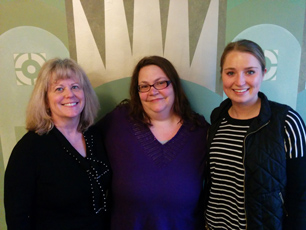
By Jenny Powers, Family Engagement Coordinator, Springfield Museums (Pictured Laura Cienciwa, Jenny Powers, and Grace Ciolek.)
Jenny Powers is the 2015/16 NEMA Fellow. As part of the fellowship Jenny is writing a series of articles for the NEMA community.
The sweetest spot in mentoring relationships is the middle. This is the spot where we still have plenty to learn, and are eager to take on new projects. We’re also knowledgeable enough to pass on what we know to the next group that is rising up. I’m fortunate enough to be in this spot right now.
When I was the Art Discovery Center Coordinator at Springfield Museums, one of my favorite parts of my job was working with interns. This internship commitment is small, with one or two days a week and a minimum of fourteen weeks. We receive a wide variety of applicants. Some apply with absolutely no work experience, while others arrive with high standards for what they hope to achieve in their semester with us. Two of our major goals for interns are that they gain the confidence and skills to work independently and the ability to take on projects of their own creation that enhance our programming.
My mentoring process begins in the interview. It’s important to get to know each candidate as an individual. Why does he or she want this internship? What is he or she hoping to get out of it? Our internships are unpaid, so relevance to their future plans and helping them discern their paths are essential. By working together with both short and long-term goals, I try to create plans that will be beneficial both to the individuals and to the museum. By law, the partnership must be more valuable to the interns than to the institution. One intern who gained as much as she put into the program was Jaimie Del Negro.
Jaimie is an incredibly hard worker. Sometimes at the beginning of the week, I would leave materials for the interns to prepare use in hands-on art activities. My expectations were for these to be completed by the end of the week, but on the days that she worked the preparations would be both started and finished. She helped me write and revise the school program I was creating with advice from my own mentor. She also created beautiful and original artwork when she hand-drew all the posters we needed for a new program. She even pitched in to help adults work on art activities at our monthly Culture & Cocktails parties. She would complete any task that was asked of her, thoroughly and well. If there ever was an intern who deserved a next great opportunity, it was Jaimie.
While she was interning at the museum, Jaimie felt stuck in a job she’d been in for seven years. She had an Associate’s Degree in Visual Arts but had been working at the same deli since high school. Because Jaimie was such a bright and talented young woman, it was hard to know what more I could do for her. In the end, it turns out the only thing she really needed from me was encouragement. I told her directly how talented she was and what kinds of possibilities were open for someone with such a strong work ethic. She needed to be encouraged to take risks and make a leap of faith. Her dream was to move to Boston, and she needed someone tell her that yes, she could and should do that. She moved to Boston in June of 2015 and got jobs at not just one, but two museums. Although she has had to cobble together part time jobs to make ends meet and live in a house shared by lots of friends, she has taken control. She is getting experience in a field she wants to work in and in a place she wants to be.
Not every intern experience has gone as smoothly. We had an intern that I looked forward to seeing every week and who I loved to discuss popular culture with, but who did not seem to understand that we were in the museum to get work done. We had another who greatly appreciated being in the environment, but who was not comfortable interacting with visitors. Stepping in and making changes can be a challenge, especially when talking to someone who works for no pay. Constructive criticism is something a mentor must be willing to give. In the first case, we needed to reevaluate if this was the right position at the right time for the intern and ultimately we decided it was not. In the second, I could model behavior and encourage the intern to answer visitor questions and be more welcoming. More effectively, I paired him with a peer who was also able to model the desired behavior. This is a strategy I learned from my own mentor.
Although she was unaware of it until very recently, I model much of my own behavior after Laura Cienciwa, the Art and History Coordinator at Springfield Museums. She is a vibrant, creative, and professional woman who comes up with imaginative school programs and has a way of finessing docents like no one else. Laura was unaware that I was paying attention and learning from her. I watched while she organized a symposium designed to update the docents about current education philosophies. I watched her change and adapt her programs when changes in the collection disrupted the original version. I watched her willingness to get silly as she did the Charleston at a docent end-of-year party, charming them and endearing her to them even more.
When I developed a new school program in Art Discovery Center, she came to do a walk-through and give feedback. Initially I was resistant to the changes she suggested, but in the long run I realized that they were improvements. When I piloted the program, the points the teacher appreciated the most were the parts that Laura had suggested. Sometimes when we work so hard and put so much of ourselves into a project, it’s hard to accept that it can be improved or that changes are needed. The right mentor softens this blow and doesn’t take away from our pride in what we’ve accomplished.
I changed roles and became the Family Engagement Coordinator in November of 2015, and now I look up to Laura even more. It’s now my job to find fun, new ways to connect families from all backgrounds with the museum’s collections. I love it when Laura comes to my office and says, “Hey, I have an idea for you.” These ideas are usually the beginning of a brainstorm that leads to popular hands-on activities for younger and older visitors alike. She has taught me how to get visitors’ attention (even if it means honking an antique car horn), how to get children to take an in-depth look at art, how to work with difficult community partners effectively, how to increase curriculum connections, and to be unafraid of expressing my enthusiasm in my work.
Some of the most satisfying mentoring relationships are the ones that flow in both directions. Working in the Art Discovery Center at Springfield Museums was by far the happiest job of my life. Nothing else could compare to having a small section of the museum to create my own programming and my own team of seven to twelve interns per semester, plus natural light through Tiffany windows. When my current position became available, I knew it was time to move onward and upward and to give myself a chance to grow. Despite my excitement about my new job, I was conflicted about leaving the old one. I’d put so much of myself into my two years in the Art Discovery Center that I wanted to see it taken over by someone who would love it and take it just as seriously as I did. I knew instantly who I wanted this person to be. Grace Ciolek, a recent graduate in Communications and by far one of the most professional interns I’d ever worked with, had recently accepted a different part time position in the Education department. I recommended her to our manager immediately and was thrilled when she was hired as my successor. Since then we’ve spent time teaching each other. I taught her how to fill out purchase orders and encouraged her to look for professional development opportunities. She’s had to teach me (gently, for the most part) about letting go of my former position. She’s set boundaries and keeps me in line. From her, I’m learning to give less unsolicited advice and to listen to her ideas more. She is making me not only a better coworker, but a better person. She sets higher expectations for her interns than I did and I can already see their internship experiences growing as she does. I’m so proud that I can say I had a hand in the start of her career.
Jaimie, Laura, and Grace all prepared me to take this next step in my career. Being a mentor to people who are beginning their own careers has been the most satisfying part of my professional life thus far. The opportunity to see younger people grow in confidence, set their goals, and achieve them makes me feel more accomplished than anything I have done on my own. If you meet someone you would like the chance to learn from, make sure to watch, listen, ask for advice, and cultivate that relationship. If you have the chance to mentor another person, the impact you can make on his or her life can be invaluable. The time and effort you spend working with him or her will be far outweighed by the rewards for both of you.
This essay was edited by Nicole Mues, a former Art Discovery Center intern, the current School Programs Assistant, and my current office mate and mentor.
