
IRS Updates Mileage Deduction Rates
The IRS has updated their mileage deduction rates for 2016. The rate for business and medical / moving both fell, to 54¢ and 19¢ respectively, while the rate for charity volunteers stayed at 14¢ (where it has been since 1998). See current and historical mileage rates from the IRS here.
Collections Assessment for Preservation
The Institute of Museum and Library Services and the Foundation of the American Institute for Conservation of Historic and Artistic Works (FAIC) have announced a new program to provide museums with collections conservation assessments. The Collections Assessment for Preservation (CAP) program will build upon the former CAP program (Conservation Assessment Program) that was funded by IMLS and administered by Heritage Preservation for 24 years, until Heritage Preservation ceased operations in 2015. The new program will continue to support collections assessments for small and medium-sized museums throughout the nation. In the first year of the program, FAIC will focus on development of the systems and infrastructure needed to run the program, such as museum and assessor application and evaluation materials; staff to manage the grant program; the creation of a roster of qualified assessors; and promotion of the program. FAIC plans to announce the first call for applications from museums to participate in the program in fall of 2016 with an early 2017 deadline.
Serving New Americans
The Institute of Museum and Library Services currently partners with U.S. Citizenship and Immigration Services (USCIS) to provide support to libraries through the distribution of information, education materials, and training sessions on immigration and citizenship. USCIS is interested in expanding this work to provide support to museums that are engaged in serving immigrant populations. New opportunities for collaboration with museums may include informational webinars on USCIS’s educational materials, training for museum staff on citizenship programming, and coordinating with local USCIS field offices to hold naturalization information sessions or naturalization ceremonies at museums. Please see the USCIS Citizenship Resource Center page for more information on the citizenship resources that USCIS provides. If your museum is interested in USCIS resources or engaging with USCIS, please contact Christopher Reich, Senior Museum Advisor, at creich@imls.gov.
The 2016 Nonprofit, Leadership and Race Survey
We are pleased to announce the launch of the 2016 Nonprofit, Leadership and Race Survey. This short, confidential survey is open to all nonprofit staff and board members. It focuses on experiences at work, views of leadership, and perspectives on nonprofits and race. Click here to take the survey, we want your perspective! The survey should take about 20 minutes to complete. The survey closes on May 15.
Direct Care of Collections White Paper
The American Alliance of Museums' Code of Ethics has long stated that proceeds from the sale of nonliving collections cannot be used for anything other than "acquisition or direct care of collections." But what qualifies as direct care? You'll find guidance in a new white paper, Direct Care of Collections: Ethics, Guidelines and Recommendations. Download the white paper here.
How Boston and Other American Cities Support and Sustain the Arts: Funding for Cultural Nonprofits in Boston and 10 Other Metropolitan Centers
Consultants TDC partnered with The Boston Foundation on a recent study of Boston’s cultural and funding landscape. The report takes a detailed look at the breadth and depth of Boston’s arts community across a number of dimensions including discipline and budget size. Analysis found that Boston has an incredibly dense and vibrant cultural scene, and highly engaged and supportive arts patrons to match.
Guidestar Redesigns Nonprofit Profiles
Guidestar recently redesigned their nonprofit profiles, adjusting the design and layout while also including new information, such as:
- narrative about the organization's mission and accomplishments
- demographic information including race, gender, and more
- board practices like orientation, ethics, and self-assessment
Read more on the GuideStar Blog.
Standards and Excellence Program for History Organizations
StEPs is AASLH’s self-study standards program designed specifically for small- to mid-sized history organizations, including volunteer-run institutions. Through a workbook, online resources, and an online community, organizations enrolled in StEPS assess their policies and practices and benchmark themselves against nationally recognized standards. The program is divided into six sections that can be addressed in any order. In each section, organizations can identify their current practice as Basic, Good, or Better. Each level has its indicators, allowing organizations to set realistic goals and tackle challenges in small, manageable steps. Work in each section at your own pace using checklists, worksheets, sample documents, and the 24/7 online community. NEMA members that enroll in StEPs receive a free AASLH webinar registration. For complete details, click here.
Humanities Access Grant
The National Endowment for the Humanities (NEH) has announced a new grant program to strengthen and sustain quality humanities programs that benefit youth, communities of color, and economically disadvantaged populations. Humanities Access Grants offer matching grants toward term endowments for programming at cultural institutions that broadens access to excellent humanities content for underserved groups. Eligible organizations include public libraries, museums, historical societies, community colleges, historically black colleges and universities, tribal colleges, and Hispanic-serving institutions.
Challenge America Fast-Track Grants
The National Endowment for the Arts' Challenge America Fast-Track grants offer support primarily to small and mid-sized organizations for projects that extend the reach of the arts to underserved populations -- those whose opportunities to experience the arts are limited by geography, ethnicity, economics, or disability. Age alone (e.g., youth, seniors) does not qualify a group as underserved; at least one of the underserved characteristics noted above also must be present. Grants are available for professional arts programming and for projects that emphasize the potential of the arts in community development. Deadline is April 14, 2016. Application guidelines for NEH Humanities Access Grants are available at neh.gov. The application deadline for the initial cycle of Humanities Access Grants is May 4.
General Preservation Assessments
The National Endowment for the Humanities' Preservation Assistance Grants examine policies, practices, and conditions affecting the care and preservation of your collections. A preservation assessment and comprehensive report is very often the key to success when seeking other grant funding for preservation or conservation. Deadline is May 3, 2016 for projects beginning January 2017.
New Federal Grants Available for Family STEM Learning in Museums
The Institute of Museum and Library Services (IMLS) is inviting proposals for special grants to research informal educational approaches that deliver programs from experts in Science, Technology, Engineering, and Math (STEM) to children ages 6-10 and their families. The initiative will provide grants up to $1 million for projects of up to two years. The deadline for applications is May 1, 2016. Click here for details.
Roving Archivist and Archival Supplies
Through generous funding from the National Historical Publications and Records Commission (NHPRC), the Massachusetts Archives is pleased to provide funding for the Roving Archivist program and funding for the purchase of supplies and materials needed to arrange, describe, preserve, and make accessible archival collections. For complete details, click here.
Preservation and Access Education and Training Grants
The National Endowment for the Humanities' Preservation and Access Education and Training grants are awarded to organizations that offer national or regional (multistate) education and training programs. Grants aim to help the staff of cultural institutions, large and small, obtain the knowledge and skills needed to serve as effective stewards of humanities collections. Grants also support educational programs that prepare the next generation of conservators and preservation professionals, as well as projects that introduce the staff of cultural institutions to new information and advances in preservation and access practices. Deadline is May 3, 2016.
Preservation Assistance Grants for Smaller Institutions
The National Endowment for the Humanities' Preservation Assistance Grants help small and mid-sized institutions—such as libraries, museums, historical societies, archival repositories, cultural organizations, town and county records offices, and colleges and universities—improve their ability to preserve and care for their significant humanities collections. Deadline May 3, 2016 for Projects Beginning January 2017
Connecticut Humanities Grants
Project planning and implementation grants.
Applications between $1,500 and $9,999: Application deadline: the first workday of May, August, and November.
Applications between $5,000 and $25,000: Application deadline: the first workday of May, August and November.
Quick Grants, applications up to $4,999: Application deadline is the first workday of every month.
Maine Arts and Humanities Grants
The Maine Arts Commission and the Maine Humanities Council collaborate to provide Arts and Humanities grants that assist organizations in Maine to investigate and present stories and cultural expressions of the state, its communities and its people. These grants support projects and public programs that include or combine both arts and humanities disciplines. The arts help build communities by helping them discover their cultural assets, building audiences and promoting the excellence of the creative sector. The humanities explore the nature and value of human experience through literature, history, theology, philosophy and the disciplines of social and political science. Deadline is April 21, 2016 at 5 pm.
Common Heritage
The National Endowment for the Humanities' The Common Heritage program supports day-long events organized by community cultural institutions, which members of the public will be invited to attend. At these events experienced staff will digitize the community historical materials brought in by the public. Project staff will also record descriptive information—provided by community attendees—about the historical materials. Contributors will be given a free digital copy of their items to take home, along with the original materials. With the owner’s permission, digital copies of these materials would be included in the institutions’ collections. Historical photographs, artifacts, documents, family letters, art works, and audiovisual recordings are among the many items eligible for digitization and public commemoration. Deadline May 12, 2016 for Projects Beginning January 2017
Rural Development Community Facilities
The U.S. Department of Agriculture Rural Development Community Facilities program provides affordable funding to develop essential community facilities in rural areas. An essential community facility is defined as providing an essential service to the local community: educational services such as museums, libraries or private schools are able to apply to this program. Year round applications, click here for details.
Google Ad Grants
Google Ad Grants offer eligible non-profit organizations up to $10,000 per month in in-kind AdWords™ advertising to promote their missions and initiatives on Google.com. You create advertisement and key word searches that relate your nonprofit, services, and organization as a whole, and when people use Google to search for related offerings online, your ad may appear next to the search results. For full program details, click here.
National Trust for Historic Preservation Emergency Funds
Intervention funding from the National Trust for Historic Preservation is awarded in emergency situations when immediate and unanticipated work is needed to save a historic structure, such as when a fire or other natural disaster strikes. Funding is restricted to nonprofit organizations and public agencies. Emergency grants typically range from $1,000 to $5,000, but unlike the majority of our grant funding, a cash match is not required for intervention projects. Contact us if you believe your project qualifies for this type of funding. Please note: our emergency funding is very limited. Click here for details.
TD Charitable Foundation
TD Charitable Foundation grants will be awarded to area non-profit and public institutions to create meaningful change and improvement in the communities.
The Edwin S. Webster Foundation
The Edwin S. Webster Foundation will consider requests for capital programs, special projects or operating income. They support organizations with an emphasis on hospitals, medical research, education, youth agencies, cultural activities, and programs addressing the needs of minorities. Before submitting a request, please contact foundation administrator Michelle Jenney at: mjenney@gmafoundations.com. The deadline is May 1, 2016.
Community Outreach Grants
Maine Humanities Council offers Community Outreach (up to $1,000) which support a wide variety of public humanities projects, such as exhibits, lecture and film series, reading and discussion programs, symposia, cultural celebrations, etc. More information here.
Cultural Investment Portfolio Projects
The Massachusetts Cultural Council's CIP Projects grants are one year grants for specific cultural public programming, and are not for general operating support. This is a one-year grant designed to support cultural projects, and is an option for organizations and programs that are not eligible for CIP Gateway, or those simply looking for one-year project support. Organizations receiving Portfolio or Gateway funding are not eligible for CIP Projects grants. Projects grantees receive a grant of $2,500 for a specific project. Applications to CIP Projects are accepted annually. The deadline to apply is May 16, 2016.
Vermont's Community Foundation Special and Urgent Needs
The Special and Urgent Needs (SUN) grant round was created to address the short-term needs of nonprofits. With a relatively small amount of funding, a SUN grant is designed to help an organization meet its mission while managing an unbudgeted, unforeseen, and time-sensitive emergency or help the organization take advantage of an unexpected opportunity that will enhance its work. There is no deadline - you may apply anytime.
Mini Grant Program
Rhode Island Council for the Humanities' Mini Grant Program for requests up to $2,000 invites individual researchers, nonprofit organizations, and schools to apply for funding in support of public humanities projects, documentary film, civic education initiatives, and individual research. Mini Grant Deadlines are May 1, 2016, and August 1, 2016.
Community Project Grants
New Hampshire Humanities Council's Community Project Grants enable NH nonprofit organizations to design and carry out public humanities programs with the help of experts in philosophy, history, literature or other humanities disciplines relevant to their topic. From dynamic lectures and facilitated discussions, to walking tours, oral history workshops and teacher professional development seminars, these programs create opportunities for participants to explore new knowledge and discuss universal questions. A first draft for Project grants up to $10,000 is due July 1. Grants up to $1,000 are due on a quarterly basis. The next deadline is May 1.
Youth Arts Project Grants
The New Hampshire State Council on the Arts Youth Arts Project Grants fund high-quality arts and cultural programs that encourage creativity, develop new arts skills and foster success for young people beyond the normal school day. Recognizing that opportunities to experience and engage in the arts, such as music, dance, theater, visual arts, crafts, photography and creative writing, may be limited in classrooms, this grant provides funding for artists to work directly with young people after regular school hours, in the summer or on weekends, in or outside of the school. The overall goal of this grant category is to afford all young people opportunities to engage in the arts so that they can develop creative problem solving skills, positive forms of personal expression, and become more engaged in their communities through the arts. Deadline for submissions is April 15, 2016.
Arts in Health Project Grants
The New Hampshire State Council on the Arts Arts in Health Project Grants support arts activities, presentations and artist residencies that occur in health care facilities, rehabilitation centers, and in centers serving the needs of the elderly. The overall goal of this grant category is to utilize the arts to enhance quality of life and promote an environment conducive to healing for patients, residents, staff and/or clients. This grant category is in response to the Arts Council’s commitment to meeting the needs of underserved populations, which can include the elderly, people with disabilities, and people with health challenges. Deadline for submission sis May 20, 2016.
Facilities Grant
The Vermont Arts Council’s Cultural Facilities Grants help Vermont nonprofit organizations and municipalities enhance, create, or expand the capacity of an existing building to provide cultural activities for the public. Examples of projects eligible for funding include: improvements such as wiring, heating, ADA accessibility features, lighting, and stage improvements; building improvements, permanent display panels or exhibit cases, permanent infrastructure or fixed equipment; and wireless/broadband capacity that enhances programming capacity. Deadline is May 2, 2016.
Head Start Arts Integration Grants
The Vermont Arts Council's Head Start Arts Integration Grants fund partnerships between local arts organizations or other nonprofits with 501(c)(3) status and Head Start agencies to support teacher and student learning in early arts education. Expert teaching artists mentor classroom teachers on how to integrate the arts into a curriculum in order to achieve social and learning objectives and foster creativity in Head Start schools.
Call for Submissions
A new book on Museums and Activism, edited by Robert R. Janes and Richard Sandell, seeks abstracts. Museums and Activism will examine this emerging trend in thinking and practice, exploring the idea of the museum as a staging ground for efforts by a variety of different groups with wide-ranging (sometimes conflicting) agendas and interests to bring about social and political change, or to advance and elicit broader support for a particular standpoint. Submissions are due September 30, 2016. Click her for the Call for Submissions.
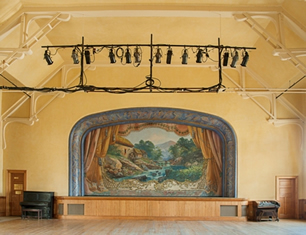
Searching for Historic Stage Scenery
"Curtains Without Borders" is a small non-profit organization that has been documenting and restoring historic stage scenery for almost 20 years. They have found 500 grand drapes, advertising curtains, and backdrops in Vermont, New Hampshire, Maine, New York, and Massachusetts plus more in other states. To date, their team of conservators has restored about 300 of these pieces of historic stage scenery, which were created between about 1880 and 1940, although on rare occasions, pieces painted after 1940 are also included.
Now they are working on a national database of historic stage scenery and they need help! They know that many town halls, Grange Halls, and opera houses have, or used to have, advertising curtains or whole sets of theatrical scenery. It is not uncommon to find that curtains have migrated to local historical societies or museums once their hall falls into disrepair or gets modernized for new uses. They are just as interested in curtains in storage as those that still grace their stages.
If anyone knows of a historic stage curtain, whether in a Grange, an opera house, an historical society, or just sitting in a barn, please let them know. You can visit www.curtainswithoutborders.com to see what they have already documented and the type of restoration work their conservators are doing. The project to document curtains nationwide is sponsored by the National Endowment for the Arts and the National Trust.
Please contact Chris Hadsel at curtainswithoutborders@gmail.com or call 802-863-4938.