
It’s often too easy for our busy schedules to leave little time to connect to colleagues—we hope this feature will help shed light on some of the great work done by your colleagues in museums and sites around New England! We are confident it will reinforce your own joy in the field and encourage you to reflect on your positive influence at your own institution.
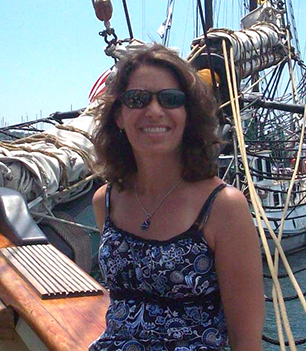
In this edition of the NEMA Member Profile, we feature Anne DiMonti, Director of the Audubon Society of Rhode Island (ASRI) Environmental Education Center.
How did you get into the field and what was your path to where you are now?
My journey into the field of marine biology started when I was very young. I might be dating myself when I tell this story, but my first word was “Flipper,” the dolphin from the 60s TV show. I think I was only about 9 or 10 months old. I was destined to work in marine conservation, and I’ve always been fortunate to work both with animals and in the non-profit field.
I have been with Audubon for 22 years and started as an environmental educator in Audubon headquarters in Smithfield, Rhode Island. I was fortunate to be part of the conceptual development of the Environmental Education Center. When the facility opened in 2000, I transferred to Bristol to work at the Center. I am now the Director of the facility — which I love.
Can you tell us a little about what your job entails?
As Director of Environmental Education Center, my job is to manage all operations for the facility and wildlife refuge, generate revenue, oversee programing and supervise animal care. I am also the principal officer for Audubon Society of RI, which means I am responsible for all federal and state permits required for the animals we care for. I love that my job is always changing. I could be found helping in the gift shop, working with an animal caretaker, assisting volunteers, or prepping for an event such as a lecture or family program. Those who work in this field know how busy it can get. It can be a challenge sometimes, but it is also the thing I love the most. Every day is different.
What tools and techniques do you use to get people involved and interested in conservation?
Education is a big part of our mission. Society-wide we reach over 20,000 people across the state each year. Our Center is accessible and our educators offer a wonderful variety of programs for all ages, preschool through adult. We have school vacation week activities, home school programs for kids, and programs like “Intro to Bee-keeping” for adults. I manage and oversee educational programing, ensuring that we are reaching a conservation niche that fulfills people’s needs, educates, and entertains them.
What current trends in the conservation field are you most excited by?
I have seen a change in the last few years towards more collaborations. When I first started in the field, it seemed that everyone was working in silos: scientists, schoolteachers, educators, environmentalists, conservationists, and even those in public offices. Now, it seems there is a trend to be more interactive and collaborative, to reach out beyond your silo. Scientists are working with educators, educators are working with scientists and we are now collaborating with for-profit companies that would not previously be addressing conservation issues.
I am a member of the education committee for the North Atlantic Right Whale Consortium; the Audubon Society of RI has collaborated with the US Sailing Association, the New Bedford Whaling Museum and Whale and Dolphin Conservation to educate recreational sailors about whale and marine life conservation. The program is called Sharing the Seas: Safe Boating for Sailors and Whales. When I started in the field, it would be unheard for a sporting industry, like sailing, to be involved in conservation issues. New partnerships, like those between the sailing industry, scientists and conservationists, have resulted in successful conservation programs such as clean ocean regattas, eliminating single use water bottles from large public events and reducing the use of plastic straws.
Collaboration is key. We get more done working together as a team, especially when you are a smaller non-profit. Collaboration benefits everyone and is a more efficient way to work. The Audubon Society has many collaborations with other facilities and organizations. For example, we have been invited to participate in the Volvo Ocean Race stopover in Newport, RI in May 2018.
Can you describe a powerful experience you have had when interacting with nature and/or ocean life/wildlife?
I have been fortunate to be in the field my entire life. I have worked in stables, zoos, aquariums, and vet offices, so picking one wildlife experience would be hard. No matter how long I have been in the field, I am constantly amazed with the natural world. There is always another “wow” moment around the corner. It never gets old.
If I were pressed, I think a recent experience was my time on the historic sail of the Charles W. Morgan [Mystic Seaport’s 1841 whaleship], I had the leg out of Provincetown [in 2014], and it was the first time since the Morgan stopped sailing in 1925 that she came upon whales. We had humpback whales off the bow, a couple of adults and a calf, swimming next to the Morgan. To think, it was the first time in almost a century that anyone had seen whales and a historical whaleship side by side as the captain cried, “Whale ho!”. I thought, “I can’t believe I’m witnessing this!” I get chills thinking about it!
What lessons about ocean conservation can we learn from the whalers and merchants of the past?
What I learned on the Morgan (my “Aha!” moment), was that to this day, we are still struggling to find a balance between our need for the ocean’s resources and preserving it for the future. That is something that has not changed since the time of the Morgan. Obviously whalers in previous eras had no idea how they were harming populations of whales, they thought these resources were infinite. Now, of course, we know better, but we are still struggling to find a sustainable way to use marine resources. The main reason I went on the Morgan was that I have always been impressed with how much knowledge modern day marine biologists have thanks to whalers from the past. They kept incredible records. Most of what we know today about whale anatomy and biology came from them. My colleagues and I still use books and whaling logs from the 1800s as resources, which for the most part, are still accurate today.
What do you see for the future of wildlife conservation?
I think the future is always positive, as more people become environmentally aware. There is a lot of upset about some of the current legislation and bills trying to be passed or changed related to conservation, but on the positive side, the general public is much more aware today of environmental health issues. The internet and Facebook are helpful tools as people get environmental information and share it. The internet allows information to get out quickly, especially when something big is happening and action is needed. We have an environmental advocacy arm in our Smithfield office that keeps our members and staff up-to-date on policy issues.
If you could instill a value or lesson to children/teens about our environment what would it be?
One person can make a difference. Sometimes it is the little things that we do every day that has the greatest impact. Recycle that plastic bottle instead of tossing it in the landfill. Get outside and help with a beach cleanup. If you see an injured bird, call a wildlife rehabilitator. Get outside for a hike and enjoy nature. Perhaps writing to your representative and letting them know you are concerned about an environmental issue.
For example, a few years ago when I was at Mystic Seaport for my Safety at Sea seminar (safety training for sailors), I realized there was no information given out on environmental issues and environmental safety. I talked to some of my colleagues in the sailing industry, and confirmed an opportunity for educating sailors on environmental issues. This was the spark for the Sharing the Seas: Safe Boating for Sailors and Whales program. So, another lesson is do not be afraid of reaching out to other people to ask for help and follow your passion.
What is on your museum and nature center bucket list (things to do, places to visit)?
We are currently working on a new master plan for the Center that includes updated exhibits, a new pollinator garden, and an outdoor pavilion. We are also thinking about new ways to balance technology with getting kids outside. Personally, I am very excited by industry and science working collaboratively with conservation; to me that is thrilling!
Whenever I travel, I always visit other zoos, aquariums, or nature centers because I get inspired and bring back ideas. If I could go anywhere, it would be the Oceanographic Museum of Monaco, https://www.oceano.mc/en.
Audubon Society of Rhode Island
Founded in 1897, the Audubon Society of Rhode Island is one of the oldest independent Audubon Societies in the country. In 2000 they opened a $3.5 million Environmental Education Center in Bristol. This site sits on the 28-acre Claire D. McIntosh Wildlife Refuge, which includes accessible trails, a link to the East Bay Bike Path, an Osprey nest, and a lovely boardwalk through fresh and saltwater marshes to Narragansett Bay. The site offers diverse programming for all ages. The Center features a 33-foot life size Right Whale model along with aquarium exhibits for marine life including an octopus and a rare orange lobster –Through a partnership with Roger Williams University, faculty and students provide technical assistance and husbandry care for the marine life at the Center. You can visit year-round to explore the trails or pop-in the Center to learn more about the various habitats in the Ocean State.
NEMA sends our thanks to Anne and the staff at the Audubon Society of Rhode Island (ASRI) Environmental Education Center for all the work they do and for being NEMA members since 1997!