The Art of Learning: A Remarkable Partnership Between A University and A Museum
By Fitchburg State University students: Zachary Barbagallo, Jack Doyle, Tim Foley, Jack Gallant, and Leanna Johnson in conjunction with Fitchburg Art Museum
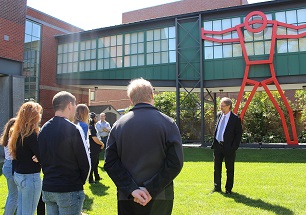
Fitchburg Art Museum Director Nick Capasso speaking to students in front of the museum.
“Our key insight is that while most art museums are busy serving art as their primary client, at the Fitchburg Art Museum we use art to serve people and people in the community, and that includes students at Fitchburg State University” - Nick Capasso,
Fitchburg Art Museum Director.
In 2015, Fitchburg State University (FSU) and the Fitchburg Art Museum (FAM) began a partnership that provided a platform for undergraduate students to produce professional media including exhibition catalogues, social media campaigns, and promotional videos for the museum, which have been professionally published and garnered community accolades. This remarkable partnership has the opportunity to serve as a model for other universities and museums who share the common goal of promoting education.
“As anchor institutions in the city, we wanted to be more actively working together for the benefit of the audiences here at the museum, students at the university, and to partner with other [organizations] in the city to help with the revitalization of the city of Fitchburg as a whole,” said FAM Director Nick Capasso. Capasso's hope when establishing the partnership with then FSU President Bob Antonucci, was to create a bond between the museum and the students of the university.
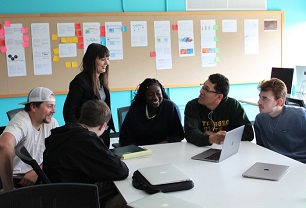
The partnership allows for the students to experience the museum free of charge. The museum and university also collaborate on a Document Design Class led by Professor Rob Carr. Carr acknowledges, "At its heart, this partnership is successful because of the commitment and collaboration between multiple parties." The partnership grants FSU undergraduates the opportunity to work professionally within a client-firm setting and Dr. Carr, students, and museum and university staff are all fully invested in the process. This provides students with a real world learning environment to supplement their traditional coursework. Dean of Arts and Sciences at Fitchburg State University, Dr. Franca Barricelli notes:
Part of our academic mission as a university is to foster creativity as one of the core values of education. The Document Design partnership with the FAM is an extraordinary opportunity for our two institutions to collaborate on advancing innovation, education, and professional communication in the arts in a way that benefits our students, our respective organizations, and the communities we serve.
The FAM Marketing Manager works with students on promotional campaigns. While the Curatorial Department provides students with an inside look into exhibitions and helps them draw upon what they’ve learned in the production of a professional catalogue. FAM Curator, Lisa Crossman, on the future of this program said,
I believe that the catalogue project will continue to evolve, but that the general model will remain the same. The marketing projects will continue to change to meet the immediate needs of the Museum and the talent of the students… Each semester I am fascinated and heartened by the growth.
The professional caliber work produced has opened doors for students such as former catalogue team member Ryan Best: “It definitely is something that will jumpstart your career because you started this from scratch and you have a professional piece of work that’s in an actual museum. How could that not be a plus in your resume or portfolio,” said Best, who used the A Curious Nature: Paintings by Shelley Reed catalogue as a flagship project in his portfolio. His established relationship with FAM led him to his internship position with the museum the following year. According to Americans for the Arts (AFTA) students who are highly engaged in the arts are more likely than their peers - who have low arts involvement - to obtain gainful employment, complete college, and volunteer in their communities. AFTA also recognizes that students involved in the arts are four times more likely to be recognized for academic achievement.
The artists themselves benefit from the representation that the catalogues provide, both in terms of documenting and marketing their work. A Curious Nature: Paintings by Shelley Reed was on view at FAM in 2017 and was one of the thirteen catalogues produced by FSU students over the course of the partnership. Referencing the catalogue Reed said,
The Document Design team created a catalogue that presented the work in a new and exciting format, offering a vision that surprised and delighted me. Through the smart juxtaposition of images, words, and clever yet understated graphic design, the catalogue actually extends the conversation begun in the show, offering a new and exciting way to look at and think about the ideas presented in the work.
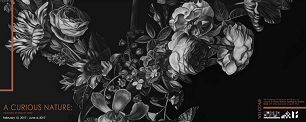

(A Curious Nature: Paintings By Shelley Reed catalogue spreads, created in 2017 by FSU students.)
The exhibition catalogue series serves to extend the lives of the exhibitions beyond their run time in the museum. This gives potential visitors the option to explore the exhibit without being physically present, still allowing them to have a thrilling art-viewing experience. The catalogue for the exhibition Land Ho! won third place in the prestigious NEMA Publication Design Awards in 2016.
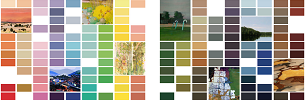

(Land Ho! Exhibition catalogue spreads, created by FSU students)
Students also work on innovative multi-media campaigns. In 2017 FAM and FSU created a video that won the Mayor’s Art Challenge at the Commonwealth Awards, which was hosted by the Massachusetts Cultural Council that February. Fitchburg Mayor Stephen DiNatale said the award was a “tribute to the city” and was a recognition of FAM and FSU and their promotion of creative expression in the city. In addition the student project team worked with the museum on their bilingual initiative in order to create an application that translates the popular Ancient Egypt exhibition into Spanish. This innovative technology helps expand FAM’s potential audience and makes the museum experience more inclusive.
Other museums across the Northeast have a range of different approaches to partnering with post-secondary institutions. Lauren Szumita, former Koch Curatorial Fellow for FAM and current Curatorial Assistant of Prints, Drawings, and Photographs at The Worcester Art Museum explains the museum's relationship with surrounding universities as similar, but as a more informal partnership with students compared to the FAM-FSU signed Partnership. WAM takes a more art based approach with their interns, enlisting them in the actual creation of exhibitions. Szumita elaborated by saying, “I’ve been working with an intern from Clark University and she's been helping me with an installation that’s going up in our cafe [which includes] photos [from] our archives from a show in 1965.” She describes the relationship between the students and the museum in saying, “the hope is that it is a mutually beneficial partnership [where students can gain professional experience] that has real world applications... it helps us build a constituency - it helps us build relationships with students which ultimately, for us, leads to people that grow up and are invested in their local museum.”
Klaus Ottmann, Chief Curator and Deputy Director of Academic Programs for The Phillips Collection in Washington, D.C., also speaks to the benefits brought about by students working with museum staff. The Phillips takes a different direction when partnering with the University of Maryland (UMD). Ottman describes this as, “a partnership between the university and [museum through] many different facets. It includes collaborations and programming. For instance, we share two fellowships, we have a joint publication, a book prize in art history, there are classes held here at the museum, it's a lot.” Through this partnership students are given a chance to ‘join the conversation’ regarding the professional world of art. One opportunity Ottmann describes as successful is
a series called Conversations with Artists which takes place six times a year. [They] invite emerging and established artists from around the world to the Phillips Collection. The artists [then] go to the [UMD campus] and work with the students mostly doing critiques and revisions. [There is a] committee for that program that consists of people from the Phillips, people from UMD faculty, and students as well.
This program is currently in its fifth year and is expected to grow within the community with a temporary educational space called “Phillips in Maryland” located in college park on the University of Maryland’s campus.
Each of these academic museum collaborations provide its own valuable model for partnering opportunities for museums and universities. In a closing statement, FAM Marketing Manager and Document Design class co-teacher Vanessa De Zorzi offered the following:
I would recommend this partnership for more universities and museums. Our model for learning is very unique and not a lot of museums throughout the country use this type of partnership, but I would highly recommend it. I feel that it really extends the museum's marketing reach and gives students hands on learning opportunities. As a [former] student, I feel like the most valuable experiences I had were always internships and project based assignments. There’s just so much more than what you can read in a book. This program is mutually beneficial.