

“Tainted Money” Session Causes Introspection and Ideas
Gasps of disbelief. Nervous laughter. Nods of sympathy. The “Tainted Money” session at the 2019 NEMA Conference elicited a range of reactions, with participants seeming to agree on one point in particular: when it comes to museum fundraising, we are entering a perilous new era.
The session was an outgrowth of last year’s news-grabbing events involving social activists and museum workers protesting the power and influence of people who, in their opinion, make money or hold views that are contrary to the institution’s mission or ethical standards.
In 2019, New York’s Whitney Museum saw the forced resignation of a major donor, Warren Kanders, from its board of trustees because he manufactured teargas used on immigrants at the Mexican border. Several museums and universities cut ties with or scrubbed the names of the Sackler family, which for years donated millions generated from sales of OxyContin, the drug that has led to the addition and death hundreds of thousands. And the case of Jeffrey Epstein, while so far not impacting the museum world directly, has given pause to fundraisers generally about the extent to which nonprofits are willing to be complicit in moral money laundering by bestowing legitimacy on wealthy criminals.
These protests have effectively upended a long-held philanthropic paradigm for museums and nonprofits generally which holds that “tainted money” is bad only when there “t’aint enough of it,” or, in other words, it doesn’t matter where the money comes from as long as it goes to a good cause. Perhaps more important, the protests exposed a rift between museum workers and their leaders, which has potential ramifications for all institutions regardless of their size or discipline.
As the 2019 events unfolded, the NEMA staff agreed that the November conference would be a perfect opportunity to host a discussion on the field’s ethical standards as they apply to fundraising, as well as the power dynamics at play between museum leadership, staff, and the public. In preparation for the session, NEMA conducted a nationwide survey with the support of other museum associations to uncover attitudes and current gift acceptance practices museums.
Unveiling the Survey
The “Tainted Money” session was held Friday morning, November 8, 2019, with approximately 75 attendees and NEMA Executive Director Dan Yaeger facilitating.
After introducing the topic, Dan unveiled the survey results, which led to a spirited discussion. The survey generated more than 200 responses from 35 states. All types of museums were represented, with 55% of respondents representing history museums or historic sites and 22% art museums, which roughly corresponds to the proportion of museums nationally. The remainder of respondents represented science, children’s, aquaria/zoos, culturally specific, and other types of museums.
Institutional budget sizes were fairly evenly represented by survey respondents. Smaller museums with annual budgets of under $500,000 composed 36% of the survey, 18% were $500k – 1 million, 31% were $1 – 5 million, and 15% were over $5 million.
Dan explained that the survey was designed to separate out opinions from those whose museum roles put them in direct contact with fundraising (i.e., development staff, executive directors, and trustees) and those who do not. Just over half of the survey respondents, 56%, reported that they had fundraising roles, indicating that the survey captured an accurate snapshot of opinions from both groups.
Respondents with direct contact with donations were asked in the survey whether they had ever turned down or returned a donation because of ethical conflicts. Only 9% reported having done so. However, a subsequent question asked whether they had ever considered rejecting or returning a donation, and 15% answered in the affirmative.
Only 30% of survey respondents involved with fundraising indicated that their institution had a gift acceptance policy they could use to guide them in determining whether they would accept a donation. Just 22% indicated that the policy was in writing.
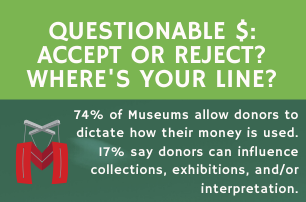
The survey asked those involved with donations what kinds of “strings” an organization tolerates in accepting donations. The vast majority, 74%, indicated that donors were allowed to influence or determine how the funds were used. 23% said donors in some cases were able to receive special treatment or recognition beyond that accorded to other donors, 17% said the donor was able to influence collections, exhibitions, and/or interpretation, and 11% said donors were able to influence the museum’s policy or power dynamics (such as board composition).
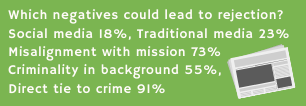
The next series of questions probed all survey respondents (those involved with donations and those not) about when or whether the respondent would reject a donation. “If the decision were up to you,” asked the first question in the series, “under what circumstances would you reject or return a donation?” 18% of all respondents said they would do so if there was negative social media exposure to the museum, 23% would if there was negative publicity through traditional media, 34% would if they objected to the donor’s livelihood, 55% would if they knew the donor had a criminal background, 73% would if the donation didn’t align with the museums mission or values, and 91% would if they knew the donation was tied directly to a crime. (The last point elicited a chuckle from the session participants when it sank in that this meant almost 10% of their colleagues were so desperate that they would seemingly accept ill-gotten gains.)
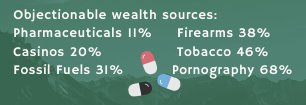
The next question asked whether respondents would reject a donation from someone who made their money in ways they felt were objectionable. 11% of all respondents said they’d reject a donation from someone who made their money from pharmaceutical manufacturing, 20% from casinos, 31% from fossil fuels, 38% from firearms, 46% from tobacco, and 68% from pornography.
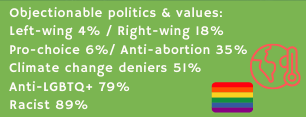
When asked whether they would reject a donation from someone who held beliefs antithetical to theirs, respondents generally exhibited a politically progressive mindset. Just 4% said they would reject a donation from someone with left-wing political views, 6% pro-choice views, 18% right-wing views, 35% anti-abortion, 51% anti-vaccination, 51% climate change deniers, 67% anti-immigration, 79% anti-LGBTQ rights, and 89% would reject a donation from someone with racial animus such as white supremacy views.
These “if it were up to you” questions illustrated some interesting differences between museum leaders in charge of fundraising and museum staff. In general, museum leaders were less likely than staff to reject a donation. Executive directors seemed to be more concerned with the museum’s reputation and social capital, being far more sensitive to negative publicity and social media coverage. Board members seemed to be more concerned about bottom line finances, in line with their fiduciary responsibility, and legality, being much more tolerant of a donor’s livelihood, but less tolerant of ill-gotten gains. (100% said they would reject criminal money – hurray for museum boards!)
Development staff were more tolerant than all other respondents, which is not surprising since they are primarily responsible for donations. They were relatively unconcerned about negative publicity or social media coverage, donor livelihood, or whether the donor had a criminal background. They were, however, more concerned than other cohorts with the alignment of a donation with the museum’s mission and values, and slightly more likely to reject criminal money.
General museum staff were on the whole far more likely to reject donations in all of the scenarios, especially all forms of objectionable donor livelihood and non-progressive donor beliefs. Museum staff were more likely to believe that a donor’s political viewpoints or party affiliation should make a difference in whether to accept a donation. And on the whole they were primed to take action if their museum accepted what in their opinion was a “tainted” donation. 71% said they would write a letter of protest to the director and/or board, 46% said they would join in a protest event at their museum, 22% said they would support a boycott of the organization, and 21% said they would resign. Just 19% said they would do nothing.
Session Takeaways
After Dan reviewed the survey results, session participants were invited to share their own experiences and opinions of “tainted money,” and were encouraged to offer ideas for how the field might prepare itself for greater scrutiny of its fundraising practices.
Several key takeaways emerged from the conversation.
- Need better education regarding fundraising. Several participants observed that there seems to be a disconnect between those who favor stringent limitations on museum donations and those who are responsible for the financial sustainability of the institution. Ironically, museum staffers who protest “tainted money” donations may also be the ones advocating for higher museum compensation. Several participants noted that museum leadership needs to do a better job of educating staff and the general public about the financial pressures on museums in order to put its development efforts in context.
- Need more intentional & transparent gift acceptance policies. Several participants commented on the survey result that indicated just 30% of museums have gift acceptance policies, and even fewer have written policies. In an informal poll of the room, a majority of participants did not have a gift acceptance policy, written or unwritten, confirming the survey results. There was consensus that museums need to erect more effective guardrails around fundraising through explicit policies, perhaps similar to investment policies that museums frequently use to align their missions and social beliefs with their financial assets. NEMA can help further this effort by collecting and publishing museum gift policies on the “Museum Document Exchange” section of its website.
- Need to scrutinize donors better. Policies help clarify types of donations that might be objectionable, but museums need to enforce the policies through improved vetting of donors. However, many participants noted the difficulties involved and how many questions this raises. Beyond Google, what is the best resource for researching a donor? What size of donation should trigger more intensive scrutiny? How far back into a donor’s past do you have to go?
- Need a crisis management plan. Many in the room noted, somewhat grimly, that depending on the circumstances, almost any size gift or any donor relationship could become a sudden source of negative publicity or social media exposure for the museum. Institutions need to have a plan to address their donor relationships and power dynamics. Greater education, more transparent policies, and better donor vetting would demonstrate that the museum performs ongoing due diligence, which strongly helps in crisis management.
- We shouldn’t demonize wealth, but we also need to be aware of the dynamic between power structures and wealth in our museums. It was clear from the survey that museum donors are frequently accorded access to special treatment, including influence over curatorial decisions and board policy, which could at the very least raise public eyebrows and at the most extreme trigger hostile protests. Participants observed that this is not a problem just for large, well-known museums; even small museums are at risk in their communities if they don’t pay attention to these fundraising details.
Resources
Developing and Managing Business and Individual Donor Support
AFP International Statement of Ethical Principles in Fundraising
Independent Sector: Principle 30: Sometimes the Juice Ain’t Worth the Squeeze
NonProfit Times: Saying “No” to Funding – An Acceptance Policy Is A Good Idea