Meet your museum colleagues from sites around New England! It is often too easy for colleagues to feel isolated in their own institutions (especially during the pandemic!)—we hope this feature will help close the gap. We also hope that it reinforces your own joy in your work and encourages you to recognize your own positive impacts.
Interview with Juan Omar Rodriguez, a contemporary art curator based in Cambridge, MA committed to equity and community in the arts. He has worked at the Institute of Contemporary Art/Boston, the Museum of Fine Arts, Boston, and the Tufts University Art Galleries. This summer he will be heading to work at the Pennsylvania Academy of the Fine Arts.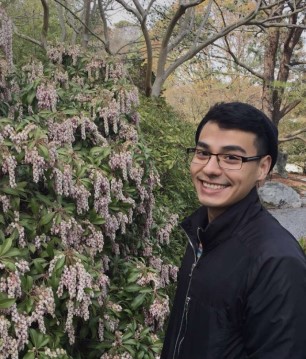
How did you get into the field and what was your path to where you are now?
I went to a science magnet school and started college with the intention of becoming a doctor. I eventually changed my mind as I learned more about perception and sensory neuroscience and after taking my first art history class. I became enamored with the way art rewarded close looking and how art interpretation exemplified the various capabilities of the brain—an organ capable of combining sensory information with memory and imagination to create meaning. After conducting independent art historical research through the Mellon Mays Undergraduate Fellowship (MMUF) at Oberlin, I decided I would go on to build my foundations in art history and museum studies through a master’s program before returning to the sciences for a Ph.D. in neuroaesthetics. I worked at the Tufts University Art Galleries and at the Museum of Fine Arts, Boston throughout my master’s studies and learned more about art curation, which inspired me to change my professional trajectory once again. As I prepare to leave New England this summer to begin my role as a curatorial fellow at the Pennsylvania Academy of the Fine Arts, I’m overwhelmed with gratitude for the relationships and experiences that brought me here and for the museum professionals and professors in Greater Boston—and the cultural workers pushing for equity in the arts elsewhere—who made it possible for me to see myself in this field.
Has there been an object in a museum collection or a specific exhibition that inspired you or made you think differently about how you approach your work?
The inaugural edition of the AREA CODE Art Fair (2020), the first contemporary art fair to exclusively feature New England artists, was really exciting. The online and decentralized in-person experiences of the fair and its profit-sharing initiative, which aimed to benefit all participating artists, provided a generative model for thinking about art ecosystems, collaboration, and material equity. I especially enjoyed taking a self-guided tour of the Storefront Project, organized by Jen Mergel in collaboration with Space Us, which featured the work of New England graduate art students from the classes of 2020 and 2021. The works were hosted by small businesses and arts organizations across Greater Boston. The accompanying image is a snapshot I took of Marla McLeod’s paintings installed at Gallery 263.
You were awarded a NEMA Board Diversity Fellowship this past November to attend the NEMA conference. This was your first-time attending conference and the first time that the conference was all virtual. What was your conference experience like? Can you tell us about a highlight or any sessions that have stuck with you?
The NEMA Board Diversity Fellowship allowed me to feel a greater sense of belonging in the museum field at a stressful moment in my career. The proliferation of layoffs, hiring freezes, and the increased attention on the equity gap in the museum field throughout 2020 made me nervous about re-entering the hiring pool at the end of my one-year curatorial fellowship at the Institute of Contemporary Art/Boston (which ended December 2020). The opportunity to attend my first NEMA Conference at this time was a timely gift, and the virtual structure provided me the flexibility to attend more sessions than would have been possible if I had to attend in person (before the pandemic, I was supplementing my part-time, contracted curatorial fellowship with another part-time job in food service). The session on “Cultivating the College Art Museum as a Site of Radical Inclusion” was really inspiring and resonated with many of my commitments. The panelists talked about collaborations with community partners, about sharing power and resources and building authentic relationships. Hearing about the panelist’s experiences affirmed and excited me as a cultural worker in the region committed to equity and community.
On your blog you recently wrote Precarity and Equity in the Art Museum. What steps would you like to see museums take to tackle challenges in the field and create a more equitable, anti-racist, and inclusive field?
Something I had been learning about and wasn’t prepared to address when I wrote that reflection is the role of art museums and settler colonialism. While I’m still grappling to understand my responsibilities as a settler in unceded Indigenous land, I think it’s still important to verbalize the continuity of this issue in the spaces I am invited to. That said, I think museums need to, at minimum, share resources and power with the Indigenous peoples on whose land they occupy. Ideally, this would be a step within a larger movement (i.e., decolonization, which I have come to understand is not the same as racial equity/anti-racism) to defer completely to the stewardship of Indigenous peoples.
What current trends in the field are you most excited by?
I want to take this moment to celebrate the various museum professionals across the U.S. who have been successful in their efforts to unionize—especially my colleagues at the Museum of Fine Arts, Boston. While we may be in this field out of love for museums, our labor merits protections, and we have a responsibility to support our colleagues who may not have the kinds of power some of us have to demand fair labor conditions in the museum. Another fantastic trend is that more of my colleagues across Greater Boston have been exercising their commitments to support local and emerging artists through exhibitions and permanent collection acquisitions. I sincerely hope this continues beyond the contexts of the pandemic. I am also excited by the conversations on land acknowledgments that my Boston-area art museum colleagues have been organizing and I hope this continues to unfold into a movement in alignment with Indigenous sovereignty.
Do you have a favorite museum book or blog which you would recommend to colleagues?
I keep returning to Karen Mary Davalos’s Chicana/o Remix: Art and Errata since the Sixties (2017) and Arlene Davila’s Latinx Art: Artists, Markets, and Politics (2020) to think about the place of collectors, the art market, and the relationships between large mainstream institutions and smaller, culturally responsive organizations and galleries in the push for greater equity in the arts. I think these two books are instructive not only on Chicanx and Latinx art (which I believe deserve more spaces in exhibitions and collection acquisitions in New England), but also on cultural equity more generally and would encourage my art museum colleagues in New England to read these books (and peruse their bibliographies) if they aren’t already familiar with these texts.
Once things safely re-open, what is on your museum bucket list (things to do, places to visit)?
While I enjoy visiting museums on my own, I also enjoy visiting with friends. I look forward to the day when I can meander through museums and galleries in the company of others and have the full range of verbal and non-verbal expression to share our experiences with one another.
Member Profile
