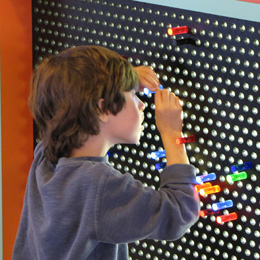
“Low Tech,” Not “No Tech”
By Janice O’Donnell, Executive Director and Robin Meisner, Exhibits Director, Providence Children’s Museum
First, some perspective: Providence Children’s Museum is a mid-sized children’s museum serving children ages 1 to 11 and their adult caregivers. We believe that young children learn best through hands-on experience, active exploration and play.
We’re not against high-tech experiences. We’re not against them in museums, not even in our museum. But you won’t find many high-tech or screen-based activities in our learning environments.
As educators and exhibit designers know, when creating an exhibit or a program, you necessarily start by defining and articulating your target audience and learning goals for the experience. You recognize your learners’ – your visitors’ – abilities and understanding so you can connect with their interests and scaffold their learning. And you select the most appropriate methods and materials to achieve your objectives.
So while we’re not against screen-based technology, we are opposed to using technology for technology’s sake. If screens are the best way to build the visitor experience and communicate the message, we’re open to using them. We have some video screens. We’ve experimented with a few high-tech components and probably will again.
Technology – of all sorts – should be a solution to a problem. High-tech experiences can be a real boon for an exhibit when they add value and further the goals set out by the institution. But all too often the technology becomes the unintentional experience in itself. We’ve all seen children pushing buttons to make the exhibit “go” in some way without waiting for or understanding the results of their actions. Button pushing wasn’t the learning experience these exhibits were intended to provide.
In the early 2000s, we experimented with a virtual reality game in an exhibit about recycling. Visitors jumped and sorted virtual trash into virtual bins. We thought it might make a somewhat didactic message a little more fun. Nearby we also provided real trash (empty cans, boxes, etc.) and real recycling bins for the younger children to sort. This actual sorting station was used by children of all ages far more frequently and for longer durations than the virtual sorting game. We know the technology behind such virtual systems has improved greatly with time, but the computer system was finicky and difficult for us to maintain. Moreover, for the system to work properly only one visitor could play at a time and, despite our best labeling efforts, visitors did not understand or want this.
All museums have a social element, but children’s museums are highly social – no one comes alone. Adult/child groups come to play together, and some caregivers visit specifically so their child will play with other children. Social interaction is critical for children’s learning. They get new ideas by watching others, and learn new skills by mimicking more advanced learners. As such, in our museum we particularly like activities at round tables where individuals gather in groups, people learn with and from one another, and what begins as parallel play often ends up as a collaborative experience. A good multimedia experience might engender social interaction, but all too often screens are designed for a limited number of users – sometimes only one.
Screen-based technologies are ubiquitous in today’s society, and many are so well designed that infants can use them. (The fact that babies are able to use them is more indicative of the intelligence of the designers than of the babies.) Despite recommendations based on understanding of child development, screen time for young children is increasing at the cost of children’s time for free play and hands-on exploration. Screen-based images are often representations of the real world, and young children need to understand the physical world before they can make sense of representations. Wooden blocks allow kids to mess around with real stuff. They explore the weight, texture, size and shape of the blocks and experiment with gravity and other physical forces, all while using their imaginations to create pretend worlds. And we have a lot of respect for children’s imaginations. For example, our climb-on, play-on sailing ship doesn’t have a video of waves crashing but kids have no problem “seeing” that turbulent ocean in their mind’s eye.
Screens do have a place in children’s lives. They can, for example, offer extensions for kids to grow their understanding of the physical and tangible. Screen-based technology can be a useful tool for allowing children access to the macro and micro aspects of our world – seeing the surface of the sun or the fine details of a snowflake. But in order to truly make sense of such things, kids need to first experience the tangible world. While it’s true that technology can provide opportunities for imparting information more effectively than the traditional exhibit label, learning is about more than acquiring information. It very importantly includes developing new skills, interests and attitudes.
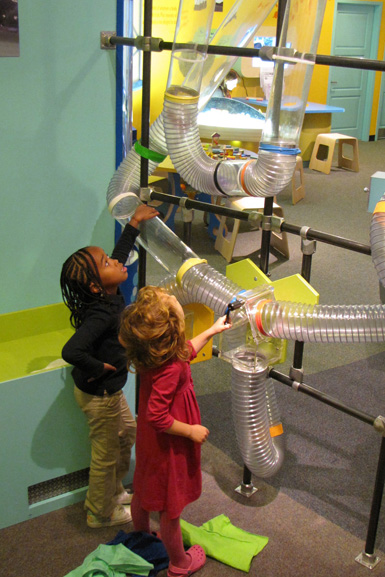
On a practical note, high-tech experiences can be expensive and difficult to maintain if you don’t have the expertise on staff. So while we wouldn’t rule out a screen-based solution just because it’s high tech, we certainly think very hard about whether such technology is the best method for achieving our goals; it would have to add significant value to make the cut.
Currently, we’re thinking about ways screen-based technologies could add value for our adult visitors more so than for their young children – although our visitors don’t ask for more technology and frequently compliment us for keeping our museum low tech.
Technology is a tool, but it’s not always the right tool – it depends on the job.