Meet Your New Museum Tour Guide: The Game-Master/ Oracle/ Renegade
By Dawn Salerno, Director of Education, Mystic Arts Center
Museum educators have posited that the “museum lecture is dead” while clinging to its traditional didactic form. A Museum-Ed list-serve query dating back to 2007 archives an informal discussion of peers that, while recognizing value in a well-constructed scholarly lecture, sought more experiential, hands-on, fun, and truly educational formats. Similarly, marketing, development, and events departments have reinvented the traditional museum fundraiser or party to attract the next generation of members and donors. The formula for these millennial events seems to be ample time for socialization in a comfortable environment, peer group experiences, food and alcohol. A 2008 study of young adults by Randi Korn & Associates, Inc. for the Isabella Stewart Gardner Museum was the first in-depth documentation of young adult dispositions towards museum programs. Whether it is the education or the marketing department running the program, the guiding principle is the same: tailor to the audience interest. The seed was planted by Stephen Weil in 1999 when he shifted the paradigm of museums “from being about something to being for somebody.”
So what’s new in adult programming in 2015?
For in-depth research on the topic, I draw attention to Museum Education Monitor, a monthly e-newsletter, which in April 2015 focused on new and current learning about adults and elders in museum education. And for a primer on the topic, you may also consult the publication Adult Museum Programs: Designing Meaningful Experiences by Bonnie Sachatello-Sawyer. The following examples highlight current attempts to actively engage adults of all ages in museums of all disciplines and sizes.
Play
Pilar Garro, Castle Hill Engagement Manager for The Crane Estate in Ipswich, MA, has an unofficial new tag-line: “Come play with us.” The emphasis on play in the reinterpretation of The Crane Estate is a manifestation of “The Excite Plan,” a major part of the strategic plan of The Trustees of Reservations, which operates the site. The Excite Plan focused Garro on creating experiences that would be unique, out-of-the-box, and creative. Those experiences, some self-guided and some as part of scheduled programming, are interactive and hands-on. The estate's Casino building, for example, will be reopened with a billiards table and giant chess and checkers sets. “This was originally a house for play for the Crane family,” says Garro. Her new programs even have playful names. Castle Hill Close-Ups are 20-minute pop-up, immersive experiences offered informally based on visitor interest in topics like miniature golf (“Take a Swing”) and the dining rituals of the Crane family (“Get Your Hands on the Silver”). On “The Guest of the Cranes” signature tour, visitors receive dossiers of actual guests and friends of the Cranes. Rather than reading a label or taking a tour, people are invited to experience a similar life-style, taking a first person role. “A Cupola with a View” tours the rooftop and “Cat’s Meow” appeals to families with a greater level of interactivity.
Play is also central to Providence Children’s Museum (PCM), as it is at many children’s museums. But what does a children’s museum do for an adult audience? Understandably, adult needs are not the focus of exhibition and program design, even if, as is the case with PCM, Brown University students occasionally invade the exhibits to let out some pre-exam stress. At PCM, parenting workshops help adults to understand how play contributes to healthy child development. Similarly, tip sheets help them navigate the museum with their children and extend the learning beyond their visit. PCM’s 2008 exhibition, “Play Powered,” was the first to have a targeted message for adults: the value of play in their children’s lives.
Professional Development
Another adult audience program trend is professional development. In her recent article in the Star Tribune, author Kristin Tillotson offers examples:
"New York City police officers have received training at the Metropolitan Museum of Art to improve observational skills. Minnesota Institute of Art staff members have done talks at the Eagan campus of Thomson Reuters, the international financial data and news company, about fakes and forgeries in the art world as a way of teaching ethics and principles of law."
In Boston, the Museum of Fine Arts (MFA) is enhancing the curriculum of residency programs at medical schools in the area. Brooke DiGiovanni Evans, Head of Gallery Learning, coordinates and teaches two of their partnerships. The workshop for Brigham and Women’s first-year residents is tied to the school’s humanistic curriculum, aimed at exploring the human aspects of medical practice. Objects in the collection are used as springboards for discussion, as they might be on a more traditional tour. However, these discussions are focused on issues future doctors may encounter, like death. Evans poses questions like, “How does this work of art speak to your experience as a resident?” Medical staff co-facilitate the two-hour workshop. Dr. Joel Katz at Harvard Medical School developed “Training the Eye: the Art of Physical Diagnosis,” which also takes place in MFA’s galleries. It uses Visual Thinking Strategies, among other techniques, to hone skills of observation and interpretation which correlate to diagnostic skills. MFA’s Visual Arts and Dermatology program is similar in curriculum.
Given MFA’s proximity to a number of hospitals, the programs make sense as a service to their immediate community. MFA is currently working with Tufts, MGH, and Beth Israel medical schools, and they are available to other groups as requested. The program has grown “organically, through strong partnerships,” says Evans.
Going Rogue
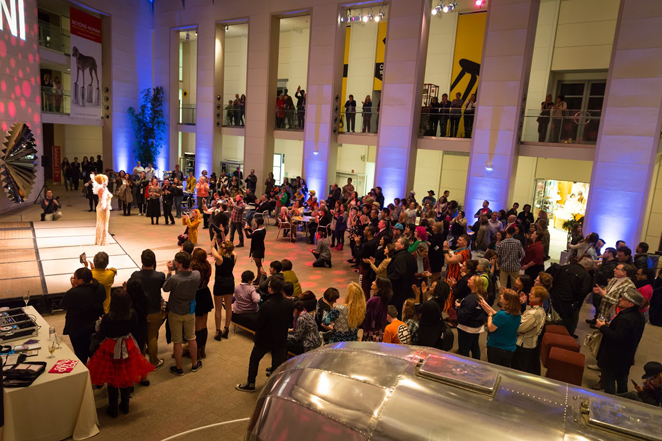
The most unusual programs for adults in museums right now have not been designed by traditional museum educators (or anyone on staff for that matter). The creators of these programs represent independent start-ups, providing educational programming now adopted by museums where staff has recognized the tremendous power they have to engage and grow audiences. By partnering with these collectives, Peabody Essex Museum (PEM) and The Metropolitan Museum of Art in New York have seen success in the form of more engaged audiences and sold-out programming.
Art-o-mancy is a program created by writer and performer Jon Spayde as an answer to his wife’s boredom with museums. Laurie Phillips realized she, like many, had fallen into a rather mechanical method of looking at the art: she’d read the label, look back at the art, read the label, ad nauseum. Spayde, inspired by French Surrealists, came up with a new way to tour the art museum. Visitors are led by an “oracle guide,” not a docent, and venture on a “quest,” not a tour. Who wouldn’t choose a “quest” over a “tour?” Before the quest begins, the visitor forms a question about his or her life and is blindfolded. The guide then helps him or her navigate the museum until, instinctively, the visitor decides to stop at an artwork. That artwork is then interpreted through the lenses of the visitor, according to the question. Says Doneeca Thurston, Adult Programs Coordinator of PEM, “We are one of the first museums in this area to work with the collective, and our patrons walked away with thoughtful answers and deeper connections to the collection.”
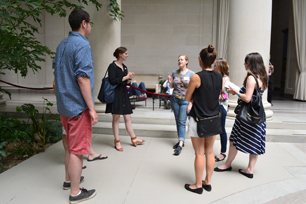
(Museum Hack at the National Gallery of Art)
According to their own website, Museum Hack "provides interactive, offbeat, renegade tours of NYC museums. Our un-highlights tour puts an alternative spin on the museum, featuring other sides to the highlights we love, as well as some of the strangest, wildest, sexiest stories hidden throughout the museum."
They go on to guarantee “110% satisfaction.” I spoke to Ethan Angelica, a “renegade/tour guide” for Museum Hack. Their target audience is Millennials; all of their marketing, content, delivery methods for content, and beta testing are aimed at the age group of 20 – 35 year-olds. Their priority for any visitor on their tours is having a great time in a social environment. “Entertainment is the gateway to education,” asserts Angelica. To prepare for these tours, each guide is allowed the freedom to research whatever is of interest to him or her. The tour outline is dictated, but not the specific content. They also tailor each interactive tour to the audience’s interests, pushing them at times to also consider art in which they did not express interest. Guides come from all backgrounds, though many have theater, museums, or other arts in their backgrounds. To be hired by Museum Hack, a candidate must be a great storyteller and researcher. “I can’t teach them to be a great storyteller, but I can give them coaching to lead the tours the way Museum Hack structures them,” noted Angelica.
Museum Hack is small, with just 25 staff and no offices. However, Angelica says this summer is the busiest they have ever been. To deliver their programs, they develop a contract relationship with museums. The museums typically take one third of the ticket price. They also work with corporations on team-building or developing young professional audiences. While they are too small and young a company to have any substantial metrics, they have noticed repeat visitation and were rated “13” on Trip Advisor’s things to do in New York City at the time of this article. Their last New York search for guides yielded 400 applicants; only two were hired. Indeed, the job of renegade does seem “criminally fun,” as one of their team asserts. Look for a workshop with Museum Hack at the 2015 NEMA Annual Conference.
For at least a few years now, museums across New England have been allowing visitors to “hack,” “remix,” and “reinterpret” objects in their collections. And staff has realized that their role in this type of programming is to enable, not be the “sage on the stage” or even the “guide on the side.” Newer and younger museum audiences today are more versed in self-designed experiences and more apt to want this level of personalization.
A randomly sampled survey of 28 New England museums (conducted informally by the author) revealed that traditionally didactic formats like lectures, talks, and guided tours are still the most frequently found in museum education menus today. The lecture is truly not dead. Even Museum Hack staff recognize the value in a traditional guided tour. And yet, from play and parenting to professional development and fortune-telling, it is clear that museum staff and entrepreneurs are taking roads never before traveled to serve adult audiences.
References & Resources
Adult Museum Programs: Designing Meaningful Experiences, Bonnie Sachatello-Sawyer, American Association for State and Local History; AltaMira Press. 2002.
An Off the Wall Night Offers Opportunities to Connect with PEM Collection, Keith Spencer, NoBo Magazine, 2014 NoBo Publishing Group Corp.
From Being about Something to Being for Somebody: The Ongoing Transformation of the American Museum, Stephen E. Weil. Daedalus Vol. 128, No. 3, America's Museums (Summer, 1999), pp. 229-258 Published by: The MIT Press on behalf of American Academy of Arts & Sciences.
Museums Are Literally Mind-expanding, Researchers Say, Kristin Tillotson, Star Tribune, May 05, 2015.
Header photo © 2014 Peabody Essex Museum. Photography by John Andrews.