
Early American Museum Practice of the Salem East India Marine Society
By George Schwartz, Ph.D., Curatorial Scholar, Peabody Essex Museum
Editor's Note: We're all interested in whence we came. The East India Marine Society began a tradition of best practice that continues today in many museums. George Schwartz does an excellent job linking past and present for the museum profession.
The East India Marine Society Museum, the founding organization of today's Peabody Essex Museum (PEM) in Salem, MA, was one of the most influential collecting institutions in the antebellum United States. From 1799 to 1867, it was a popular destination for people from all walks of life and viewed as a model museum for the country. In addition, it was open to the public free of charge with an introduction from a member. As a New York paper wrote of the museum in the 1830s: “Has the reader ever visited the Salem East India Museum?—We have many a time: and we do not hesitate to say that to us it is the most interesting Museum which we ever entered.” Unlike other early American museums, the Society left a substantial institutional archive currently housed at the PEM’s Phillips Library that offers a unique opportunity to assess how an early American museum functioned. Internal minutes reveal how the Society grappled with museological issues as well as the antecedents of some contemporary museum practices and procedures.
When twenty-two master mariners formed the East India Marine Society in 1799, Salem was at the epicenter of American consciousness as local East India ships ventured into uncharted waters around the globe. Unlike other marine societies, whose primary focus centered on providing relief to the widows and children of deceased sailors, the Society had loftier ambitions beyond benevolence. Membership was limited to Salem masters and supercargoes who navigated the seas beyond both Capes, and among the many by-laws of the organization was one instructing members “to form a Museum of natural and artificial curiosities, particularly such as are to be found beyond the Cape of Good Hope or Cape Horn.”[1]
Almost immediately, museum business became a central feature of Society meetings. In the early days of the institution, museum operations did not fall to one person alone. Several individuals were tasked with day-to-day maintenance. In March 1802, a committee of five members was tasked “to compleat [sic] a catalog of donations for the cabinets of curiosities,” while others were responsible for purchasing casework and installing objects.[2] Objects, too, were acquired through various means—through donation, purchase, and exchange. Starting in March of 1800, donors were acknowledged at the beginning of each meeting. In this instance, a standing committee offered “thanks…to Mr. John Derby for the curiosities presented by him.”[3] An 1802 bill in the treasurer’s accounts notes payment to a William Molloy in the amount of sixty-four dollars for his collection of birds and butterflies.[4] Later, on March 4th, 1812, the Society accepted the proposal of Mrs. Rich, wife of the diplomat and a founder of the Boston Athenaeum, Obadiah Rich, “for the exchange of shells belonging to the Society, if in their opinion it will be advantageous to the Society.”[5]
By 1820, the collection had grown to more than 2,000 objects and was difficult to maintain. Then Society president Nathaniel Bowditch hired a local medical doctor, Seth Bass, as superintendent—the first professional curator of the East India Marine Society Museum. Bass crafted the museum’s first published catalogue in 1821, copies of which were sent to Presidents Thomas Jefferson and James Madison, and reorganized the collection. A few years later at the January 1824 Society meeting, separate committees were formed to investigate empowering the superintendent to grow and refine the collection. One recommended “[t]hat the Superintendent of the museum be authorized to purchase any articles of curiosity for the use of the society to render their collection more complete…and…deliver…an account in writing of all purchases made by him, which account shall be laid before the Society by the President at said annual meeting.”[6] In addition, they suggested that the Superintendent should be authorized to “exchange any articles of the collection which may have been presented by members or purchased by the Society and of which there may be more than one specimen, for other articles of which the collection may be deficient and which may be deemed not less valuable to the Society.”[7] Like contemporary museum acquisition and deaccession policies, which require the approval of a director, chief curator, and/or a collections committee, the Society stipulated that the superintendent obtain written authorization from the President and two members of the Committee of Observation for adding and removing objects.
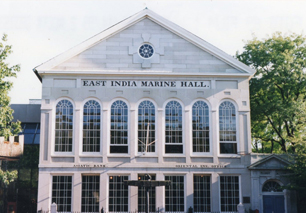
Two months later, the Society laid out the parameters for constructing their first permanent home on Essex Street in Salem near their current quarters. To pay for the cost of construction, the Society would do two things—rent out the bottom floor of the new building, which “would yield to the subscribers an annual interest of five per cent annum and perhaps more,” and create “an association to be incorporated…under the name of the ‘East India Marine Hall Corporation’…for erecting a building of about forty five feet by ninety five, for the East India Marine Society and other purposes.”[8] While the East India Marine Hall Corporation was a publicly traded entity, the Society held the majority of shares and its members filled the ranks of its officers. A year later, East India Marine Hall was opened to great fanfare with a dinner attended by President John Quincy Adams and other dignitaries.
Caring for the collection in this new facility was still a challenge. In 1838, Henry Wheatland, the museum’s fourth superintendent and later President of the Essex Institute, undertook a thorough examination and modification of East India Marine Hall. At the September 6th, 1838 meeting, he informed the members present that he took all objects out of their cases for cleaning, and changed the places of many. He notes that visitors had damaged many of the figures of Chinese and Indian merchants. As a result, he decided to encase one figure of a Canton merchant that was recently carved by Joseph True of Salem. This was done partly “to prevent any injury or defacement that may arise from the exposure to the air, dust,” but mostly to protect it from “the excessive handling by visitors; A habit to which the Yankies [sic] are very much addicted and one which is said by some peculiar to this genius.”[9] The Society aided Wheatland’s efforts by authorizing their President and Committee of Observation to “take such measures for the deposit of umbrellas and cains [sic] of visitors as they shall think necessary.”[10] Ten years later, the Society voted unanimously to bar children under fourteen from the Hall unless accompanied by a parent or guardian “to take proper care of them.”[11]

Like many American institutions past and present, the East India Marine Society Museum was not immune to financial hardships. As the United States entered the postbellum world as a broken nation, Salem’s Golden Age as a premiere global port was long gone. As a result, Society membership dwindled due to a lack of local men who met the organization’s strict nautical qualifications for joining and funds diminished. The Society realized it was too costly to operate a museum and adhere to their principal focus as a charitable institution. Through a complex negotiation in 1867, they sold East India Marine Hall and deposited the collection in a new institution funded by philanthropist George Peabody—The Peabody Academy of Sciences, born in the mold of natural history and anthropology museums that were developing in America at the time. A few decades later, the Society, reassured that their legacy would be kept alive by this new incarnation of the museum, reincorporated in 1915 to insure remaining beneficiaries would be paid when the last members passed away. They also allowed museum trustees to become members, and by mid-century, the Society and the museum’s board became one in the same. Today, almost a third of the original collection remains at the PEM and East India Marine Hall still stands. Contemporary visitors to the Hall, which is arranged in a manner akin to its antebellum form, can gaze upon objects once viewed by their nineteenth-century counterparts and reflect on the Society’s efforts in “collecting and arranging…a history of the globe.”[12]
Bio
George Schwartz holds a doctorate in American & New England Studies from Boston University. His dissertation, “Collecting and Arranging…a History of the Globe”: A Reconsideration of the Salem East India Marine Society and Antebellum American Museology, aims to reorganize our understanding of nineteenth-century museums. For twelve years, George was as an assistant curator in the Maritime Art & History and Exhibitions & Research departments at PEM, and currently serves as a curatorial scholar.
[1] East India Marine Society, The East-India Marine Society of Salem (Salem, MA: Printed by W. Palfray, Jr., 1821), 4.
[2] Records/Minutes 1799-1824. East India Marine Society. Records, 1799-1972. Peabody Essex Museum, Phillips Library. MSS# MH-88, Box 1, Volume 1..
[3] Ibid.
[4] Treasurer’s Accounts 1802. East India Marine Society. Records, 1799-1972. Peabody Essex Museum, Phillips Library. MSS# MH-88, Box 4, Folder 4.
[5] Records/Minutes 1799-1824. East India Marine Society. Records, 1799-1972. Peabody Essex Museum, Phillips Library. MSS# MH-88, Box 1, Volume 1.
[6] Ibid.
[7] Ibid.
[8] Ibid.
[9] Ibid.
[10] Ibid.
[11] Ibid.
[12] Ibid.