Authenticity and Accessibility: Perspectives on Historic and Contemporary Art Reproductions
By Hannah Weisman, Director of Education, Boston Athenæum
Today we have virtually unlimited digital access to visual and material culture: from cat videos to the finest paintings and most fragile artifacts held in the world’s preeminent museums. The quantity of material available online is constantly growing, and barriers to accessing that material are being eroded or eliminated. In 2013, The Getty opened access without restrictions to nearly 100,000 images of works of art in the public domain from the J. Paul Getty Museum and the Getty Research Institute.[1] The Metropolitan Museum of Art followed suit in 2014 when it made 400,000 digital images available for non-commercial use.[2] Since 2014 The British Museum has been publishing 3D scans of objects to Sketchfab[3] from which they have had nearly 30,000 downloads.[4]
Despite seemingly unfettered access to the world’s artistic treasures, people still choose to go to museums to see artwork in person. It would seem analogous to music lovers listening to recordings by their favorite artists but still relishing the opportunity to hear the musicians perform live. Surely museum goers are looking for an opportunity to experience “the real thing.” So why, then, are tangible (i.e. not digital) reproductions of art on view and employed in interpretive programming in museums?
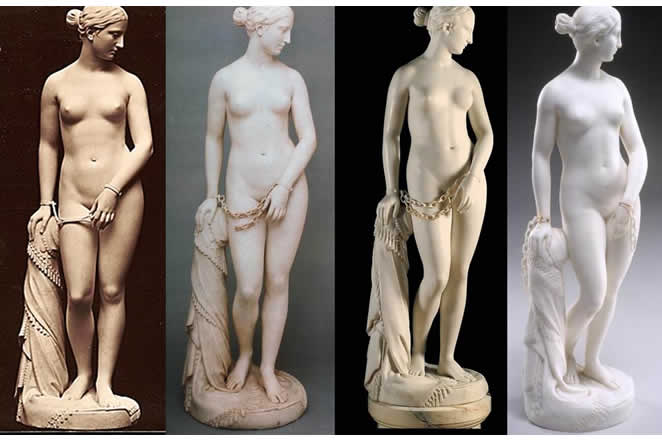
The Boston Athenæum, like other collecting institutions of the nineteenth-century, collected copies of sculpture voraciously. By the Civil War it had amassed one of the most important collections of casts in the United States. Although the size of the collection has shrunk since then, copies and casts remain a hallmark of the Athenæum’s sculpture collection, including plaster casts of historic sculpture such as Discobolus and Hermes Belvedere, a marble copy of the historic Venus de’ Medici, plaster casts of busts of founding fathers by Jean-Antoine Houdon that once graced Thomas Jefferson’s Monticello, and a plaster cast of Houdon’s full-length portrait of George Washington commissioned for the Virginia Statehouse.
Why do the Boston Athenæum and other museums continue to exhibit and use copies, casts, and other reproductions? How were and are these reproductions produced? What are the parameters for and repercussions of using reproductions to offer museum visitors the “authentic” experience they seek? Can a reproduction ever be “authentic?”
In an attempt to find answers to the questions above, as well as create dialogue about the definition and value of “real” art, the Boston Athenæum presented a two-part series on art reproduction this spring. The series began in March with a lecture by David Dearinger, the Susan Morse Hilles Senior Curator of Paintings and Sculpture and Director of Exhibitions at the Boston Athenæum, entitled “Copies, Casts, and Cads: Reproducing Sculpture in 19th-Century America.”[5] Following Dearinger’s lecture, the Athenæum hosted a panel discussion called “Authenticity and Accessibility: Art Reproduction Today” with panelists Hannah Goodwin of the Museum of Fine Arts, Boston; Steve Gyurina of Artopia Giclée; and Jim Olson of the Peabody Essex Museum; and moderated by Elisabeth Nevins of Seed Education Consulting.[6]
In his lecture, David Dearinger explained the historical practices of copying art for pedagogical purposes, describing how young and aspiring artists would spend their days copying masterworks in museum galleries to learn composition and technique. He then focused on the system by which sculptors of the nineteenth century earned a living by selling marble (and in some cases plaster) copies of their own works to art collectors. Dearinger’s lecture demonstrated that art reproduction has long been regarded as a legitimate means of disseminating art and making it accessible to collectors, students of art, and the general public; that art reproductions can have artistic value; and that artists themselves can authorize and approve of reproductions as honest representations of their work.
The themes established in Dearinger’s lecture resurfaced in the “Authenticity and Accessibility” panel discussion. Steve Gyurina’s meticulous work photographically reproducing paintings echoes the painstaking work of nineteenth-century craftsmen and women reproducing sculpture to an artist’s specifications. Together with the artists who commission his work, Gyurina makes artworks available for people who may not be able to purchase an original painting while protecting and supporting the artist and the integrity of the artist’s work.
Hannah Goodwin and Jim Olson addressed different ways in which reproductions can be used in a museum setting. Goodwin discussed how the Museum of Fine Arts, Boston uses various types of reproductions to provide multiple points of access for all visitors, including those who are blind or have low vision. She raised important questions about types of reproductions, pointing out that what may work for one audience may not work for another. Goodwin used the example of a bronze sculpture reproduced in plaster and painted to look like bronze. The reproduction would have a different weight, texture, and temperature than the original. While it might suffice as a point of access for sighted visitors, it might misrepresent the artwork to visitors who are blind.
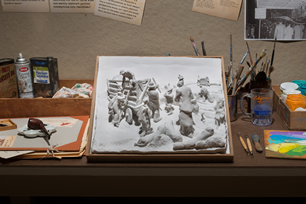
Courtesy of Peabody Essex Museum. Photography by Allison White.
Olson discussed the Peabody Essex Museum’s use of a 3D-printed model of a clay maquette by Thomas Hart Benton in the exhibition American Epics: Thomas Hart Benton and Hollywood. The museum opted to scan and print a 3D model of the maquette after the original was deemed too fragile to travel for the show. The model was used in the exhibition in a setting evocative of Benton’s studio to help tell the story of Benton’s artistic process. The museum clearly marked the model as a reproduction and invited visitors to touch it. Olson stressed that the museum did not make its decision to include a reproduction in the exhibit lightly, but the curatorial team ultimately felt its inclusion was important to creating the desired visitor experience in the show.
Both the lecture and the panel discussion offered audience members a context for understanding why and how art reproductions are created, collected, and used, particularly in museum settings. Recognizing that reproductions have been valued and employed for a variety of pedagogical and commercial purposes throughout time helps legitimize their contemporary use. The speakers also helped frame the questions that need to be asked when a museum chooses to use reproductions. Ultimately, their use in museums today must support and enhance a visitor’s experience of an artwork, exhibition, or narrative. Perhaps it is time to shift the question of authenticity away from a focus on individual objects and towards a focus on the stories we tell and the ways in which our visitors experience them.
[1] “Open Content Program,” J. Paul Getty Trust, http://www.getty.edu/about/opencontent.html, accessed 28 June 2016.
[2] “Metropolitan Museum Initiative Provides Free Access to 400,000 Digital Images,” The Metropolitan Museum, http://metmuseum.org/press/news/2014/oasc-access, accessed 28 June 2016.
[3] Sketchfab.com is an online platform for publishing and exploring 3D and virtual reality content.
[4] The British Museum, Sketchfab, https://sketchfab.com/britishmuseum/models, accessed 28 June 2016.
[5] A recording of “Copies, Casts, and Cads: Reproducing Sculpture in 19th-Century America” is available online at https://vimeo.com/album/3752017/video/161076565.
[6] A recording of “Authenticity and Accessibility: Art Reproduction Today” is available online at https://vimeo.com/album/3752017/video/168241455.