Catch ‘Em All
Sometimes we wait for something with great anticipation – holidays, an Amazon delivery, romance – only to find when it arrives it’s not all it was cracked up to be. Then there are things that arrive without prior fanfare which totally knock us off our feet with a shockwave of unexpectedness. Once we regain our bearings, we look around and say, “Where did that come from?”
The arrival of Pokémon Go is such a thing.
Since the release of Pokémon Go on July 6, museums and historic sites have witnessed zombie-like throngs of children and adults invading their spaces in search of virtual critters. The responses of said museums and historic sites are varied.
Many have invited the invasion by taking to social media, promoting that they feature Poké Stops or, more augustly, Poké Gyms while not fully comprehending what this means. Sites of conscience such as the Holocaust Museum, Arlington Cemetery, and 9/11 Memorial have objected to gamers attempting to capture Pikachu in a sacred place. Some have expressed concern over gamers damaging artwork, disturbing visitors, and carelessly injuring themselves in the museum and subsequently suing. A good share of museums are taking a wait-and-see attitude, baffled at the phenomenon and wondering whether to capitalize on it.
Not long ago Elizabeth Merritt, the founding director of the Center for the Future of Museums, explained to me the difference between trends, which track slow changes into the future, and “disruptive events,” which make sudden, decisive changes in the course of history. Trends we can observe and use to make plans. Disruptive events cause us to improvise. With Pokémon Go, even the most prescient among us is playing catch up.
Disruptive events also unmask deep-seated beliefs, biases, and fears. Our reactions to Pokémon Go are a marker for how the museum field views itself and its mission at this moment in time.
On the one hand, we’re overjoyed because suddenly people are visiting museums and historic sites in droves. Yay! New audiences! And our joy is multiplied when we find out that many of these new Poké visitors are Millennials, those curious and treasured souls over whom we have fretted, tried to lure with hip after-hours programming, and despaired will never share our museum addiction.
But wait. They’re not serious visitors! They just wander around the museum glued to their smartphones. They don’t even look up to see the objects! Museum folk have that sinking feeling every geeky kid has when one of the popular kids show up for their birthday party, only to realize that they came to spend time with one of their guests. They don’t really like me. They’re using me!
Sooner or later we grow up and realize it didn’t really matter whether they came for me or one of the cute partygoers. What mattered is that they came. For one afternoon at least, their coolness rubbed off. So for now, we can revel in whatever coolness factor Pokémon Go brings us.
Apropos of the “collections” theme of this issue of Museums Now, the Pokémon Go craze also highlights the fear many of us have over the long-term sustainability of museums in a digital universe. Because of our collections, museums are bastions of authenticity, of the “real.” We watch the virtualization and gamification of social spaces the way an Oklahoma rancher watches an oncoming tornado. The juxtaposition of Charmander and a marble statue in the augmented reality of Pokémon Go perhaps seems to us the first gust of an unstoppable twister.
Maybe, maybe not. First, it might be a fad, something that brushed by us in the summer of 2016. It is, after all, an open question whether people will retreat to their couches after the novelty wears off.
But it might be that Pokémon Go is a disruptive event with lasting impact. And perhaps it will have a lasting positive impact on museums. I’d be curious to learn how many gamers who blunder into our spaces looking for JigglyPuff indeed look up from the screen for a split second and experience that transformative moment most of us in the field have felt at some point in our lives. That magical, intoxicating flash of consciousness where you just know you belong in a museum.
Our challenge: get them to look up.

Dan Yaeger
PS
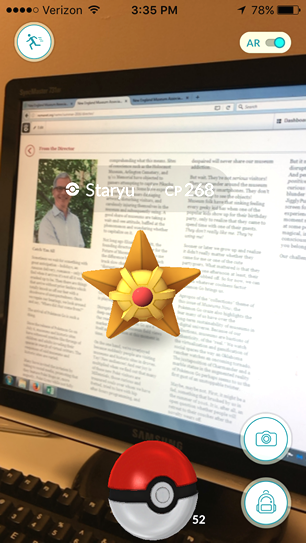
You can even find Pokémon in the NEMA office.