New Tour Experience and Freshly Preserved Interiors Await Visitors to Hartford’s Harriet Beecher Stowe House
By Catherine Burton, Ph.D., Museum Educator, Harriet Beecher Stowe Center
When Katherine Kane joined the Harriet Beecher Stowe Center as Executive Director in 1998, she faced both internal and external pressure to reimagine the organization’s role. Declining historic house museum visitation, visitor feedback, as well as changes in community expectations and funding required charting a new course for the Hartford institution.
Kane and the Board of Trustees began with two fundamental elements: articulating Harriet Beecher Stowe’s ongoing international impact and honing a new mission statement. The 19th century author of the bestselling anti-slavery novel Uncle Tom’s Cabin had galvanized abolitionists and contributed to the outbreak of the Civil War. Her words changed the world, and her life would be an example of how one person can make a difference.
For the newly adopted mission, the Stowe Center chose to preserve and interpret Stowe’s home and historic collections as well as promote vibrant discussion of the author’s life and work and inspire commitment to social justice and positive change.
Changes to the visitor experience began with program variety as the organization worked to find its programmatic niche. “Salons at Stowe” launched in 2008. These community conversations on contemporary social justice issues inspire audiences to move from dialogue and debate to action and civic engagement. With guidance from staff facilitators and guest speakers, Salon audiences have tackled topics such as juvenile justice, women’s healthcare, homelessness, white privilege, and mass incarceration.
Enthusiastic responses to these discussions convinced the museum to use a conversation framework for all Stowe Center programs. And since visitors were asking for a more interactive tour, the museum incorporated the Salons at Stowe model into the Stowe House visitor experience. Rather than being object focused and didactic, tours would be conversational with a focus on Stowe as inspiration for how one person can effect change. Led by Shannon Burke, Director of Education and Visitor Services, with consulting support from Linda Norris, reinterpretation of the Stowe House commenced.
At the same time, the organization needed to replace aging systems in the 1871 National Historic Landmark where Stowe lived her final 23 years. After being open to the public for nearly 50 years, the home required new climate controls, state-of-the-art fire suppression, and renovation of historic windows -- all vital to preserving the structure and collections. As the home’s contents would be moved to storage while work was completed, the Stowe Center undertook refreshing the entire interior -- replacing carpets, wallpapers and paints.
The Stowe Center hired a Project Curator to manage the preservation project. Cindy Cormier describes the relationship between preservation and interpretation as one of trust: “Preservation creates the stage set for reinterpretation. If you don’t present the house with historical accuracy, people can’t get on board with the interpretation.”
Cormier worked with Stowe Center development staff to continue raising funds to support the project, oversaw the plan of work, and managed dozens of contractors to complete mechanical systems upgrades, interior design changes and artifact conservation.
Based on extensive staff research, Cormier and Collections Manager Beth Burgess worked with historic interiors consultant Jean Dunbar to identify historically accurate Stowe-inspired finishes for the renovated space. They combed photographic evidence, Stowe’s letters and published works, and articles written by 19th century Stowe House visitors, and conducted paint analysis to select the color palette of blue, maroon, buff and gold.
By 2011, the two projects -- tour reinterpretation and interior preservation -- moved forward hand-in-hand with one informing the other. “I talked about ‘blowing up’ the tour and the experience,” Kane says. “We needed to disrupt our patterns, and de-installing the house allowed for this deconstruction.”
Internal and external assessments of the museum—including the national AASLH Visitors Count! and statewide Reach Advisors surveys—provided a clearer sense of where and how to rethink the tour. Staff also received valuable feedback from informal focus groups with theater professionals, students, museum members, and donors, as well as non-visitors.
Staff set out to define tour themes, goals and objectives. Norris held sessions with interpretive staff, asking them which museum artifacts were essential to tell the story. She encouraged extensive prototyping, and staff quickly rolled out changes, and focused on experimentation rather than perfection.
Along the way, standard components of house museum tours went by the wayside: velvet ropes and stanchions were removed and a “no photographs” policy was set aside. According to Shannon Burke, removing many of the “sacred cows” proved liberating.
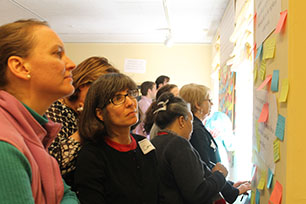
Stowe Center staff generate narrative concepts at a 2013 interpretive planning session.
By summer 2014, staff began prototyping the new tour with low budget, non-permanent tools. Staff filled a passageway with posters featuring quotes about Stowe from well-known historic and contemporary figures. They added butcher paper to the kitchen table for visitors to record their ideas for social change. They rearranged parlor furniture and added folding chairs for visitor conversation on 19th century issues that connect to the present. They simulated a multi-media experience depicting Stowe’s thoughts as she prepared to write Uncle Tom’s Cabin using PowerPoint. Interpreters incorporated discussion materials—a poster rewarding the return of a runaway slave, a bill of sale for an enslaved man, the anti-slavery alphabet, and song of the abolitionists.
Most importantly, staff participated in training and daily meetings to learn and practice facilitating conversations on difficult topics – how 19th century issues of race, class and gender persist today. Interpreters held daily meetings to share anecdotes and tips for productive, provocative, and powerful conversations.
Working with museum consultant Conny Graft, staff implemented a formative evaluation process to gather visitor feedback. Evaluation included tour observations, in-person visitor interviews, and a post-tour online survey. In addition, interpreters shared their experiences. Asking the questions “Why did this work?” and “Why did this fail?” became daily practice. Working together, staff could quickly revise and evaluate an adjusted approach.
Visitor reaction was overwhelmingly positive. Burke points out that guests appreciated the Stowe Center’s willingness to include them: “We were open about our prototyping, and people were honest; they loved being a part of the process. There’s something endearing—even democratizing—about letting everyone contribute.” Perhaps most encouraging, Burke adds, “we found that people were willing to talk about social justice.”
By 2016, the entire contents of the Stowe House – furniture, art, decorative arts, books, and rugs – were carefully packed and moved to secure storage. A team of workers, under direction of a general contractor, began installing the new mechanical systems.
The Stowe Center remained open for tours, and the flexible staff continued providing an excellent visitor experience. Stowe’s story, and conversations on 19th and 21st century social justice issues, were shared in two other historic buildings on the campus. Key images and artifacts were installed in the 1873 Stowe Visitor Center and 1884 Katharine Seymour Day House, a gilded age mansion named for the museum’s founder. Following stops in these two spaces, interpreters guided visitors into the Stowe House to view preservation in progress.
Today, as the Stowe Center launches the new visitor experience in a freshly preserved space, professionally designed and manufactured exhibits and multi-media experiences have replaced “homemade” prototypes. The tour has been refined and finalized. Carpets, wallpaper and paint reflect Stowe’s aesthetic, and furnishings, decorative arts and paintings have returned to the house.
Staff agree that change is hard but risks are worth taking. Hiring and training have taken on heightened importance as the museum recruits educators rather than guides, interpreters skilled at facilitation, adaptability, and narrative development.
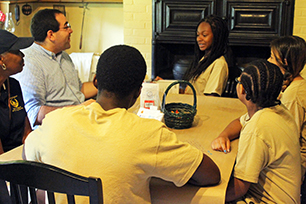
Students were among the first visitors to prototype the new tour experience in 2014.
Group interviews—where applicants are asked to interpret objects and discuss their connections with the Center’s mission—provide opportunities for multiple staff members to assess potential new hires. Training is an ongoing process, with daily exercises and discussions that encourage self-awareness, reflection, and innovation.
According to Burke, “We are now braver. We take risks, prototype, and are more comfortable existing in a state of flux. We are better storytellers: we engage visitors, weave narratives, and link historical and modern-day experiences. We innovate, push boundaries, and help expand the role of museums.
“This newfound flexibility is indispensable as we navigate and respond to uncertain and changing cultural circumstances. We are keenly aware of our indebtedness to the many museum professionals, consultants, visitors, and members of the public who have given us endless amounts of advice, ideas, and feedback.”
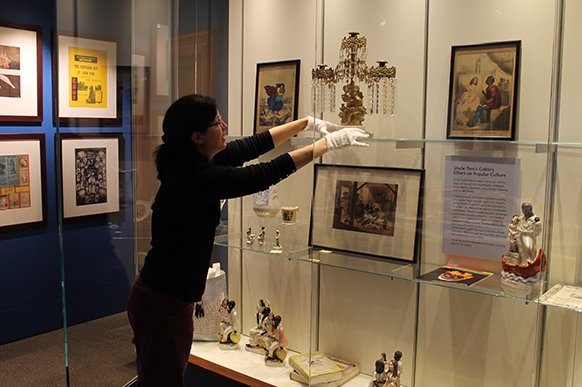
(Main photo: Collections Manager Beth Burgess installs artifacts in the new Uncle Tom’s Cabin Impact Gallery.)
The Harriet Beecher Stowe Center thanks the generous funders and donors that supported Stowe House preservation and tour reinterpretation. For a complete list, visit HarrietBeecherStowe.org.