
From the Fellow: Transformative Leadership, Three Ways
By Amanda Wastrom, Assistant Curator, Heritage Museums & Gardens and Principal, Lily Pond Hill Creative Communications

Amanda Wastrom is the 2018/19 NEMA Fellow. As part of the fellowship Amanda is writing a series of articles for the NEMA community.
What does it take to be an effective leader? This question never seems to get old. What is that secret sauce that makes an organization hum? There’s a reason we look to successful models—we are searching for nuggets to add to our own leadership toolbox. One of the best ways to learn about successful leadership is to see it in action.
Profiled here are three non-profit leaders, Christine McCarthy, Cherie Mittenthal, and Bob Nash. Three different people. Three different styles. Yet, there is much more that connects them than sets them apart.
- Geography: they are all working in the same region: Cape Cod.
- Experience: combined, they have over a century (and counting) of leadership experience.
- Institutional knowledge: Each one has been at their institution for at least ten years.
- Success: Each institution is a leader in the cultural life of our region.
- Growth: Each one has guided their institutions successfully through significant transformations.
So, how do you grab the reins at an organization and ferry it into an unknown future? Here’s how these three did it:
FROM FLIP FLOPS TO CAPITAL CAMPAIGNS
Christine McCarthy, Chief Executive Officer, Provincetown Art Association and Museum
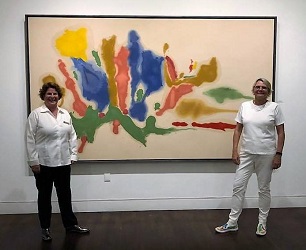
Christine McCarthy (left) and Lise Motherwell, President of the PAAM Board of Trustees, at PAAM’s Helen Frankenthaler show in 2018.
“I came in a suit and it was literally one-hundred degrees,” recalls Christine McCarthy, Chief Executive Officer at the Provincetown Art Association and Museum (PAAM), about her first interview for the job, in June 2001. “Everyone on the search committee was in shorts. In my head, I was like, I’m not taking this job.” McCarthy was working in Boston at the time, at the Institute of Contemporary Art. While her job title was “Assistant to the Director,” the Director had left, leaving McCarthy to lead in the interim. PAAM—and Provincetown—with its summer vacation vibes and antique two-story clapboard captain’s house, proved quite the culture shock. “I asked the board members what their annual contribution was,” she says. “Forty dollars, for their membership dues. I said, no way.”
Yet, there was one board member who brought her to her house filled with paintings by Milton Avery, Jim Forsberg, Karl Knaths, Henry Hensche, and Pauline Palmer—artists that McCarthy knew and loved. Despite her early hesitations, the town and the organization won her heart. She took the job.
On McCarthy’s first day, she was locked out, with a class waiting outside. She sat down at her desk and felt her office chair slide across the cockeyed floor. “That first summer, I just stayed in the galleries to see what people wanted. I had to apologize a zillion times.” Founded in 1914, PAAM had an amazing history—and a terrible building. McCarthy made the decision to renovate the entire museum. It was big, it was bold, and not everyone was on board. Half the board left. “I got a TON of resistance. I was probably one of the most hated people in town. When I went to the grocery store, people would tell me I was ruining the town,” she says.
Undaunted and convinced that this was the way to continue PAAM’s mission, McCarthy focused on rebuilding the board. She brought in a colleague from her days teaching museum management at Boston University to do a one-day board retreat focusing on what needed to happen to launch a capital campaign. After over a year of education and cultivation, she had 100% board participation. “You have to revamp and vote on every policy. Everyone needs to understand their role and PAAM’s mission,” she says.
Board education was—and continues to be—key. “We do a lot of training. Full day retreats and boot camps. Each board member gets to work with a different staff member—registrar, installer, a life drawing class,” she explains. “The more you know, the better ambassador you’re going to be.” She has worked hard to create a unified sense of team and mission throughout the organization. “When I started we were very divided. We had to have symbiosis of all three components: the museum, the school, and the art association,” she says. She has been able to grow her staff from one person in 2001 to thirteen people today, along with a volunteer crew numbering around 250.
McCarthy takes a team-oriented approach to her leadership. “I am a champion of the small museum. We are a powerhouse! I don’t want to work with 3,000 people whose names I don’t know. No one is above or below doing anything,” she says. “We look at what needs to be done and say ok, how are we going to do it?”
The renovation of the museum, completed in 2006, was a game changer. PAAM became the first green art museum in the country and was awarded a Silver LEED rating by the United States Green Building Council. “No one believed we could do it. There was a lot of animosity. There were a lot of doubters,” says McCarthy. “People were so blown away that we actually did this that the attitude became we can do anything!” The buzz was palpable, driving in visitors and volunteers. Programs have been upgraded and expanded. With state-of-the-art exhibition facilities, the museum could also step up its exhibition program, balancing art association member shows with world-class contemporary art. McCarthy earned the respect and trust of PAAM members and the Provincetown community. It has been full-steam ahead ever since.
Visitors and members alike are waiting to see what PAAM will do next. For McCarthy, not surprisingly, the answer is change. “I see growth in our future and that is key. As long as we stay fresh. We have a really unique model.”
LEADERSHIP FROM BOTH SIDES OF THE BRAIN
Cherie Mittenthal, Executive Artistic Director, Truro Center for the Arts at Castle Hill
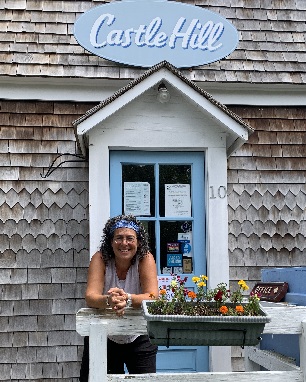
When artist and printmaker Cherie Mittenthal came on as Executive Director of Truro Center for the Arts at Castle Hill in 2002, she was the newest in a line of artist-leaders at the non-profit arts center. “It has always been run by an artist,” she says. “Most organizations are not. Being an artist and being connected to that world, it’s important.”
Castle Hill (as locals call it), was founded in the early 1970s by artists looking to breathe new life into a crumbling, nineteenth century barn. They envisioned studio spaces and arts classes. Its first director was sculptor Joyce Johnson, who thought it wise to move her sculpture school indoors (her previous “studio” was a clearing in the woods in nearby North Eastham). With no funding, the artists planned classes for the summer of 1972, then held their breath to see if anyone would come. People did come and they even made a modest profit.
Now in its 48th year, Castle Hill still remains true to that vision, offering classes in visual arts, writing, and more, studio spaces, exhibitions, and residencies. At the same time, it has grown from a sleepy, seasonal studio to a buzzing year-round cultural destination spread across multiple locations. “We still have that funk feel. The nature of the buildings and being in a rural, beautiful place,” says Mittenthal. “We have really great artists that come from all over the country. We get national attention now.”
Most of this growth has taken place during Mittenthal’s tenure. “I came on when they were looking for change. It was a summer place and my charge was to start off-season programming.” Mittenthal had never been an executive director, but she knew how to grow an arts program from the ground up. Previously, in Hartford, Connecticut, she spent twelve years building the city’s afterschool program from “a disgusting church basement” into a robust program serving 150 kids in multiple schools with classes in art, music, and computers.
Mixing a well-honed combination of non-profit savvy and creative problem solving, Mittenthal has steadily built up Castle Hill’s staff, programming and facilities, from 60 summer-only classes to 150 classes in spring, summer, and fall. The staff has grown from one to six full-time and up to five seasonal workers. Expanding beyond the footprint of the original barn, Castle Hill now has a campus of multiple buildings.
At every step, Mittenthal checks in with community needs to make sure that projects fit with Castle Hill’s mission. “When I first started, I sent around a survey to our community and to our members,” she says. “Deep down, the core and the mission have always stayed the same: to promote artists whether they’re beginners or advanced. We are very open. There’s not a lot of competition.”
That easygoing feel is key to Mittenthal’s leadership and is something that sets Castle Hill apart. “I’m a pretty laidback leader. I’m not a micromanager although I like to know that the people are doing their jobs. It’s all about communication and moving on the same train together.”
Whether it’s a new staff or board member, Mittenthal pushes education and training. New board members have an orientation and are paired up with older members. “I encourage my staff and my board to take at least one class every year. Once someone takes a class, they’re like OH, I can’t believe how great this place is. For the staff, taking part in things really changes the way you work with a class and with a teacher.”
Mittenthal brings an artist’s love for experimentation and fresh ideas to her leadership. She also still keeps her practice alive, spending one day a week in the off-season on her own work. “I love my job. Being around creative people, that’s always great. Being an artist—I don’t think there’s many organizations who have both sides of the brain. We are always trying new things—things that people might not think of.”
STARTING FROM SCRATCH—LITERALLY
Robert Nash, Executive Director, Cultural Center of Cape Cod

In 2000, a group of neighbors in South Yarmouth, Massachusetts got together to solve a problem: what to do with the Bass River Saving Bank building, right in the historic center of town? The abandoned, dilapidated building had stood empty for seventeen years. The group thought, what about an art center?
Flash forward to 2019—and plenty of donations, sweat equity and manpower later—in twelve short years (it opened in 2007), the Cultural Center of Cape Cod has become a thriving presence in the regional art scene. It’s a dynamic mix of everything from performances, exhibitions, installations, and classes to studio spaces, a recording studio, a teaching kitchen, a farmer’s market, a digital lab and—believe it or not—more. It truly lives its mission “all of the arts for all of us.” The Cultural Center was awarded an Adaptive Reuse award from the MA Historical Commission, a Community Impact Award from the Town of Yarmouth, and a Community Leadership in the Arts Award for the Cape Cod region.
“It was one of those ‘if you build it, they will come,’” says Bob Nash, who has been Executive Director since 2006. “By 2010, we were at capacity. We couldn’t do any more. Our calendars were filling up a year plus in advance. And people were still coming and asking.”
Nash has been with the Cultural Center since 2003, when the organization was only a vague idea. His background includes a mix of business and non-profit management, having run his own commercial photography and previously worked with a group of artists who revamped an old mill into an art complex. He learned about the Cultural Center by accident. “I was at a festival, came across these people at a table and we started talking. There were things that sounded similar.” He volunteered and quickly became the de facto general contractor. His first four years were mostly spent on top of scaffolding, scraping, painting and working with other volunteers.
When the building was complete, the board was unsure of how to proceed. To bring this idea to life—to create the whole thing from scratch—was daunting. “They weren’t sure quite how it was going to function. We’ve got this beautiful building, now what?” Nash says. “That’s when I came in. I had a vision for what this place could be.”
Nash credits the organization’s quick success to a few central ideas instilled in the Cultural Center’s early days. First, is respect for the visitor. “We treat everyone like we are inviting them into our home. All the studio doors are open,” he says. “If someone asks you for something, you do whatever you can to make it happen.” It is a critical way for the organization to stay true to its neighborhood roots.
Second, diversify. He prioritizes sustainability and is constantly looking for new income streams. Performances, studio rentals, classes, exhibition and even publishing are opportunities for both income and mission-driven work. The Cultural Center covers 61% of its operating costs through its offerings.
Collaboration has defined the Cultural Center’s growing role in Cape Cod’s art world and Nash’s own leadership style. One year, they counted over one hundred organizations with whom they had partnered. Projects come in all shapes and sizes. “You never know where your collaborations are going to come from. The R.F.K. Children’s Action Corps did an event here and the next thing you know, they’re bringing their students, working in the recording studio, doing painting classes.” Nash sees it as a way to increase the Cultural Center’s profile, to allow for funding opportunities, and to serve the community.
At the staff level, Nash looks for people who can share their skill sets and jump into new situations. “It’s identifying people who have the capacity to learn,” he says. “We all wear multiple hats. Just because you’re the PR person doesn’t mean you won’t be setting up chairs.”
Central to the organization’s culture is forward momentum. “Change is key. No two days are ever the same. It’s a dynamic place,” he says. “We are a work in progress.” The Cultural Center has outgrown their space again (they added an Education Center in 2013) and are dreaming up plans for the future.
Caption for Chris McCarthy’s photo: Christine McCarthy (left) and Lise Motherwell, President of the PAAM Board of Trustees, at PAAM’s Helen Frankenthaler show in 2018.