

Museum Governance Snapshot: Board Practices & Issues in New England Museums Benchmarking Survey: Summer 2019
By Meg Winikates, Director of Engagement, NEMA
Without their boards, non-profits would not exist as we know them. Across the world of non-profits, discussions about governance abound, covering best practices, communication strategies, roles and responsibilities. But what does governance in museums—specifically New England’s museums—look like right now? How close are we to those ideals we espouse? We at NEMA decided to revisit the benchmarking survey last performed in 2015 to uncover the current state of museum governance, and what current concerns and issues are forefront in the minds of senior staff and board members themselves.
A few logistical notes: the 2015 survey netted responses from 46 participants; this year’s survey totaled 49, so the results are comparable, and represent just over 10% of NEMA’s institutional membership. However, the overwhelming proportion of respondents this year came from history museums (78%), which is a higher percentage than the approximate proportion of history organizations in NEMA’s membership (around 60%). Therefore, we do not have statistically significant results to break down the categories further as is our usual practice (i.e. comparisons of art museums vs. science & children’s museums).
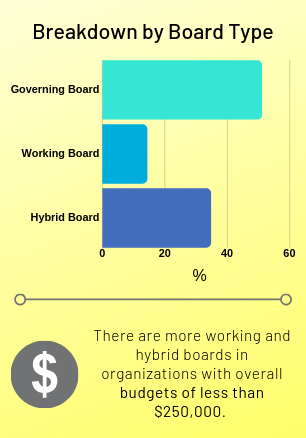
As with 2015, most responding museums had boards with between 10-20 members. However, in 2015 28% of museums reported having more than 20 board members, which is down this year to only 20%. The number of museums reporting small boards (fewer than 10 members) rose from 4% to 16%. Boards which have term limits remained proportionally similar: 67% reported having term limits this year, and 70% reported the same in 2015. Just over half (51%) of these boards are governing boards (focused on policy and oversight), 14% are working boards (managing operations), and the remainder (35%) claiming to be a hybrid of the two. When broken down further, the results are as expected; there are more working or hybrid boards among museums with annual budgets of under $250,000, and most of those organizations are history-oriented (91%). Organizations with higher budgets have more governing boards and represent more of the art, science, and children’s museums in the respondent pool. A few commented that they are newer organizations transitioning from working to governing, and others that they were governing except in the realm of fundraising, where they take a more active role.
The ongoing work of boards, either governing or working ones, largely takes shape in the form of standing and ad hoc committees, as well as in short-term task forces. A standing committee is one required to exist because it is written into an organization’s by-laws; all other committees are ad hoc or ‘temporary’ committees, even if they continue on a regular basis. Usually short project-based committees are termed task forces, although some respondents to our survey indicated that they use ‘ad hoc committee’ and ‘task force’ as interchangeable terms.
The most popular standing committees in our recent survey are finance (81%) and executive (77%), with collections and acquisitions (67%), nominating (65%), and development/fundraising (60%) rounding out the top five. Just over half the 2019 respondents had buildings and grounds committees, and roughly a third of respondents had programming (33%) or governance/ethics committees (29%). This number is significantly lower than in the 2015 survey, in which 43% of respondents had an ethics committee as part of their board makeup. Marketing and membership were the two standing committees most frequently included in the list of other committees.
Among ad hoc or temporary committees, the most common were nominating (29%), development/fundraising (24%), and audit (12%), although strategic planning and executive search were also frequent responses. There was a lot of overlap with the topics for task forces, though one respondent noted helpfully that they differentiate task forces from committees because task forces are designed to “handle items that combine interests of multiple committees. For example, a facilities issue that also impacts the historic house would be handled by a task force made up of some members from each of those committees.” In general, the use of task forces went down between the 2015 and 2019 surveys.
There is good news in the fact that more of our respondents reported their boards were participating in a number of generally accepted best practices. In 2015, 26% of respondents said they used a consent agenda with their boards to help make meetings more efficient; in 2019, 33% said so. 70% in 2019 said they reviewed their organization’s Form 990, and 67% review their investments annually. Providing new board orientation (63%) and engaging in strategic discussions at every meeting (61%) are also now majority practices, although it appears that fewer boards are now performing annual reviews for their executive directors (41%). This may be a reflection of the differing makeup of respondents from 2015, which had more large organizations responding and a wider range of disciplines. Other numbers haven’t changed: exactly as in 2015, only 11% of respondents said that their boards performed a self-assessment or that they go on an annual retreat.
The core documents which outline board responsibilities are also on an upwards trend. While the number of respondents reporting using a conflict of interest policy remains similar (74% in 2015, 71% in 2019), more museum boards are using board handbooks (up to 61% from 50% in 2015), and at least half have ethics and investment policies. Fewer museum boards say they are using a dashboard of reported organizational data (27% as compared to 37% in 2015), but nearly all (98%) say they have and refer to organizational bylaws. Other documents this year’s respondents mentioned included whistleblower policies and harassment policies, as well as others which are often contained in a board handbook, such as organizational charts, committee descriptions, and outlines of the responsibilities of board and staff.
This last one appears to be particularly important to have in written form, as 60% of the responding organizations said they do not explicitly cover the distinctions between staff and board responsibilities during orientation for new board members. (This number does not include the 18% of respondents who have no paid staff, such that the question is not applicable to them.) In addition, only 55% of respondents discuss conflicts of interest during the onboarding process. This is clearly an area with room for improvement. When asked to describe how their institutions define and separate the roles of board and staff, respondents said these things among others:
- “The only differentiation we make is the role of the Executive Director. Otherwise, we all interact and overlap.”
- “We are currently working this out.”
- “Staff roles outlined in bios and organizational chart. Implementing a one-pager on division of responsibilities as of 2020”
- “The Executive Director works to ensure that the roles are distinct. Some of the Board members understand the distinction.”
- “The board executive committee has not done this despite continual education provided by Executive Director.”
- “Defined job descriptions for everyone on staff and a description of the board. Roles are clearly defined, if not always followed.”
Others were more positive:
- “Board has fiscal oversight and hires the Executive Director. Operations is handled by the Museum. Committees provide recommendations, and when they overlap with operations there is usually strong staff involvement.”
- “Responsibilities are tasked to either staff or board in annual work plan”
- “My board largely understands director to manage staff and don't micromanage”
Board orientations seem to take many forms, with the most common being a combination of distributing relevant documents like the board handbook, recent meeting minutes, and other policies, conversation with one or more officers of the board, and often a tour of the museum or property, and sometimes meeting with key members of the staff. Several respondents mentioned formal or informal mentoring of new board members by current board members, and specifically mentioned the importance of a review of financial reports and processes. There were also a handful of respondents who said they hadn’t had a new board member in years, or that they don’t orient new board members. One noted “we need to be much more conscientious about this process.”
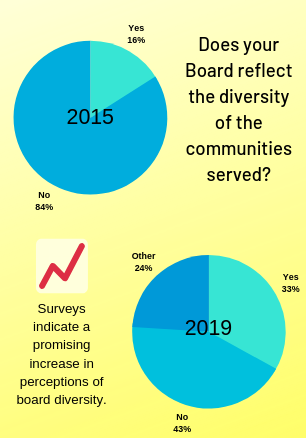
Diversity and representation on museum boards has been a hot topic of discussion for quite a while, and recent new projects, such as the grant initiative just launched by the Alliance of American Museums are aiming to make museum and similar non-profit boards more reflective of the communities they serve. When we asked our respondents if the makeup of their boards was proportionate to their communities, 33% said yes, 43% said no, and others elaborated, because it is not a simple question. Diversity and representation can mean gender or orientation, ability, race and ethnicity, life experience, or even geography (locals versus tourists), and some people aren’t willing to say ‘yes’ to a work in progress:
- “It needs to be more diverse. We have a significant Hispanic population and no one on the board represents this group.”
- “If by diversity you mean race, no, if you mean the different parts of the community - educator, business, geographic, philanthropic, finance, etc – yes”
- “We need more women on our Board”
- “Yes, though we are in one of the least diverse states in the union”
- “The board is all white and female at this point.”
- “Board skews male and higher income/donor level. We have work to do!”
- “Increasingly it does, although traditionally it has not.”
- “We have had little success attracting a diverse membership or board.”
- “We would like to expand who we serve. Mostly locals at present.”

Improvement can take many forms. While 29% of survey respondents in 2019 indicated they were satisfied with their boards’ performances, 63% were somewhat satisfied, and indicated that the most frequent areas for improvement needed were fundraising, helping the executive director network in the community, strategic thinking, and being engaged in not only the work of the board but the activities of the organization (showing up to events, participating in programs, etc). One particularly frustrated respondent even said, “They could start with having a more clear understanding of what we actually do and what the museum world is like.” Another voiced empathy with this disconnect between the staff who live the job, and the board who do not: “Our Board has voiced that members don't always know the best way to help more directly, beyond financial support. It's an ongoing conversation with individual members - their skills, interests, and time-availability fluctuate, as do the needs of the Museum at any given time. Meshing all those is tricky.”
Most respondents wished for time and training to help alleviate these frustrations; professional development with board buy-in topped the list, with time for retreats and networking coming a close second. Assistance from a third party, such as a consultant, was also frequently mentioned.
Even the respondents in difficult situations with their boards had positive things to say, however, about ways in which their boards can and do work well. There was a lot of praise for respectful, fruitful discussions, and board members who can work well enough together to support the decision of the majority once a vote has been taken. Others were given accolades for being:
- “Always available. Quick to respond. Supportive.”
- “Our Board is passionate about the intersection of history and education, and the Museum's role in sharing its resources with communities outside its own town. They are superb advocates.”
- “Genuine enthusiasm for the projects the organization is involved in.”
- “Taking the long view about investing our resources in projects and staff which may not have immediate return.”
- “They understand their role as governing and fundraising. They know the community of donors that support the museum. They care about the museum's financial health.”
Some issues tackled by board-staff teams remain evergreen; communities change, financial situations fluctuate, personalities clash as leadership changes on both sides of the organizational chart. However, there is progress to be seen in just the four years since NEMA’s last survey on this topic: organizations are taking steps towards greater inclusion, aligning their core documents with best practices, and recognizing where they need greater consciousness in their practices going forward.
