
Facilitating Digital Transformation for Museum Education in Response to COVID-19
By Melissa Houston, Director of Education, Keeler Tavern Museum & History Center
This is a lightly abridged version of Houston’s original white paper. The full text original may be downloaded here.
Museums traditionally have had physical sites or buildings in which they do most of their teaching through exhibits, field trips, and programming. However, museum educators have always brought learning into the classroom through “traveling trunks”, object studies, and outreach programs. During the spring of 2020, museums had to quickly shift to bring the learning to classrooms through digital tools given the quarantine put in place by COVID-19 which restricted museum visitations and shut down schools.
Education departments in small museums have not had the expertise nor funding to make the transition to digital tools though instructional technologies have been widely available for the past decade. Given the changing landscape of education in the wake of COVID-19 school closures and mandated social distancing, museums must turn to digital tools to fulfill their educational mission. In order to create a sustainable digital content strategy, museums’ need to consider four areas of change:
- Institutional goals and budget reallocations
- Educational department’s program development process
- Individual educator’s digital literacy
- Program and technology integration
This change needs to happen quickly so museums can continue to offer meaningful content to area schools during closures or mandated social distancing. There is the potential for an increased audience for digital programs given that, “Access to subject-matter experts is no longer dependent upon geographic locale.”[1] Digital literacy is a challenge at many museums, but a digital transformation is imperative to help these institutions increase program attendance and remain relevant to their communities.
(Key Vocabulary for Museum Education Digital Transformation)
Background on Digital Learning in Museums
In research conducted by Herminia Din[2] concerning the pedagogy and practice of online learning in museums, four large observations became clear:
- Technology offered the opportunity to deliver more integrated learning experiences and could enhance onsite visitors’ participation
- Technology provided a powerful context for multi-faceted learning but opportunities for miscommunication and misalignment of goals also emerged
- Working with new technologies could mean risking the technology malfunctioning or even ceasing to function entirely during a program
- Transforming a grant-based project into a sustainable program required additional institutional strategic planning
In the past decade, museums have used a variety of instructional technologies, from videoconferencing to virtual reality, to engage visitors in digital learning. It has increased the museum’s reach, developed more informed audiences, and created a diversity of platforms for participation. Interactions through digital platforms have included blog posts, wiki documents, presentations, social media interactions, and video chats. With the seemingly endless number of ways to use technologies, small museums are often delayed in adopting or adapting technologies due to lack of technology literacy within the staff. This is evident in the fear of technology breaking or in potential for miscommunications to occur in virtual interactions and the lack of funding to maintain the programs, especially if the technology was made available through a grant. However, digital learning is here to stay, and museums need to harness instructional technologies to keep their education departments relevant. “As technology allows both museums and their visitors to experience collections in new and different ways, museums must be leaders in developing new approaches to these interactions, and see these opportunities as a means to evolve from teaching institutions to learning institutions.”[3]
Studies completed by the Center for Interactive Learning and Collaboration (CILC) have shown that Interactive Virtual Learning experiences have a strong connection to historical sites and history museums.[4] During the COVID-19 quarantine, New-York Historical Society maintained a robust online learning program with not only live virtual lessons for school-aged children but also printable resources, programs for adults, lessons to build digital literacy and digital citizenship.[5] These offerings address the different ways and opportunities that teachers have for presenting information to their students digitally. Digital files for download are static but evergreen, pre-recorded lectures or lessons allow for asynchronous learning, and live teaching offers students a chance for interaction in a responsive online classroom setting. “Interactive Virtual Learning (IVL) programs are intended to link the virtual visitors with museum content as well as offer insight and personalization to meet the specific needs of those participating.”[6] While static lessons such as PDFs may be quick to develop and available for asynchronous use, they provide less of a personal connection and do not allow for customization or flexibility for individual classes.
Elementary schools are the core academic level that make use of IVL programs offered through CLIC.[7] The report data presented to the right is from January through March 2020 so it reflects the first month of quarantine as well as a period of regular classroom learning. There are a variety of ways to share content that is created including through the museum’s website or digital newsletter, press releases, social media, and listings such as the Center for Interactive Learning and Collaboration.
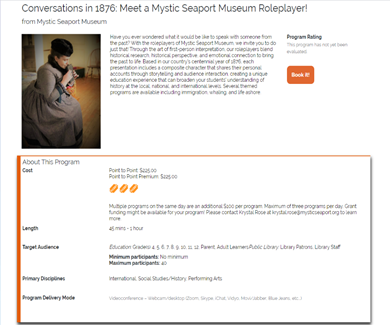
Programs on this site include a brief write-up of the program, technology requirements, suggested grade levels and primary disciplines as well as the State and National Standards that the program meets.[8] Program details fully explain the format of the program, learning objectives, and include links to the museum’s website for further information on standard alignments. This type of fully developed IVL program shows how museum education programs can be built when a museum’s digital transformation happens at the institutional level, the departmental level, the individual educator level, and the programmatic level. These four tiers in the museum all need to shift to a digital mindset to support comprehensive digital, online, and interactive learning experiences.
Facilitating Digital Transformation for Museum Education
The digital transformation of an institution is an involved process that starts with changing the mindset of the institution and staff, then moves to creating goals and benchmarks for the institution, before turning to concrete actions. The focus of this paper is to broaden the understanding of the changes in mindset and process of program development that need to occur for museums to respond quickly and effectively to school needs for digital programs during the COVID-19 pandemic.
Institutional Transformation
COVID-19 and its related quarantine has made it clear that museums must improve their digital competencies in order to meet the needs of schools, teachers, and students during this time and beyond. “The first imperative to advance digital transformation is to provide both strong senior leadership and inspire and support staff engagement with digital technology. It is essential that an institution-wide digital strategy be woven into the fabric of the entire organization.”[9] In order to have a systematic shift in the organization, it must come from the Director’s office and the senior leadership should not only support the change but participate in it. To have a “digital first” mindset in the organization, the leadership can look to seven areas to create goals for change:
- Accessibility – All audiences should be considered as content is developed and stories are shared.
- Capacity – Building the institution’s capacity ensures that the digital transformation happens and that it continues. This includes investing in staff resources and skills to make the institution more agile and innovative. Budget allocations need to be designated to support digital efforts.
- Collaboration – By including all departments in the digital transformation it facilitates a culture shift, or mindset, for the institution that strengthens digital program development.
- Creation – Museums have a history of creating learning experiences, including onsite exhibits or programs, and the transition to digital builds on that knowledge and skill set.
- Data – Staff should include data collection in their work from membership numbers to teacher surveys. This enables the institution to see how data points interact and how departments can work collectively.
- Infrastructure – With the expansion of digital assets, a clear infrastructure needs to be developed and maintained. A strategy for storing and backing up content should be included in a disaster plan.
- Preservation – A digital preservation policy and plan should be developed to ensure documentation.
In addition to creating benchmarks in these seven areas, all digital efforts need to support the institution’s mission and brand. “Ambitious museums must strike a balance between innovative and/or experimental projects, and an unflinching dedication to mission-focused work that might not provide opportunities for change but serve as grounding element for staff and patrons.”[10] While museums are currently seeking to respond to schools’ needs for digital content, it is equally important to lay a strong foundation through clear internal goals and processes, as well as a focus on the content and aptitudes that exist at the museum. These benchmarks and digital initiatives need to be supported by an institutional commitment of budget funding, regardless of whether the program received initial funding through a grant line, in order to be sustainable.
Departmental Transformation
Once there is an institutional commitment, and a budget is allocated for digital projects within the education department, there are steps to take at the departmental level to ensure that digital transformation occurs.
Content Strategy
Organizing the institutions content strengths and digital assets into a content strategy helps create a clear path for program development. “Simply put, ‘the goal of content strategy is to create meaningful, cohesive, engaging, and sustainable content’.”[11] All of the programs developed, for digital or onsite delivery, should be thematically consistent with the museums mission and Interpretive Plan, and based on the content that can be harvested from the museum’s collection. If done well, these digital stories can create evergreen content – content that remains useful after its initial purpose and will remain a digital asset after the program is complete. By using core stories and collections, the content can be easily migrated across platforms as technologies change.
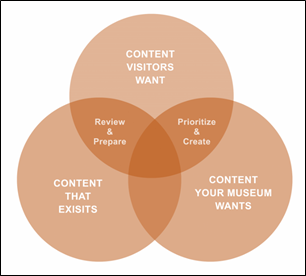
There are innumerable objects in a museum’s collection that cannot be used in onsite programming or outreach. These objects, and their stories, can be told through digital media or technology to expand the museum’s program offerings as well as its research. However, all content strategies must have a goal for the content that is created. “There is a necessary and contingent relationship between mission and goals… A clear mission should dictate a limited set of goals. Each goal should be aligned with just a few strategies, but then any number of tactics can be employed to accomplish each strategy.”[12] It is the role of the education department staff to work on the departmental goals set by the mission while taking into consideration requests from schools, curriculum guidelines, and digital tactics or tools that best fit the content. A review of the recommended instructional technologies should happen at regular intervals so that the Department stays on top of developments in the education field just as a review of recent acquisitions to the collection can help inform changes in the museum’s content.
Audience Data
To avoid the common mistakes of not listening to visitors and not balancing the audience’s needs with your institution’s needs, it is helpful to lean on routinely gathered information. Education departments should adopt a data-driven focus by surveying teachers, students, and staff about programs that are offered. During this pandemic, it is very important to understand the digital literacy of the local school districts so the programs museums build can be readily used. “We must think locally and create versions of DH (digital humanities) that make sense not at some ideal universal level but at specific schools, in specific curricula, and with specific institutional partners.”[13] Surveying commonly used instructional technologies and conversing with classroom teachers, who have previously used your museum for onsite field trips, will help narrow the options for digital delivery of your institution’s content. All programs should be designed for simplicity of use, to be engaging and relevant to your audiences, and broadly accessible.
Educator Transformation
For a museum to be able to offer online or virtual learning opportunities, it needs to have committed education staff trained in the instructional technologies that the museum has committed to using. For the staff to work effectively with digital integration in their programs the museum needs a combination of:
- Educators establishing effective attitudes toward digital options
- Educators recognizing how to match education goals to available digital tools
- Educators working with technologists to advance the tools used to serve audiences even more effectively[14]
Becoming more digitally literate at the personnel level is essential for museums who are offering digital learning. Museum educators need to keep pace with their local schools, teachers, and students to be able to reach those audiences. “We need students and colleagues who are adept and thoughtful about tools, platforms, and media of our day”[15] to make digital programs successful. Professional development for those who are going to use instructional technologies and those who are developing digital programs builds the institutional capacity.

Staff members hired into the Education Department should be hired with the expectation that they will be trained on the instructional technologies that the institution has adapted. Not all digital tools will work for every museum and a survey of the programs, as well as technology the museum will use, should be done to ensure the sustainability of the programs developed. “Creating well-designed system-application-workflow diagrams is a critical first step to bringing staff along. An audit of hardware, software, information systems, processes, workflows, digital assets and staffing are all important to understanding and improving your museum.”[16] By clearly informing the staff of the instructional technologies they will be using and maintaining a workflow system with the programs and technologies, the education staff can confidently fulfill their role.
Program Transformation
Technology used in the education programs of a museum should be fully integrated and not simply superimposed on existing programs. When assessing the potential digital platforms or instructional technologies for a program, the purpose of its integration should be clear. The SARM chart[17] below outlines how technology can be used in educational settings at varying levels:
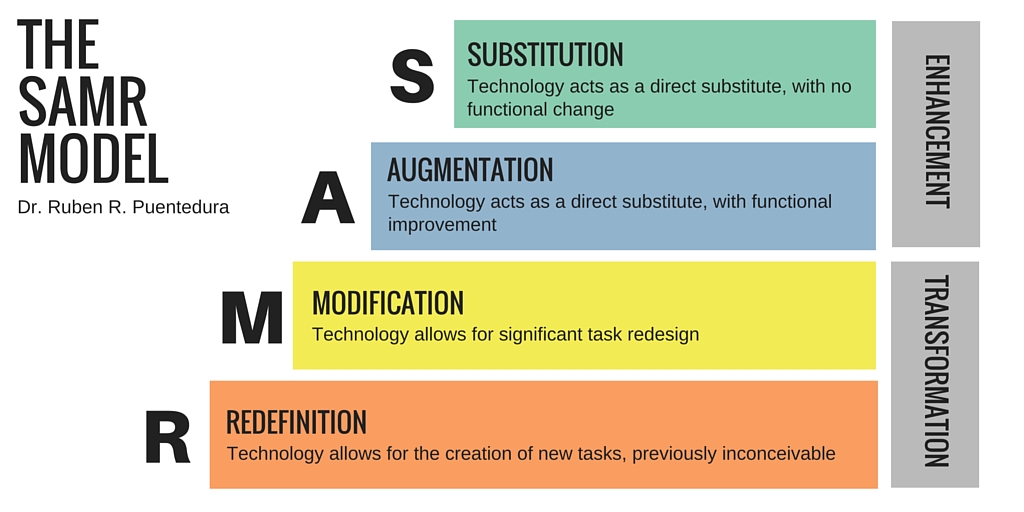
The example given earlier of making PDFs of worksheets previously used in onsite programs available to teachers, would be considered “substitution”, or the first level of integration. Instead of providing the printed materials, the museum provides digital files that teachers can distribute to their students either in the classroom or through platforms such as Google Classroom. This type of technology integration simply enhances the educational offering. Migrating a previously hands-on activity, where students can handle objects to create their own miniature exhibit, to an interactive Google Slides project would fall in modification – it is using technology to transform the learning experience.
Existing content or programs may work well with digital tools, they may need to be completely redesigned, or they may not have the ability to migrate to digital platforms. Using the content strategy developed by the education department, program development should start with reviewing and preparing any existing content that is being requested by teachers. Then, if there is content that fits the benchmarks and mission laid out by the institution, and there is an audience that is seeking it, all additional program ideas should be first prioritized and then created.
Institutions would do well to first focus on foundational content or the content that is expected of your museum. This will satisfy current audiences and build on the well-known stories from your collection so the focus can be on finding the right instructional technologies for your institution. Once these content areas are addressed, the development of new content projects which take more effort and resources to develop, but have greater potential impact or measurability, can be undertaken.
Conclusion
To summarize, museum education departments need to look at the current change in operations, due to the response to COVID-19, as a time to take on a digital transformation. Without having the usual calendar of onsite programs, time constraints for capacity building have eased. In addition, due to social distancing mandates, schools are not anticipating an immediate return to onsite field trips and instead are turning to digital resources to enhance their classroom instruction. Museums can respond to this need, and grow their audiences, by developing institutional practices that shift to a digital mindset, defining education departmental goals using content strategies and audience data, and encouraging staff to build digital literacy. By focusing on internal changes and putting an emphasis on building digital strategies from the leadership down, museums can continue to be relevant learning sites in their communities.
Key Vocabulary for Museum Education Digital Transformation
Online learning = education that takes place over the Internet; a shift away from top-down lecturing and passive students to a more interactive, collaborative approach in which students and instructor co-create the learning procesas.
Digital Learning = any type of learning that is accompanied by technology or by instructional practice that makes effective use of technology. It includes blended learning, flipped learning, personalized learning, and other strategies that rely on digital tools to a small or large degree.
Interactive Virtual Learning (IVL) = synchronous distance learning programs that are facilitated by content experts, such as virtual museum educators.
IVL Program = live synchronous educational lessons facilitated by virtual museum educators who actively teach groups using the collection, interactive discussions, hands-on activities where possible, and technology.
Instructional Technology = process of using technology for instruction; describes the technologies that facilitates access to information of all types; evaluation, management, and integration of instruction with tools available.
Asynchronous learning = general term used to describe forms of education, instruction, and learning that do not occur in the same place or at the same time.
Synchronous learning = a learning event in which a group of students all engage in learning at the same time.
References
Center for Interactive Learning and Collaboration. (2020). CILC Program Quarterly Statistics: January through March, 2020. N. Mankato, MN.
Cordell, R. (2016) How Not to Teach Digital Humanities, Debates in the Digital Humanities 2016. University of Minnesota Press. http://www.jstor.com/stable/10.5749/j.cttcn6thb.39
Din, H. (2015) Pedagogy and Practice in Museum Online Learning, Journal of Museum Education, 40:2, 102-109, DOI: 10.1179/1059865015Z.00000000086
Gaylord-Opalewski, K. & O’Leary, L. (2019) Defining Interactive Virtual Learning in Museum Education: A Shared Perspective, Journal of Museum Education, 44:3, 229-241, DOI: 10.1080/10598650.2019.1621634
Holter, Eric. (2018, January 12) Sustaining the heartbeat of your museum’s content strategy. MW18: Museums and the Web 2018. https://mw18.mwconf.org/paper/sustaining-the-heartbeat-of-your-museums-content-strategy/
Kraybill, A., Fredrick, D. & Peterson, K. (2015, February 23) "Beyond the virtual field trip: The online museum classroom." MW2015: Museums and the Web 2015. https://mw2015.museumsandtheweb.com/paper/beyond-the-virtual-field-trip-the-online-museum-classroom/
Ludden, J. & Russick, J. (2020, January 21) Digital Transformation: It’s a Process and You Can Start Now. MW20: Museums and the Web 2020. https://mw20.museweb.net/paper/digital-transformation-its-a-process-and-you-can-start-now/
Spero, S. B. (2011) Museum Educators and Technology: Expanding Our Reach and Practice, The Journal of Museums Education, 36:3, 233-228.
Terada, Y. (2020, May 04). A Powerful Model for Understanding Good Tech Integration. Edutopia. https://www.edutopia.org/article/powerful-model-understanding-good-tech-integration
[1] Kraybill, A., Fredrick, D. & Peterson, K. (2015, February 23) "Beyond the virtual field trip: The online museum classroom." MW2015: Museums and the Web 2015. https://mw2015.museumsandtheweb.com/paper/beyond-the-virtual-field-trip-the-online-museum-classroom/
[2] Din, H. (2015) Pedagogy and Practice in Museum Online Learning, Journal of Museum Education, 40:2, 102-109, DOI: 10.1179/1059865015Z.00000000086
[3] Din, 107.
[4] Center for Interactive Learning and Collaboration. (2020). CILC Program Quarterly Statistics: January through March, 2020.
[5] Visit for more information: https://www.nyhistory.org/education/history-home
[6] Gaylord, 233.
[7] Center for Interactive Learning and Collaboration. (2020). CILC Program Quarterly Statistics: January through March, 2020.
[8] For complete program information visit: https://www.cilc.org/ContentProvider/Program.aspx?id=7371. For more information on Mystic Seaport Museum’s education programs visit: https://www.mysticseaport.org/learn/.
[9] Ludden, J. & Russick, J. (2020, January 21) Digital Transformation: It’s a Process and You Can Start Now. MW20: Museums and the Web 2020. https://mw20.museweb.net/paper/digital-transformation-its-a-process-and-you-can-start-now/
[10] Ibid.
[11] Holter, E. (2018, January 12) Sustaining the Heartbeat of Your Museum’s Content Strategy. MW18: Museums and the Web 2018. https://mw18.mwconf.org/paper/sustaining-the-heartbeat-of-your-museums-content-strategy/
[12] Ibid.
[13] Cordell, 471.
[14] Spero, S. B. (2011) Museum Educators and Technology: Expanding Our Reach and Practice, The Journal of Museums Education, 36:3, p 226.
[15] Cordell, R. (2016) How Not to Teach Digital Humanities, Debates in the Digital Humanities 2016. University of Minnesota Press. http://www.jstor.com/stable/10.5749/j.cttcn6thb.39
[16] Ludden, J. & Russick, J. (2020, January 21) Digital Transformation: It’s a Process and You Can Start Now. MW20: Museums and the Web 2020. https://mw20.museweb.net/paper/digital-transformation-its-a-process-and-you-can-start-now/
[17] Terada, Y. (May 4, 2020) A Powerful Model for Understanding Good Tech Integration. Edutopia. https://www.edutopia.org/article/powerful-model-understanding-good-tech-integration