
Meet your museum colleagues from sites around New England! It is often too easy for colleagues to feel isolated in their own institutions (especially during the pandemic!)—we hope this feature will help close the gap. We also hope that it reinforces your own joy in your work and encourages you to recognize your own positive impacts.
Interview Q&A with Susan Kaplan, Professor of Anthropology, Director of Peary-MacMillan Arctic Museum and Arctic Studies Center, Bowdoin College. Bowdoin’s Peary-MacMillan Arctic Museum is dedicated entirely to all things Arctic. The college is built on Wabanki land in Brunswick, Maine. The museum is named after Arctic explorers and Bowdoin graduates Robert E. Peary (Class of 1877) and Donald B. MacMillan (Class of 1898). Learn more about Kaplan's career and the great work being done at the Peary-MacMillan Arctic Museum and Arctic Studies Center at Bowdoin College.
How did you get into the field, and what was your path to where you are now?
I attended Lake Forest College, pursuing my interests in art, art history, and anthropology in a totally disorganized fashion. My senior year I stumbled into an opportunity to work for John Terrell, a curator at the Field Museum of Natural History, where I analyzed ceramic sherds he had excavated in Melanesia. Under his mentorship, I published a paper on my work and discovered that I enjoyed analyzing material culture and piecing together unwritten histories of the past.
I received my MA and PhD from Bryn Mawr College where I trained as an anthropological archaeologist with a specialty in the Arctic. I studied how the Inuit of Labrador (now Nunatsiavut, Newfoundland-Labrador, Canada) adapted to environmental change and contact with western cultures. I was awarded a predoctoral fellowship at the Smithsonian’s National Museum of Natural History (NMNH). While there, I continued doing archaeological research, studied as many museum collections as I could, and spent my lunch hours watching how visitors navigated through exhibits.
Near the end of my fellowship year I was invited with William Fitzhugh, a NMNH curator, to co-curate a major exhibit using a significant collection I had been studying. This was my introduction to the value of exhibits and public outreach initiatives. Also, I visited Alaskan communities whose material culture was represented in the exhibit and was struck that museums have responsibilities to connect with such communities.
After the exhibit opened and I completed my dissertation, I accepted a position as a visiting curator at the University of Pennsylvania Museum of Archaeology and Anthropology. Then Bowdoin College advertised a position for an individual to run their museum and teach anthropology and archaeology. The position seemed ideal, for I could pursue my research, teaching, and public education interests while also strengthening the museum and expanding its programs.
Is there an object in the collection that inspired you or made you think differently about how you approached your work?
One day we received a call from someone who was dispersing the contents of a family’s home, asking whether we might be interested in two garments made out of a tissue paper-like material. We immediately knew she was referring to gutskin garments, waterproof jackets fashioned from seal and walrus intestines by Inuit and Aleut women. We were very excited and arranged to visit the ancestral home.
We were taken to an unheated barn where the garments had hung for decades. Fashioned by Iñupiat women from seal intestine, sinew, feathers, and silk, they were as brittle as potato chips, but were otherwise in amazingly good condition. We got permission to go through the house looking for clues to the family’s links to the Arctic. We discovered that in the 1860s a family member had been the captain of a whaling ship working off the Alaska coast. We surmised that he must have traded for the Alaskan garments while in the region.

The museum has been able to use the gutskin garments to tell stories about historic economic links between Maine and Alaska, the changing ecology of northern oceans, and the nature of colonial encounters. In addition, this stunning and technologically sophisticated clothing has provided us the opportunity to feature the knowledge, skills, creativity, and ingenuity of Iñupiat seamstresses, too often neglected in written histories of the region. This is just one example of the importance of doing research on the provenience and life history of an object; one can contextualize the piece and tell interesting stories with the information.
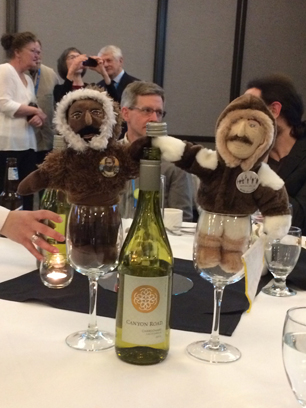
The “Where in the World are They” campaign features arctic explorer Matthew Henson and Robert Peary dolls photographed at sites around the world. How did his start?
We developed the plush Peary doll in anticipation of the hundredth anniversary of Robert E. Peary’s discovery of the North Pole, and since he was an explorer, it was clear that he needed to go out into the world and do what explorers do! Even before we announced the “Where in the World” site, someone who was given one of the first Peary dolls as a gift sent us a photograph of plush Peary next to penguins in Antarctica! Matthew Henson accompanied Peary on most of his Arctic expeditions, so a few years after creating plush Peary we introduced the plush Henson doll. These two fellows appear in interesting places throughout the world and bring joy and fun wherever they go.
During this global pandemic with museum staff in isolation, how as a leader have you engaged and motivated your staff?
Initially we all worked from home. In addition to using email and video conference calls, we set up a site in which we could easily communicate with one another. Every morning I greet the staff on that site, with positive and sometimes amusing observations as we begin our work day. We have video conference staff meetings every week where people report on their progress on various projects and brainstorm about others. All the work people are doing that is being posted online is reviewed by at least two other staff members, which has encouraged regular interaction amongst groups of people.
I have encouraged the staff to step out of their comfort zones and try new things, like transcribing explorers’ journals as we put more museum resources online. Also, I have encouraged them to use their creativity and to have some fun in order to engage quarantined people and provide them interesting things to read, look at, or do. We have hosted a virtual pop-up museum with contributions from the public, a series of fun and educational social distancing posters featuring plush Peary and Henson, discussions about Inuit music and film, word searches, behind-the-scenes stories, and numerous virtual exhibits, all evidence that the museum is blessed with a creative and hardworking staff.
The museum collection has grown over the decades to include more Alaskan and Canadian contemporary Inuit art. Can you expand on the impact these additions have on the founding collection?
The museum’s founding collection of ethnographic objects, exploration equipment, photographs, films, and journals is wonderful, but reflects the Arctic of the nineteenth and early to mid-twentieth century, and the interests and perspectives of outsiders visiting the region. We believe it is our responsibility to teach that colonial history, but also to inform people about contemporary challenges and opportunities facing the Arctic and its people. Exhibiting Alaskan and Canadian contemporary art provides visitors insights into Inuit perspectives on climate change, environmental and social justice, enduring cultural traditions, and exciting innovations. Also, we use the works to discuss some of the global political, social, and environmental issues affecting the region and have invited Inuit to Bowdoin to see the collections and interact with the community.
Your site is involved with communities beyond Bowdoin. Are there any collaborative projects ongoing? Any lessons learned that you want to share?
Donald MacMillan and his wife, Miriam Look MacMillan, gave the museum over 100 embroideries created by people in Labrador. Each is a visual ethnography of life on coastal Labrador in the early and mid-1900s. Unfortunately, the MacMillan’s did not leave records of how or where they acquired the pieces, or the names of the artists.
In 2014, I showed people in the community of Nain, Labrador, photographs of some of the embroideries and because of their excitement, a community-based project was born. Two years ago three staff members visited Nain and in open houses showed people excellent photographs of the textiles. We were told, in no uncertain terms, that the photographs would not do. People wanted to examine the actual pieces. We consulted with Camille Breeze, a textile conservator, and last spring hand carried two dozen embroideries to four communities in Nunatsiavut.
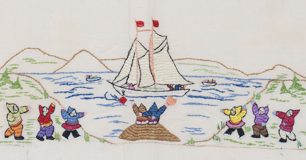
When studying the embroideries, the museum staff focused on the activities in which the tiny human figures were engaged and thought of the landscapes and icescapes as incidental artistic backdrops. So, we were ready for robust discussions about the activities depicted. To our surprise, all the open houses started –and were dominated by– discussions about exactly what area or community on the coast was represented in a particular textile. People identified specific mountains in the embroideries, and pointed out buildings that stood or once stood in certain communities, even naming who lived in which house. They discussed coastal features and vegetation characteristics in considerable detail as they tried to determine what exact place was represented in each embroidery. In retrospect, their focus makes sense, for this ecologically complex coast, where knowledge of place is critical, is their home. We learned to step back and let the community drive the discussions, and to adapt to whatever pace and trajectory they set. We hope to continue this project once we can again travel across the border and safely meet with people.
Is there a piece of advice that you would give to someone new in the museum field?
I encourage people new to the museum field to look for opportunities in the challenges they and their institutions face. Continuing to acquire new and diverse skills is important, because in many museums staff members have to wear a number of different hats. However, being open to new perspectives and being willing to imagine new possibilities for yourself and your institution when faced with a crisis are essential skills.
A few months ago, the pandemic forced all of us to find new ways of operating and delivering programs. Now museums have a lot of soul searching to do in light of the BLM and BIPOC movements. Staff members who are willing to have difficult conversations about the ways racism operates in the museum world, and who have the capacity to reimagine their jobs and modes of operation, will help museums undertake the transformative journeys necessary given the fraught and complex time in which we find ourselves.