
Out of Office but In Session: The Museum School at the Springfield Museums goes Virtual
By Paige Moreau, Courses Coordinator, Springfield Museums
On an average day at the Springfield Museums, my job is largely hands-on; dashing between five buildings, setting up for classes, greeting students and instructors, and facilitating bus trips. I work in our Museum School, a two-person team and subsection of the education department, where we plan and execute over 100 studio classes, a dozen bus trips and a handful of international excursions a year. Working from home seemed like an impossibility in early March as many of my duties are forward facing and customer service based. Yet here I am, three months later, working from my personal computer at home, planning a hybrid schedule of in person and online classes for our fall semester.
Since March, my colleague Jeanne Fontaine and I have completely reimagined the structure and mission of our department. The Museum School generally functions on a model of active participation and discovery through travel and experience. While we quickly realized that holding in person classes and taking busses of 40 people around New England during a pandemic would be impossible, we wanted to keep our focus on the pillars of participation and discovery that have made us strong. How do you bolster student participation when you can’t be in the presence of students? Enter Zoom. If everyone from graduate students to second graders were transitioning to online learning in a matter of days why couldn’t we?
Almost immediately, our creative writing instructor Theresa Chamberland was rallying her dedicated students to join her in online sessions. After quickly canceling our studio classes through the end of March, we just as rapidly began moving classes online and started riding the momentum of our already successful transition with the creative writing course. Reaching out to our instructors was the first step in gauging the plausibility of a remote Museum School. While some of our teachers were reluctant to give Zoom teaching a try at first, for fear of insufficient equipment and the awkwardness of video calls, many of our instructors were thrilled when we reached out and began planning content tailored to remote learning.
With the doors of museums shuttered and programming across the arts getting suspended day after day we anticipated that people of all ages and varied interests were going to need a creative outlet and some mental stimulation. And they did. Since beginning our online course offerings we have sustained interest from our usual students and attracted new students from across Massachusetts, New England, and even the country. This success can be attributed to the breadth of our offerings, from kids STEM programming to oil painting in the style of the Impressionists for adults.

Online classes at the Springfield Museums.
From the middle of March through the middle of June we have run 21 online courses, 10 of which were converted from classes originally intended to meet in our studios and 11 of which were designed in the midst of the pandemic for remote learning. The new, made for online, classes have been a mixture of our usual studio course topics as well as content we may not have considered under normal circumstances that take full advantage of using computers and the internet as primary resources. We have continually tried to view this time of uncertainty and change as an opportunity to get creative. In doing so, we have introduced coding classes for all levels, digital art workshops, genealogy classes using online databases, and many more opportunities still in the works.
Although the Museum School at the Springfield Museums was one of the first museums in the area to begin offering online classes after the outbreak we certainly haven’t been the only one. Noelle Fournier, Director of the Danforth Art School at Framingham State University has also been using this time to think creatively about programming. Like many, Noelle cites frustrations with the now ubiquitous frustrations of communicating with coworkers remotely and the roadblocks that come with working from home, and yet the Danforth Art Museum successfully held spring classes for all ages online and converted their youth Summer Arts Program and 8 week adult summer sessions to online courses. The Fitchburg Art Museum is also looking to offer online youth classes in the coming months, Laura Howick reports. Additionally, the Worcester Art Museum has been keeping their constituents busy with a range of art and art history classes offered online.
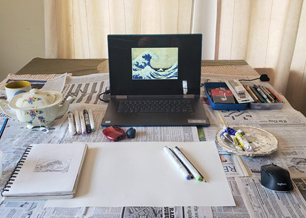
Online art class offered by the Danforth Art Museum.
With the expansion of our online offerings we are thinking about the overall growth of our department and how to set ourselves apart from other offerings. We will continue to tap into our unique resources including our status as the only Dr. Seuss museum in the country and our popular HomeSchool programming while working to broaden our reach via collaborations with other organizations. We have successfully worked with our local JCC and Council on Aging but are also interested in developing partnerships with other museums and cultural institutions around the country. These partnerships have the potential to provide mutually beneficial opportunities that combine online learning experiences with membership benefits. In growing our Museum School we will continually be looking to add to and diversify our talented pool of instructors and will remain open to the changing needs of our constituents.
As we look toward the future and the “new normal” of the next year or so, we anticipate online classes becoming part of the Springfield Museum’s regular repertoire. As uncertainty concerning a second wave of infections mounts we plan to buffer our studio offerings with online alternatives and hybrid courses to ensure that we are prepared for any scenario and that all of our students feel safe and comfortable. Positive student feedback and packed rosters for our coding classes, digital art classes, and beyond signal to us that beyond the threat of COVID-19 there will continue to be a need for these online programs at our museum. Further in the future, in a post COVID-19 world, continuing to offer online classes can only serve to strengthen our Museum School and attract new students with no limits to geography. Our museums and instructors have so much to offer and by moving online our resources can now be shared with the world, something we wouldn’t have discovered had we not been pushed out of our comfort zone.