
Many of our NEMA museum members have reopened or are in the process of reopening to the public. While many things have changed since March, our love for museums have not. Just make sure to wear your mask and wash your hands!

Costumed historian at Old Sturbridge Village.
Connecticut
Connecticut Historical Society was awarded $238,604 from the IMLS Museums for America program. The Connecticut Historical Society will inventory, rehouse, catalog, and digitize the Connecticut Cultural Heritage Arts Program CCHAP collection which documents the cultural traditions and heritage within the rich diversity of Connecticut's ethnic and workplace communities. The project will improve all aspects of the care, condition, management, access to, and use of the CCHAP archive. Museum staff will work with a project archivist and data technician to rehouse objects in the collection and create comprehensive object files and digital catalog records. Video and audio components will be digitized to preserve that collected material. New object files will be created including high resolution photos. The project will result in better management of the objects by staff and improved public access to these digital records through the Connecticut Digital Archive (CTDA).
Greenwich Historical Society (GHS) was awarded $173,590 from the IMLS Museums for America program. The funds go to increase public access to and knowledge of Greenwich history through ongoing stewardship of its archival collections. This project will support a new project archivist to process and create detailed online finding aids for 49 archival collections and a digitization specialist to digitize and describe 22,200 images and publish them online in the Connecticut Digital Archives (CTDA). Recently processed collections will be rehoused in new archival enclosures, improving the long-term preservation and stability of the collection. The completion of this project will make the collections widely accessible through the web sites of GHS and CTDA. Exhibition planning and educational programs will benefit from the discovery and exploration of collections long obscured by a lack of finding aids.
The Gunn Historical Museum has been recognized with three prestigious awards for their exhibit, Washington Connecticut – An American Story. This innovative work designed by SandorMax, and made possible by a grant from the Connecticut Department of Economic and Community Development, was created by museum staff and volunteers and shares the story of the unique people, places, and events that have shaped Washington’s rich history.
- The American Association for State and Local History: 2020 Award of Excellence
- The Connecticut League of History Organizations: 2020 Award of Merit
- Graphic Design USA: 2019 American Graphic Design Award
The Darien Historical Society is dusting off its image with some exciting initiatives and topping the list is a new name – the Museum of Darien (MoD). The society is introducing a fresh new logo and website, which can be viewed at www.museumofdarien.org. And while the museum's facility at 45 Old Kings Highway North is currently closed, volunteers will be reaching out to the community and giving local businesses a boost with special visits throughout town of the Whaleboat Middlesex, a 24-foot boat replica built in the 1970s that was recently refurbished thanks to a grant from The Darien Foundation.
The Bruce Museum is pleased to announce a significant new gift of minerals from the renowned private collection of Robert R. Wiener. The recent donation follows the gift of nearly 100 world-class minerals Wiener pledged to the museum in 2018 and includes a number of exceptional – and exceptionally large – museum-quality specimens.
Housatonic Museum of Art, Housatonic Community College was awarded $9,399 from the IMLS Inspire! Grants for Small Museums program. The funds go to support a collections stewardship project to increase storage space for current and future acquisitions and ensure proper care and preservation of its collections. Due to limited storage space, the museum will install new modular units in a reconfigured storage area for framed works on paper. They also will relocate artworks while the new units are installed. After inspecting and evaluating each piece, staff will develop a condition report and enter it into a database that will reflect donation provenance, appraisal valuations, installation and exhibition histories, loans, and current locations.
The Webb-Deane-Stevens (WDS) Museum is nearing completion of its new, $6.5-million Education and Visitor Center that will bring exciting changes to Wethersfield, the largest historic district in the state. When the new Education and Visitor Center opens later this year, WDS will be able to offer year-round, hands-on programming for the public, school groups, and private-tour groups. The center will also add much-needed exhibition and public-meeting spaces, facilities for research, and full access to the new addition for people with disabilities. The expansion will also boost the museum’s already considerable economic impact on the surrounding community, benefitting area businesses and bolstering Wethersfield’s heritage tourism.
Lyman Allyn Art Museum was awarded $123,595 from the IMLS Museums for America program. The funds go to support inventorying and digitizing their permanent collection, which includes approximately 18,000 objects such as paintings, sculpture, works on paper, decorative arts and furniture, textiles, and toys. The project team will locate, identify, examine, photograph, and rehouse about 5,000 objects, creating new or more robust digital records in the museum's collections management database. The project will improve care and accountability for the museum's collections for staff and the public. Additionally, the initiative will upload object metadata and images to the Connecticut Digital Archives (CTDA) for long-term preservation and public access.
Mystic Seaport Museum is one of four museums in the country to be recognized with a 2020 Sustainability Excellence Award, presented by the American Alliance of Museums (AAM). First presented in 2014, the awards recognize sustainability efforts in facilities, programming, and exhibits in both large and small institutions. In the last five years, the award program has recognized 20 different museums for their efforts. Mystic Seaport Museum received a Special Award of Merit for its accomplishments in eliminating single-use plastic on its entire 19-acre site. The awards jury “was impressed by the institution’s comprehensive approach: the attention paid to inculcating behavior change; addressing cost challenges; data collection and analysis; and the detailed documentation of its process,” the award announcement stated.
Mystic Seaport Museum was also awarded $167,303 from the IMLS Museums for America program. The funds go to support restoring its 1921 fishing schooner-L.A. DUNTON-a National Historic Landmark vessel and one of the last surviving examples of its kind. The project will involve removal of the vessel's interior joinery, cataloging and storage of the joinery for future re-installation, and documentation of the entire process. The work will preserve the vessel's design and structural integrity and be performed by the museum's Preservation Shipyard with the support of two students from the International Yacht Restoration School who will join the project team for a 12-week internship. Progress will be captured on video for podcast and other forms of distance learning to further expand the project reach.
At the start of its COVID-19 lockdown on March 15, the Mystic Museum of Art reset its programming, to provide visual art, prompts for art practice, and continued contact with audiences online. MMoA has fostered a partnership with Mystic artists, and Hartford HealthCare HealthCenter to support healing through art in the new medical building at 100 Perkins Farm Drive. Selections from Photo Show 42 will adorn 17 walls behind the reception desks on all three floors to benefit medical professionals, staff, and patients. More than 70 photographs by Mystic artists was installed on June 27 and remain on display through August 29. A virtual tour of Photo Show 42 may be seen on MMoA’s website.
Stepping Stones Museum for Children was awarded $179,951 from the IMLS Museums for America program. The museum will complete pre-concept design phases of an immersive, three-dimensional storybook exhibition with digital elements that explores America and its people, places, and innovations that make it unique. The project, titled We (Heart) America!, is a multi-component exhibition that will serve as a statewide, regional, and national platform for youth to learn from history and catalyze a greater appreciation for and knowledge about civic engagement tools they can use to make positive changes in their community.
Maine
L.C. Bates Museum was awarded $16,913 from the IMLS Inspire! Grants for Small Museums program. The L.C. Bates Museum, a natural history museum on the rural campus of Good Will-Hinckley Homes, will conduct a collections stewardship project that will conserve and safeguard its historic taxidermy mounts, including 24 bird mounts and a blue fin tuna mount. The treatment of the mounts will comply with the American Institute for Conservation of Historic and Artistic Works Code of Ethics and Guidelines for Practice. The museum will conduct a collections care workshop in partnership with Maine Archives and Museum. They will create a tuna presentation and conservation exhibit, including visitor conservation activities, and develop related programming.
The Kennebec Historical Society has received a $2,000 Community Grant from the Maine Bicentennial Commission for projects that honor and celebrate Maine’s 200th anniversary as a state, according to a news release from Scott Wood, KHS administrative director. The society will use the money to extend honorary bicentennial memberships to the Maine Legislature, supplement the purchase of new software to replace the current membership and collection databases, and to augment the KHS schedule of lectures that celebrate Maine and its rich history. The society would be unable to pursue these projects if it were not funded in part by the grant from the bicentennial commission.
The Brick Store Museum looks forward to re-opening to the public on Wednesday, July 1, 2020. They are working within the guidelines provided by the state of Maine to ensure your safety and the safety of our staff and volunteers
The Penobscot Marine Museum has been granted a CARES Act Award from the National Endowment for the Humanities. This grant will allow them to continue to adapt and expand their educational programming during this challenging time.
Dorr Museum of Natural History, College of the Atlantic was awarded $96,449 from the IMLS Museums for America program. The funds go towards completing the George. B. Dorr Natural History Museum Collections Relocation project, which consists of developing a collections relocation plan, purchasing and installing collections storage systems, relocating the collections, and evaluating the project. The building that houses most of the collections will be torn down, presenting the opportunity to relocate the collections into state-of-the-art storage systems in dedicated storage rooms in the Center for Human Ecology, the college's new academic building. The project includes the purchase and installation of a movable high-density storage system, with museum-grade cabinets and shelves, as well as related archival collections storage supplies. The collections relocation project will support stewardship of the museum's valuable natural history specimens.
Massachusetts
Fitchburg Art Museum is leveraging our curatorial collection strengths in photography and African Art to create a new collection of 21st Century African Photography – photos by contemporary African artists of African people, places, and cultures across the African continent. This project is supported by an initial $25K grant from the Genevieve McMillan – Reba Stewart Foundation, and is being led by two distinguished scholars, FAM’s Consulting Curator for Photography Stephen Jareckie, and our Consulting Curator for African, Oceanic, and Native American Arts Jean Borgatti. This will culminate in a major exhibition projected for 2023 or 2024.
The Iris and B. Gerald Cantor Art Gallery at the College of the Holy Cross will soon relocate to the new Prior Arts Center on campus. The building is designed by the architectural firm of Diller Scofidio + Renfro (DS+R) – designers of the ICA, Boston, and the new MoMA expansion – and will, in addition to the Gallery, comprise a series of performance, rehearsal, and studio spaces. The Center will encourage an integrated approach to the arts, and will enrich the College’s academic offerings by attracting world-class artists and performers, and by providing space for inventiveness and interdisciplinary exploration. The building will open in the fall of 2022, and the move is being overseen by the Cantor’s new director, Meredith Fluke, who joined the staff in fall 2019. This year, the Cantor has also participated in the Museum Assessment Program through the AAM-IMLS to support collections stewardship assessment.
Harvard Museums of Science and Culture was awarded $156,910 from the IMLS Museums for America program. The funds go towards implementing a project to expand Hispanic engagement by collaborating with youth. The consortium will partner with youth-serving agencies in Chelsea and Somerville, neighboring cities that have large Hispanic populations. Museum staff will conduct community-based workshops and invite youth to apply for a museum-based program. During the museum-based studio sessions, teens will create audio and visual responses to exhibits. They will then host a public "opening" at the museum where they will share their experiences with their families and the community. This project will enhance the impact of exhibits; increase feelings of relevance and inclusion for Hispanic visitors; and expand knowledge about contemporary Hispanic viewpoints among museum visitors.
Old Sturbridge Village is happy to welcome back members (July 1-3) and the public (starting July 4). During reopening, the Village’s goals are to provide a safe environment for all staff and visitors, use the unique outdoor setting to expand stories of early New England life, and to deliver the engaging, educational experiences the museum is known for. Costumed historians will be interpreting throughout the Village. Many favorite programs have been adapted for viewing outside of the buildings, while new programming has been developed to feature additional outdoor activities at the households and trade shops – allowing even more stories to be told about life in the 1830s.
Peabody Museum of Archaeology and Ethnology, Harvard University was awarded $250,000 from the IMLS Museums for America program. The Peabody Museum of Archaeology and Ethnology will catalog and digitize the Marshall Family Archives, which document the Marshall's eight expeditions to the Northwest Kalahari region of Africa (1950-1961) and illuminate how the region's indigenous peoples lived before their extended contact with the "modern world." The archives will be accessible on the museum's website via Collections Online, for use by K-12 educators, anthropologists, scholars, and members of the general public who are looking for insights into the culture of traditional Kalahari communities. The museum will collaborate with the Museums of Namibia; !Khwa ttu Heritage Center; the University of Cape Town, South Africa; and the San Research Centre at the University of Botswana to disseminate the newly digitized material to the Kalahari San people.
Plimoth Plantation recently announced it is dropping "Plantation" from its name, to be replaced with a new name yet to be decided, a move it said has been underway for more than a year. For now, Plimoth Plantation, which is celebrating the 400th anniversary of the Pilgrims' arrival in America, is using "Plimoth Patuxet" as its identifying moniker. Patuxet is the name of the indigenous people who lived on the land where the Pilgrims established themselves, today known as Plymouth. The museum plans to announce its new name later this year.
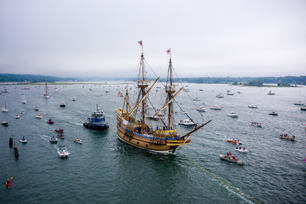
Plimoth Patuxet's fully restored reproduction of the original Mayflower makes her way under tow down the Mystic River on July 20, 2020. The ship is undergoing sea trials in New London, and is slated to arrive home to Plymouth Harbor on or about August 10, 2020. © Plimoth Plantation
Plimoth Patuxet is delighted to announce that MAYFLOWER II, its 64-year-old historic reproduction of the ship that brought the Pilgrims to the shores of historic Patuxet in 1620, began the voyage home to Massachusetts on July 20, 2020.
Plimoth was also awarded $227,272 from the IMLS Museums for America program. The support goes towards developing a suite of educational resources for teachers, students, and the general public focusing on the relationship between the early Pilgrims and the Wampanoag people. Educators are seeking more information about the role of indigenous cultures in the context of early American history, as well as how to present that topic in an inclusive, equitable, culturally sensitive, and more historically accurate manner. To meet that need, the museum will develop two products: in-school educational programs and curricular resources; and, an updated website with an interactive web-based educational tool. Those new resources will help disseminate the results of research that has come to light within the last decade, telling the nuanced Wampanoag - Pilgrim story from multiple perspectives.
Thanks to Sitka Creations of Shirley, the Shirley Historical Society developed a new website (www.shirleyhistory.org) right before the pandemic hit. Since March, we have spent a lot of time developing online exhibits for our Facebook page and will be converting those posts to extra pages on our website.
The Public Health Museum is pleased to announce that it has been awarded a $10,000 grant from the Network of the National Library of Medicine New England Region (NNLM NER) for its Community Outreach efforts. The Public Health Museum is honored to have been chosen as a recipient for the third year in a row, and will bring its immersive student public health program Outbreak! free of charge to rising 11th and 12th grade students. Due to the coronavirus pandemic, the Museum decided to move to an online format, thus extending the program immediately to students across the region. "We are very pleased to bring Outbreak!2020 to students in a virtual format," said Public Health Museum president Dr. Katherine Domoto. "We're able to reach students from all over New England and actually increase participation in the program by developing online presentations."
Springfield Science Museum was awarded $84,637 from the IMLS Museums for America program. The funds go to support participation in informal science learning by making its educational programs and learning spaces more accessible and inclusive. Museum staff will undergo Disability Inclusion and Universal Design training to redesign and enhance a core multi-use learning space and principle STEM program that can remove physical, cognitive, and social barriers to learning. External evaluators will measure access needs and learning outcomes before and after project upgrades in order to track progress and develop a scalable model of inclusive practice for all the museum's science programming. The result will be an improved educational experience for visitors of all ages, abilities, and backgrounds.
The Worcester Art Museum has received a $200,000 capital grant from the Massachusetts Cultural Facilities Fund for the museum’s Lancaster Plaza Project, the museum announced Monday. The money will be used to revamp the museum’s Lancaster Street entrance, which 90% of the museum’s use to enter the building, according to the announcement. The project will include replacing the deteriorating exterior stairs and installing a new accessible elevator. The renovation is part of the larger Worcester Art Museum Campus Master Plan.
Worcester Art Museum was awarded $250,000 from the IMLS Museums for America program. The funds go towards developing and designing an Arms and Armor Gallery for the permanent installation of its newly acquired Higgins Armory Collection, which is composed of 2,000 objects primarily from medieval and Renaissance Europe but also from around the globe reaching as far back as ancient Greece and Egypt. This new gallery will emphasize accessibility and accommodate different learning styles, empowering visitors of diverse ages, backgrounds, and abilities to curate their own experience in exploring the stories behind these objects. An interdisciplinary museum project team will work closely with project partners, as well as directly with target audiences and a team of consultants with expertise in accessibility, digital design, exhibition design, and evaluation, to help shape the project. The goal is to respond to changing community demographics and increasing visitor expectations for customized experiences by re-imagining the way museums use collections to attract and engage new audiences.
The Wistariahurst Museum will remain closed into late fall as work commences on the historic home’s antiquated electrical system. Kate Preissler, the museum’s director, announced the extended closing. Like most municipal buildings, the former Skinner family homestead closed due to the coronavirus pandemic. “Because of this, the public access to the historic site will be closed through at least November, though archival projects and research access will continue as planned and the grounds will remain open to drop-in visitors until work begins at the site,” the statement read. The stately Victorian building, replete with lush gardens and a lavish interior, is saddled with an aging electrical system that dates back to the 1920s in some rooms. The Holyoke Community Preservation Committee recently awarded the museum a $214,500 grant, which included a match from the Massachusetts Cultural Council Facilities Project fund. The cash infusion and closure allows the museum to accelerate the repairs. “Rather than sticking to a previously drafted plan designed to minimize disruption to public access of the site, the project will be launched in its entirety starting in July,” Preissler stated. The former construction schedule would have caused significant disruptions in the museum’s operations, especially the popular weekend tours, public and private receptions, and a slew of cultural events.
The University Museum of Contemporary Art (UMCA) at the University of Massachusetts Amherst has received a $25,000 grant from the National Endowment of the Arts to host a residency and exhibit by Allison Janae Hamilton, a celebrated multimedia artist who draws on the landscapes of the American South as inspiration for her work.
Museum of African American History was awarded $50,000 from the IMLS Museum Grants for African American History and Culture program. The funds go to improve the care and management of its collections associated with the African Meeting House, which is preserved as a reminder of a thriving 19th century African American community on Nantucket Island. Following the recommendations of a 2016 Museum Assessment Program (MAP) report, museum staff will work with consultants to assess the condition of the objects and archives currently in storage on the island; re-organize storage spaces; identify materials to be moved to a climate-controlled facility; and improve controls and documentation to increase accessibility of the collections for staff, visitors, and scholars. By assessing the collections and improving their storage, the museum will gain improved intellectual and physical control of the objects, thereby better serving both scholars and the general public who visit the museum's Nantucket campus.
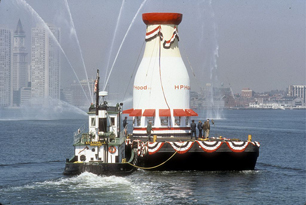
The milk bottle arrived by barge to Boston Children's Museum in 1977.
Boston Children's Museum announces that the iconic Milk Bottle will undergo a major renovation to its facade and infrastructure with the support of HP Hood. The Milk Bottle was built in 1934 by Arthur Gagner of Taunton, Mass., to dispense the homemade ice cream he produced. Standing 40 feet tall and weighing in at 15,000 lbs., the Milk Bottle was one of America’s first fast-food drive-in restaurants and an authentic example of the “Coney Island” style of architecture.
The National Black Doll Museum of History and Culture officially closed its doors at the end of June. Debra Britt opened the NBDMHC eight years ago on North Main Street, in the heart of Mansfield’s downtown. Since its founding, the museum has been a source of education and outreach, offering tours, programs and workshops from within the museum, in addition to contracting with schools throughout Connecticut and Massachusetts to bring the learning to them. The museum was also used as a key element in working to make Mansfield a designated Cultural District, and Britt has been a resource in offering guidance and advice to anyone seeking to gain cultural literacy. In early June the owner of the building announced his intention to raise the rent and do work in the building, forcing Britt to make the tough decision to vacate by June 30. The space has already been leased by a new business.
The Forbes House Museum was one of 123 humanities organizations to receive a grant for general operating support from Mass Humanities. Funding from Mass Humanities has been provided through the National Endowment for the Humanities (NEH) as part of the federal CARES Act legislation. These emergency funds recognize that art, culture and history are an integral part of the region's recovery from the COVID-19 pandemic, and we are extraordinarily grateful.
Forbes House Museum was also awarded $47,179 from the IMLS Inspire! Grants for Small Museums program. The funds go to support a collections stewardship and public access project to improve physical and intellectual control over its collections and provide more public access to them. Better environmental controls will allow for better storage of the collection. The project team will inventory and number objects and artifacts so that they can be more easily tracked and create a a Collections Management Plan. The museum will also develop training modules on collections care and conduct a training workshop for staff and volunteers.
The USS Constitution Museum is proud to announce two recent grant awards to support our operations and programs, which have been deeply impacted by COVID-19. This week, the National Endowment for the Humanities (NEH) awarded us a highly competitive CARES Act grant of $232,468 to support our virtual All Hands on Deck exhibit, as well as virtual programs and field trips through the end of 2020. Mass Humanities awarded them a $10,000 grant to sustain our core operations until we can reopen to the public. Both grants were made possible by funds that the National Endowment for the Humanities received through the Coronavirus Aid Relief and Economic Security (CARES) Act. The museum is grateful to the National Endowment for the Humanities and Mass Humanities for their long-time support and strong endorsement of our value to the community, state of Massachusetts, and the nation.
USS Constitution Museum was also awarded $250,000 from the IMLS Museums for America program. The museum will launch a Salute to Service initiative to transform itself into a hub for conversation, connection, and community around military service. A strategic focus on service members, veterans, and their families will significantly strengthen and expand how the museum, in collaboration with the U.S. Navy's USS Constitution, enhances the general public's understanding of the military community. The major goals of the initiative are for the military community members to see the museum as a trusted space for community engagement, and civilian participants in Salute to Service programs to gain an elevated understanding of military service and family sacrifice.
The Gibson House Museum, a National Historic Landmark and time capsule of nineteenth- and early-twentieth-century domestic life, is thrilled to announce it has recently received several grants. In addition to a $2,500 Mass Humanities CARES Act grant, which will assist with operating costs during the COVID-19 crisis, the museum has been awarded a $44,000 grant from the George B. Henderson Foundation for brownstone and window-well restoration; a $95,000 Community Preservation Funds award from the City of Boston to help underwrite critical ground-floor structural repairs; and a $5,300 Mass Humanities Project Grant to fund a reinterpretation plan, "Women at Work: The World of 'Domestics' in Victorian Boston." The restoration and interpretation projects will enhance the narrative of the immigrant servants who lived and worked in the house for generations.
Museum of American Bird Art, Mass Audubon was awarded $47,659 from the IMLS Inspire! Grants for Small Museums program. The funds go to support The Nest: A Nature Inspired Space, Design Workshop, and Art Studio, a new project designed to provide a dedicated space and robust mobile component for pre-K to grade 5 aged children, their families, and educators. Working with community partners, the museum will create an interactive exhibition integrating nature, art, and science, using existing underutilized space at the museum. The project team will test and develop prototypes of content, materials, and equipment for the Nest, along with curriculum and programmatic activities. Through the immersive exhibition and supporting programmatic activities, the museum will better serve an expanded group of learners with nature-based STEAM programs.

Handwritten document from Mount Auburn Cemetery.
The Friends of Mount Auburn Cemetery has been awarded a grant from the National Endowment for Humanities (NEH) for an innovative project that enables people to work from home and open access to historical documents: “Providing Comfort and Inspiration: Transcribing the Records of America’s First Rural Cemetery.” To keep its community involved from afar, the nonprofit organization had to pivot quickly. Its Historical Collections & Archives staff launched an innovative web platform that welcomes volunteers to transcribe 19th- century handwritten documents—many never seen before—that tell the story of the Cemetery’s early decades. Working remotely, volunteers sign up to help at FromthePage.com/mountauburncemetery. On the site, transcribers choose among uploaded digitized documents that include individual letters, trustee minutes, and founding records. Guidelines assist in deciphering the documents, which are often difficult to read in 19th- century cursive. Already, 900 pages have been transcribed by volunteers from more than 10 countries.
Nantucket Historical Association was awarded $190,237 from the IMLS Museums for America program. The funds go to support the Collections Stewardship Project which supports the classification, cataloging, and rehousing of archaeological holdings that were extensively gathered, studied, and cataloged between the 1970s and 1990s. A collections specialist working with a consulting archaeologist will inventory and catalog the collection of at least 5,000 Native American stone tools, Native American pottery, and historic-period ceramic fragments and Colonial fragments; create digital records of the collection; rehouse the archaeology collection into new museum-quality enclosures and shelving; and provide public access to object descriptions, historical context, and photography through a new, online collections portal. This project will provide the springboard for the NHA to bring these collections and the stories imbued in the stones, bones, and shards to the fore for study and education and further research.
Stone Zoo, Zoo New England was awarded $50,000 from the IMLS Inspire! Grants for Small Museums program. The funds go to update its conservation education graphics and interactive experiences for children and families, school groups, and other visitors at its two locations. New graphics will include messages that will foster appreciation for wildlife and encourage conservation behavior. They will update information about the conservation status of the animals to reflect current realities and implement multi-sensory experiences to engage visitors of all education levels, interests, and abilities. A consultant who specializes in behavior change theory will assist staff in considering all the drivers, motivations, barriers, and benefits to changing behavior in relation to conservation, animal welfare, and the environment.
New Hampshire
Squam Lakes Natural Science Center has been named a 2020 Champion in Action® in the category of Environmental Stewardship The award, announced jointly by Citizens Bank and New Hampshire Union Leader, includes $35,000 in unrestricted funding as well as promotional and volunteer support for the organization’s outstanding work.
The Londonderry NH Historical Society was awarded a general operating support grant for $3,000 from New Hampshire Humanities. The grant is funded through the federal CARES program and the National Endowment for the Humanities. It will help the Society cover operating expenses, present additional programming, and upgrade and increase its online presence, which will allow the group to reach Londonderry residents and history enthusiasts beyond the Londonderry community.
Children's Museum of New Hampshire was awarded $47,182 from the IMLS Inspire! Grants for Small Museums program. The funds go to support conducting the Advancing Play-Learning in New Hampshire project - a series of educational initiatives designed to help kindergarten teachers, parents, and caregivers implement play-based learning activities in children's early education. The museum will host two open houses and four workshops for kindergarten teachers, as well as an off-to-kindergarten family event. The museum also will develop 12 five-minute videos and use social media outlets to distribute tips and trends on play-based learning. School trips to the museum and museum outreach to classrooms will occur throughout the school year. All the activities are being designed to create deeper learning experiences for children as they explore, discover, and develop literacy, numeracy, and social skills.
New York
Southold Historical Society is pleased to announce that it is a recipient of the Robert David Lion Gardiner Foundation’s COVID-19 General Operating Support Grant. This grant was offered solely to Nassau and Suffolk County history mission organizations to counter the financial impact of the COVID-19 pandemic. The Society received $2000 which was the maximum award. Awards were made available to alleviate expenses related to general operations including technology support, database functions, building monitoring and security, landscape maintenance, utilities, etc. SHS recently announced their newly updated website which is filled with fascinating information about local history, landmarks, and much more. In an effort to fulfill its mission to create and promote interest and to further knowledge in history, education, and culture, SHS has increased their efforts to provide material that is relevant to a variety of different interests
Rhode Island
Hearthside House Museum has received a grant of $33,000 from The Champlin Foundation towards the construction of an environmentally-controlled archival storage space within the existing garage. Hearthside was the subject of one of the 7 episodes of a RI PBS series, Treasures Inside the Museum, that aired last fall. The program featured Hearthside at different points of the year and showed its various exhibits, as well as showcasing the adjoining properties of the Great Road Heritage Campus: the Hannaway Blacksmith Shop, the Moffett Mill and the Pullen's Corner one-room schoolhouse. All four properties are managed by the Friends of Hearthside, an all-volunteer organization. A $2,000 operational grant was received from the RI Council for the Humanities to help during the COVID crisis.
Preservation Society of Newport County was awarded $184,576 from the IMLS Museums for America program. The Preservation Society of Newport County will complete a major digitization initiative of 13 high-priority special collections that document the role Newport has played in shaping national cultural and social movements. The digitized images and information will be uploaded to Newportal, a multi-institutional website of Newport history. The project goals are to make this collection accessible to scholars and the public; to enhance intellectual control of the collection for internal management and use in public programming; and to preserve the collection by reducing physical handling of the objects. This project aligns with the Preservation Society's public service mission to "engage the public in the story of America's vibrant cultural heritage."
Providence College Galleries was awarded $47,742 from the IMLS Inspire! Grants for Small Museums program. The funds go to implementing an Art Collection Documentation, Interpretation, and Digitization project to make part of its art collection accessible online. Through the project, they will digitally photograph 600 modern and contemporary works - including several by prominent women from Providence and New England - and craft interpretive texts and further-research reading lists for 400 of those pieces. All of the newly generated images and texts will go into a collection management system. To make the collection more accessible to broad audiences, they will create and launch an online catalog.
Providence Children's Museum was awarded $45,531 from the IMLS Inspire! Grants for Small Museums program. The funds go to support expanding and refining its Cultural Connection program, which brings diverse arts and humanities organizations from across Rhode Island to the museum on a monthly basis to enhance their work with young children and families. Arts organizations will have the opportunity to work with museum staff on translating their content into family-friendly presentations and to co-develop in-depth learning opportunities and events. The museum will provide free tickets or vouchers to families to attend an upcoming event at a featured arts organization. By tapping into the museum's team of experts in child development, arts and cultural organizations will learn how to create accessible experiences and open doors to new audiences of young children.
Vermont
The Robert Frost Stone House Museum at Bennington College plans to re-open this summer thanks to a $5,000 Vermont COVID-19 Cultural Relief Grant from the Vermont Arts Council and Vermont Humanities.
Lake Champlain Maritime Museum’s Dept. of Research and Archaeology was awarded a National Park Service American Battlefield Protection Program grant to support a new archeological survey of Arnold’s Bay, located on the Vermont side of Lake Champlain. This battlefield site is where American troops under General Benedict Arnold burned their remaining fleet to prevent capture by the British after escaping from the Battle of Valcour Island on October 13, 1776. The project was one of 17 nationwide grants in 11 states and will begin in 2021.
Earlier this year, Lake Champlain Maritime Museum introduced a new logo for the Museum that reflects the essence of all our work: Lake Champlain. The lake is pivotal to our education programs about the water, on the water, or by the water. It is a focal point in our regional history. The lake is the grounds and training space for our archaeological work and research. Lake Champlain is where we bring youth and adults together around boat building, rowing, kayaking, and sailing to grow as leaders. The Museum’s new logo and brand emphasizes the importance of Lake Champlain through text and graphic identity, pairing the importance of words with a visual representation of the lake. The logo was designed internally through a collaborative staff process.
Shelburne Museum was awarded $76,190 from the IMLS Museums for America program. The funds go towards conducting an inventory and assessment of the contents in their pharmaceutical collection, which consists of medicinal products, cosmetics, and patent medicines. This project will address the unknown details about the contents of the collection, and enable staff to accurately quantify safety concerns, such as inhalation of or exposure to unknown contents and/or broken containers. There are about 5,000 containers dating from the mid-19th to early 20th century that may have become unstable over time. Project staff will upload the data gathered during the inventory to a collections management system and generate reports to share with a consulting chemical hygienist who will provide input for the next phase: identifying unknown contents and safe removal of hazardous contents from historic containers. This will determine how much of the collection is safe to keep, and what objects will require special handling or should be disposed of in the future.
Fairbanks Museum and Planetarium was awarded $24,8966 from the IMLS Museums for America program. The museum will design, produce, and install Science Alive-a 1,500-square-foot astronomy and meteorology exhibit-as well as develop and implement supporting programs to promote lifelong learning through participation in scientific explorations. Science Alive will leverage the museum's strengths in meteorology and astronomy by translating these core competencies into dynamic and relevant exhibits and programs. It also will address the community's STEM educational deficiencies through science methodologies and content. The project's exhibition and programming components will benefit students, visitors, and the community.
University of Vermont Natural History Museum was awarded $50,000 from the IMLS Inspire! Grants for Small Museums program. The funds go to support cleaning and restoring its collection of bird and mammal mounts, intended for display when the museum completes a renovation project. Two conservators will train staff in cleaning the 149 mounts and will restore a subset of approximately 30 of the mounts that need repairs. Museum staff will work alongside the conservators to clean the remaining mounts and will install improvements to their cases before replacing them. A preservation specialist will then consult with staff about further steps to mitigate environmental hazards.
New England
Congratulations to the following NEMA members on receiving a National Endowment for the Humanities Grant
Preservation Assistance Grants
- L.C. Bates Museum (Good Will Home Association), $5,844, Developing Storage Space and Housing Significant Humanities Collections
- Mark Twain House, Outright: $2,690, The Mark Twain House & Museum Conservation Assessment
- Noah Webster Foundation and Historical Society of West Hartford, Inc., $15,000, Planning for Enhanced Educator Access to Digitized Collections
- Wadsworth Atheneum Museum of Art, $7,521, General Preservation Assessment of the Auerbach Art Library and Wadsworth Atheneum Archives
Scholarly Editions and Translations
- Massachusetts Historical Society, $350,000, Adams Papers Editorial Project
Sustaining Cultural Heritage Collections
- Newport Restoration Foundation, $50,000, Assessment and Proposals for Improving Care of the Whitehorne House Museum Collections
- Peabody Essex Museum, $350,000, Implementing Sustainable Barkcloth Collection Storage
- Plimoth Plantation, Inc, $49,200, Creating a Preservation Plan for Plimoth Plantation’s Historical and Archaeological Resources
Historic Places: Implementation
- Old Sturbridge Village, $250,000, Foundations of Interpretation
NEH CARES: Cultural Organizations
- American Antiquarian Society, $101,387, Activating Virtual AAS
- Chosen Vale, $78,610, Enfield Shaker Museum: Expanding Visitor Access Through Digital Collections and Smartphone Tours
- Connecticut Historical Society, $45,049, Connecticut Historical Society Distance Learning Project
- Currier Gallery of Art, $170,404, Understanding Frank Lloyd Wright’s Usonian Automatic House
- Edith Wharton Restoration, Inc., $300,000, The Mount Humanities Programming in Response to COVID-19
- Fitchburg Historical Society, $15,662, “I Remember When”: Wellness through Connection & Local History on TV & Internet
- Historic New England, $300,000, Historic Place to Cyberspace: Exploring Six New England Sites from Home
- House of Seven Gables Settlement Association, $102,434, H7GSA Archives Inventory Project
- Lake Champlain Maritime Museum at Basin Harbor, Inc., $53,036, Navigating for the Future
- Penobscot Marine Museum, $66,605, From Collections to Community: Adapting to Digital and Remote Learning Platforms
- Pettaquamscutt Historical Society, $29,833, Preserving Kenneth T. Mars, Jr. Photograph Collection
- Plimoth Plantation, Inc., $299,953, Seeds of Change: Transforming the Landscape of Seventeenth-Century Plymouth & Patuxet
- Pocumtuck Valley Memorial Association, $152,879, Serving Audiences Better with an Expanded Virtual Presence, Safe Museum Visit Protocols, and Retention of Humanities Staff
- Rhode Island School of Design, $252,310, From Kyoto to Providence: Preserving the RISD Museum’s Lucy Truman Aldrich Collection of Asian Textile Masterworks for Educational Access
- Sheldon Art Museum Archaeological and Historical Society Inc., $29,362, Archives Alive: Building Primary Source Collections During COVID-19
- Somerville Historical Society Inc., $17,034, Somerville Museum Humanities Programs
- Springfield Museums Corporation, $141,300, A Glimpse into the Gilded Age: Discovering the Archives of the George Walter Vincent Smith Art Museum
- Sterling and Francine Clark Art Institute, $166,578, Clark Art Institute: Clark Connects Public and Academic Programs
- University of Vermont, $69,263, Virtual Visitor Engagement at the Fleming Museum of Art
- USS Constitution Museum, $232,468, All Hands Online
- Vermont Historical Society, $133,512, Preserving and Expanding Access to Vermont’s History
- Worcester Historical Museum, $129,030, Securing Worcester’s History: Making History Together