A Barnum Blog and Beyond
By Adrienne Saint-Pierre, Curator, Barnum Museum
Many of us remained firmly planted at home during the pandemic, unable to go to our normal workplaces let alone travel any distance. But an unexpected benefit of being confined this past year was the opportunity to travel through France and the United Kingdom with none other than P.T. Barnum. My journey took the form of reading—and writing a blog about—Barnum’s letters from 1845 and 1846 while he was on a European tour promoting little-person performer “General Tom Thumb.” The correspondence is contained in a copybook written in his hand, saved by descendants and donated to the Barnum Museum in Bridgeport, Connecticut.
The bound volume of 750 tissue-thin pages is a gem among the Barnum Museum’s many treasures, but until a National Endowment for the Humanities grant (2016-2017) funded its digitization and access online, it could not be made available to researchers due to its delicacy, nor did the museum staff have more than cursory knowledge of the content. Yet it promised to be a golden primary resource and one the Museum had prioritized to make accessible.
Barnum was only in his mid-thirties when he wrote these letters, and he had recently become the new proprietor of the American Museum in New York City. He was at the beginning of his meteoric rise to fame and fortune, and the three-year tour of Western Europe with his protégé “Tom Thumb” (Charles S. Stratton), vastly expanded their audiences both then and for years to come. While in France and England, Barnum also sought opportunities to purchase novelties and attractions for his museum, including an exceptional automaton made by Robert Houdin. These were to be heavily promoted for their European origin as well as for Barnum’s “tireless efforts” to acquire them for his American audience.
This early period of Barnum’s career has always been more intriguing to me than his better-known circus endeavors of later decades, and I believe that having written these letters as a younger man, his voice was less restrained, providing greater insight into his character. In addition, writing to his trusted correspondents served as an antidote to the sometimes overwhelming homesickness he suffered while living abroad; I suspect he shared more of his inner feelings even in business letters than would ordinarily be the case.
My “Covid project” did not begin with a weekly blog in mind, but quickly turned into that as I began reading. In mid-April of 2020 when all of us were feeling scared and needing morsels of emotional comfort, I composed a friendly e-blast from the Barnum Museum to our subscribers and decided to use some of Barnum’s words from his first (partial) letter in the copybook—just because they had some relevance to the message. Working from home, uninterrupted by phone calls, I could not resist the temptation to read a few more letters in the copybook, and after all, as the Museum’s Curator, shouldn’t I have a better understanding of them? I discovered such interesting and diverse topics that I thought surely other people would also enjoy reading Barnum’s words, perhaps gathered into another e-blast or two. And then it dawned on me that this forced at-home time presented an opportunity to lead people to the copybook in its online form—our digital surrogate in the Connecticut Digital Archive (CTDA) hosted by the University of Connecticut. Though it had been available in the CTDA for three years and has excellent user tools to aid in reading it, the copybook had not been accessed often. I was sure the sheer quantity of pages, densely covered in script, was daunting to potential readers. So I wondered if referencing specific letters and providing hyperlinks to them in the e-blasts might be a way to encourage some brave souls to “dip a toe” into the volume, and—who knows—maybe get hooked and keep reading.
Sometimes it’s best not to dwell on the length of the road ahead when it comes to a long-term project. I dared not think how many weeks or months—or even the year-plus it has become—might be needed to get through the whole copybook in the process of reading, transcribing and writing about the letters. The old adage about how to eat an elephant seemed especially appropriate in this case, and I thought the only thing to do was start, going at it a few pages at a time. As of June 4th, 2021, I have written 58 blog posts covering the letters through pages in the 580s, so I know I still have a few more months to go. Fortunately I have never found myself “stuck” on what to write about—Barnum’s letters offer endless possibilities! The copybook has proven to be an even greater treasure than I had imagined, and occasionally I have had to stop myself from continuing to mine the richest “veins” (such as Barnum’s eight-page letters to his museum manager) in order to move on to a new group of letters. I remind myself that this is to be like a journal, not a dissertation, and my mission is to share this virtual journey complete with surprises and “ah-hah” moments with others who have an interest in Barnum. And keep moving.
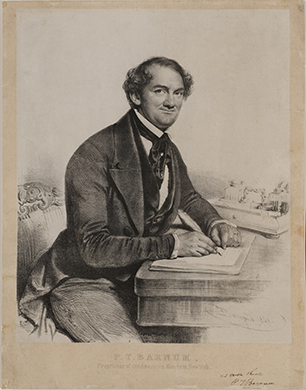
Print portrait of P. T. Barnum by Charles Baugniet
Barnum was a prolific letter-writer and a good one. Words seem to have flowed from his pen as easily as if he was in conversation, and he often uses intriguing expressions. So from the outset I planned to primarily share Barnum’s own words in each blog post, often in the title too, using my voice just to guide the stories and provide needed or useful context. Over time the blog topics have generally clustered around several broad themes, including those pertaining to the Gen. Tom Thumb tour; Barnum’s direction of the American Museum from abroad; his acquisitions and purchases, including other museum collections (Peale’s), and items for a planned home that are now in the Barnum Museum collection; his various business partnerships and network of showmen, publishers, and authors; and his family life and relationships with other relatives. The copybook contains, for example, letters to Barnum’s wife and young daughters; his crotchety though beloved uncle and sometime business partner Alanson Taylor; his highly trusted museum manager, Fordyce Hitchcock; his showman friend and competitor in Boston, Moses Kimball; printers and publishers; various friends in London and Paris; French theatre managers; and famous people such as George Catlin and Albert R. Smith. The diversity of recipients enables us to see many facets of Barnum: as a husband, father, nephew, businessman, entrepreneur, showman and promoter, and as a mentor and father figure to young Charlie, whose own father was, in Barnum’s opinion, not much of one.
Some of the letters include “difficult topics” that need to be addressed, and the blog has provided an opportunity to explore these in a thoughtful way, pausing to consider the time period in which Barnum lived and how his actions and attitudes reflected that era. Thus, topics such as his determination to exhibit partially twinned infants; hire “fat boys” and “giants” for display; partner with George Catlin to bring Native American Ojibwa and Iowa peoples to Europe for royal and public performances (which exposed them to diseases that often proved fatal); and exhibit wild animals that were certain to die without keepers who had specialized knowledge of their care are discussed in the blog. The point is to at least lighten, if not remove, the veil of our 21st-century mindset so we can be more objective in understanding behaviors that are viewed today as egregiously inappropriate, intolerable, or ignorant. We at the Museum are sensitive to this because at times, Barnum is villainized by the media when writers or reporters fail to realize he acted in ways that were commonly accepted in his time. Barnum, like all of us, was a “work in progress” and his attitudes and actions became more enlightened as he matured. The opportunity to address the hard topics is valuable to the Museum since we seek to be a trusted source of information on Barnum’s life and legacy, and wish to promote accuracy in interpreting this very complex man.
The copybook letters have also revealed discrepancies between the dates or time periods of events mentioned in Barnum’s autobiographies and those indicated by the dates of his correspondence. Since many historians and authors have relied on Barnum’s autobiography for information, these “fuzzy” dates are repeated again and again. The faults could be due to the author’s memory, though perhaps these were intentional “adjustments” to the story.
The transcription created in the process of preparing the blog posts will be a foundation for future projects, including as a resource for exhibitions and projects built with new digital platforms. Having access to a greater wealth of Barnum’s own words will facilitate more compelling and engaging storylines and discussions. Barnum’s letters to the New York Atlas, written in his capacity as a foreign correspondent, were not used for the blog but have nonetheless been transcribed by Museum Volunteer Tova Clayman, and can thus be the basis for a related project. An unanticipated result of the project is that the blog posts themselves have created a new resource to build upon. In the near future, the Museum plans to transform the posts, which currently reside on our website’s blog page, into a podcast series. A professional voice actor (male) will narrate, and we expect the impact of Barnum’s words in spoken form will be very appealing to listeners.
While I personally feel I have learned a great deal from the copybook, my aim to share the stories took form in an almost accidental way as a result of the Covid-19 pandemic restrictions. Reading and writing about Barnum’s letters has indeed made for a memorable desk-chair journey over the past 15+ months, and I hope to see the fruits of this trip evolve into fascinating new experiences for others to enjoy as well.
If you are curious, you can see the copybook in an episode of the Curious People Wanted video series, posted to the Barnum Museum’s YouTube channel.
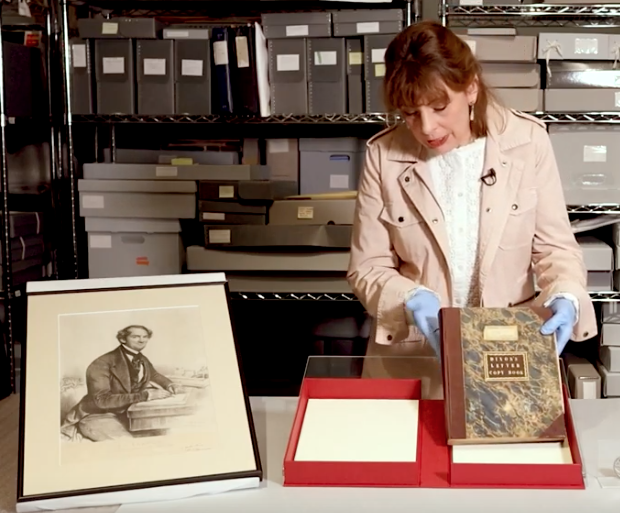
Header image: Screen still of Adrienne Saint-Pierre, Curator, Barnum Museum with a bound volume of P.T. Barnum Letters.