
It’s a New World
By Emma Winter Zeig, Education and Interpretive Programs Manager, Historic Northampton
When Massachusetts issued a stay at home order, I already had wipes and frozen food. This luck gave me the chance to panic about a different resource: educational museum content. And so, the night before Massachusetts shut down, I found myself in the basement of Historic Northampton, taping videos about boy’s dresses and Civil War uniforms, and taking Instagram-able photos of collections items. As I was planning how to turn photos of butter presses into a coloring activity, I heard a creak directly above me. Historic house museums are full of creaks, I told myself. Then my phone rang, it was museum Co-Director Betty Sharpe.
She had called to tell me that the museum’s alarm had just gone off, and the police were on their way. I heard the creaking sound again, much louder this time. I told her to tell the police to hurry, and went to hide behind a collection of historic candlesticks.
It was easy while sitting in the dark, questioning the logic behind keeping the cabinet with all of the swords locked, to think that this would be the hardest moment of the pandemic. I had enough stored material for six videos, four months of social posts, and three online activities. That had to be enough, right? All I had to do was get past the fear, and ignore the sounds of someone moving around the museum above me. I couldn’t have known the marathon that the pandemic would turn out to be.
I used almost all of the material that I gathered that night to create History at Home, the first virtual space for interactive activities that Historic Northampton has ever had. However, it wasn’t long before we realized that we needed to do more to directly address the pandemic, so Historic Northampton started to collect stories.
In partnership with the Daily Hampshire Gazette, we put the word out that we wanted to hear from our community about their experience with the pandemic. Of course we wanted to build an archival collection that spoke to the current moment, but we also knew that Northampton’s experiences with the pandemic would be just as, if not more, useful to current residents as they would be to the future generations who would see them in our archives. So I began to build an online display for our COVID-19 Stories Project that went live less than two weeks after we put out the call for submissions. The response was even bigger than we thought it would be.
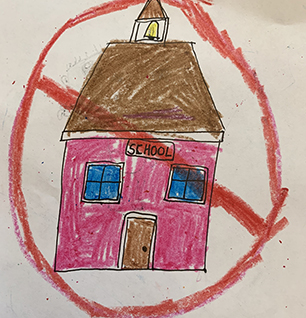
Carter R., Age 11
There was no singular Northampton experience of the pandemic. For some, it was a time to hold family close: one family exchanged daily haiku to process emotions and stay in contact (an example from Eagle Glassheim: “Now that washing hands/ Is patriotic duty/ I lather longer”). For others, the pandemic brought hardship, illness, and dark thoughts about what lay ahead. We received poems about hating the world, songs about emptiness and isolation, and photos of deserted streets. These responses were not limited by age: ten-year-old Gus was scared because “Our country is really messing up on trying to stop corona.” The response that stuck with me the most came from eight-year-old Reiter K., who captured the duality of happiness and fear: “It feels happy because we are all out of school and…I can be with my bunny all the time. It feels sad because of everything else.”
We received far too many responses to put on a single web page, so Betty thought of nine dominant themes within the submissions, and we began to sort. Having thematic pages gave visitors choice as to what kind of experience they wanted. If they wanted to be inspired by Zoom dance parties and drive-by birthdays, they could click “Hope and Togetherness” or “Family and Neighborhood Fun.” If they wanted to feel like they were not alone in going through a painful time, they could click “How Illness Feels” or “Fear and Worry.” The most common theme was “It’s a New World.” Even though Northampton residents processed their emotions about the pandemic differently, it was a shock to the system for the whole city, from high school students who missed graduation, to people without homes who found landlords even less willing to take them on as residents.
It was a new world at Historic Northampton as well, as we adjusted to sharing local history from home. I created a “Choose Your Own Adventure” witch trial and taught myself how to make stop-motion animations with museum objects and peg dolls. I worked with our other Co-Director, Laurie Sanders, to launch our first ever virtual events for an audience almost four times the size of what we could fit in our in-person event space. Even as the museum was adjusting to the current moment, we were also using this time to plan for our own future. Artisan woodworker Sharon Mehrman led the process of removing collections items from the historic Shepherd Barn, as Collections Manager Kelsy Sinelnikov and Museum Manager Marie Panik worked on projects like cataloguing those collections and reorganizing the museum archives. The Shepherd Barn has been used as a gift shop and as collections storage in the past, and over the course of the pandemic it has been emptied in preparation for the next phase in its life: a performing arts and exhibition space.
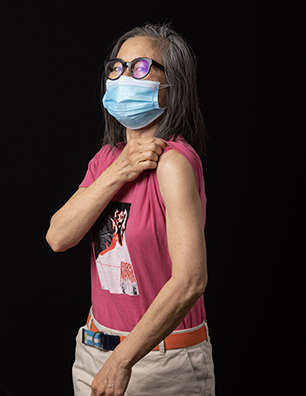
Lynee Yamamoto "Relief!!!!!" by Paul Shoul
As the vaccine became more readily available, we worked with photographer Paul Shoul to take portraits of people who had just received it, a fitting next chapter to the COVID-19 Stories Project. In the images and quotes that the subjects provided, I saw some of the same themes as the submissions throughout the pandemic: fear, love, exhaustion, joy. Even so, the change in mood was palpable. Faces beamed, people hugged, and our most popular response was “Yay” with a varying number of exclamation points. If the COVID Stories Project was a community holding its breath and trying to keep it together, this was a collective exhale.
On that night before lockdown, my own exhale could not come soon enough. After about 10 minutes of sitting in the dark, I got another call from Betty, telling me that the police were outside, and I should go to them. I tore out of the building clutching the tote bag of clothing I had brought with me so it wouldn’t look like I had filmed all of the videos on the same night. Panicked, I asked one of the officers if they had found the person in the museum. He gestured to the footprint-less snow around the museum, and told me that it was impossible for anyone to have arrived in the past few hours. Moreover, he and the other officers had been trying all of the doors on the museum for the past 15 minutes. The timeline snapped into place: the police had already been there when Betty called me for the first time. The creaking sound that I heard was them banging and pulling on all of the doors. I had not been facing down danger, just my own fear.
Once I was outside, we found the source of the alarm: a dislodged bank of snow on the Shepherd Barn. The police had not seen it initially, because they were focused on trying to enter Damon House, where I had been working. The initial tripped alarm had been labeled “Gift Shop” and, since the policemen were Historic Northampton visitors, they started trying the door they remembered was close to the current gift shop, in Damon House, not its old location in the Shepherd Barn where the alarm still had its old label. I kept thinking back on this part of the night throughout the pandemic, of hearing my shoes crunch through the snow while one of the officers told me about coming to our exhibit with his family.
Our museum has a small staff who are dedicated to serving our community, but the experience of the pandemic has also been one of seeing how the community has supported and valued us. From the audiences who turned out for virtual events and stayed engaged and joking through technical difficulties, to the volunteers who spent hours helping us clean and rehouse hundreds of objects from the Shepherd Barn, we have seen the grace and generosity of the people surrounding us again and again. I know that some of the programming choices we have made during the pandemic are here to stay: online interactive activities and virtual programming come to mind. As we prepare for whatever new world we are returning to, I find it comforting to think that we are entering it not only with the new skills we have learned but with the same support that has always made our work possible.
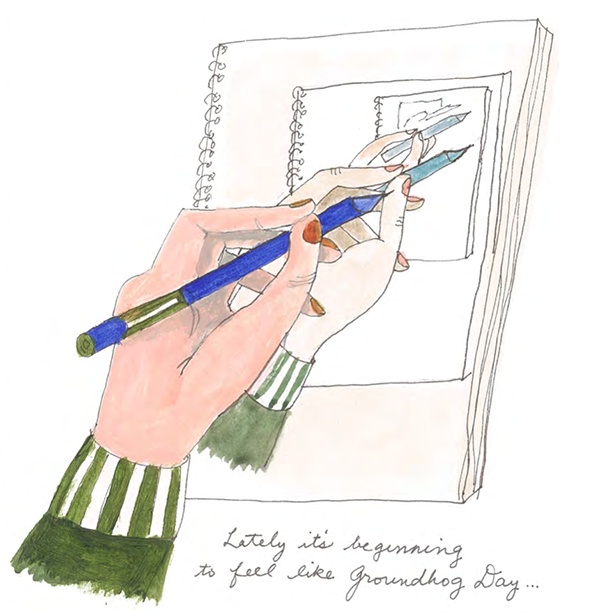
Header drawing by Rosetta Marantz Cohen.