The Not So Simple Things
By Erik Greenberg, Ph.D., Director of Museums, Newport Restoration Foundation
It is not an exaggeration to observe that the COVID-19 crisis changed almost everything that we do in the field of museum work. At our institution, the Newport Restoration Foundation, even the commonplace task of reopening our seasonal museums became a rather fraught endeavor filled with fear and uncertainty. Nevertheless, we did it, and that small fact, that most basic function of museum work (opening to the public) is one of the proudest moments in my career as a museum professional, and it was a significant accomplishment for the entire NRF museum team. Because, as I’m sure most readers are aware, the once simple act of reopening our museums was a remarkable exercise in planning, implementation, and teamwork.
Like so many in the field of museum work in America, by mid-March of 2020, the year-round staff of NRF’s museums had shifted much of their attention from planning for onsite visitors to the creation of a robust, intellectually rigorous, and extremely creative library of YouTube content. This allowed us to stay present in the public’s mind while also sharing our collections and research with a much wider audience than we had in years past. Our efforts to maximize our web presence also played out in the online growth of our museum store, which, thanks to our Manager of Interpretation and Visitor Experience, proved a profitable enterprise in the midst of some very difficult economic circumstances. I am really thrilled with our accomplishments during that time, and if there are any silver linings to be found in a global health crisis, my team’s growing sophistication in developing video and other online content is surely one of them.
Nevertheless, as early as the first week of April, we had begun to prepare for a world in which museums reopened to the public—at least museums in Newport, Rhode Island. To be sure, we really had no idea when or even if we would be allowed to open our museums, but I wanted to be ready the minute it was safe to do so. Fortunately, I had the support and input of an amazing team of museum professionals. So while our Senior Curator worked with contractors to try and determine how and when we might install 2020’s rotating exhibition, and our Manager of Education and Public Engagement continued to develop online content and work with our local school district to move our annual partnership from in-person to remote learning, I started holding regular problem-solving meetings with our Manager of Frontline Operations and our Manager of Interpretation and Visitor Experience.
Within minutes of our first meeting I came to see how fortunate I was to work with such a bright and perceptive team. Prior to that gathering, I had (in my mind at least) already arrived at what I believed to be the safest way to welcome visitors back to Rough Point. I assumed that we would return to an earlier form of engagement focused exclusively on guided tours made by appointment for groups of ten to fifteen people. My staff, on the other hand, recognized that I had not really thought the problem through all the way. They quickly observed that such tours rely on a group of people gathering (crowding, really) around a single guide, and that such behaviors directly contradicted the advice of state and federal health officials. Instead, we continued to station guides throughout Rough Point and Whitehorne House (as we have for several years now) and had our visitors take a predetermined path through our museums where they could encounter our guides at a safe distance for everyone. This was the safer, more thoughtful choice, and I’m glad that others on our team understood this fact, even if, initially, I did not.
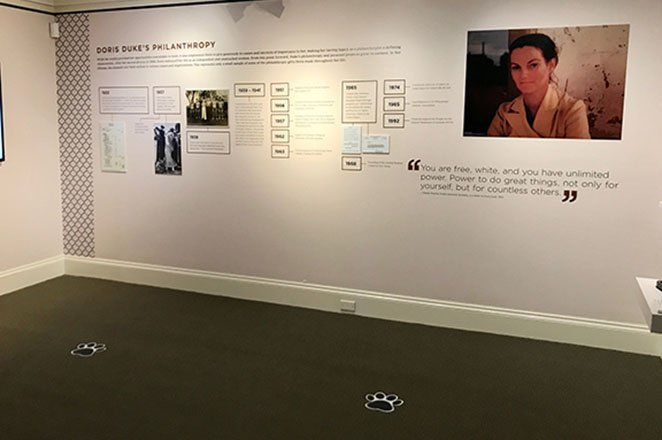
Our meetings were continually filled with questions about the safety of our staff and visitors, and our team answered them carefully and thoughtfully. How could we reduce our check-in staff’s exposure to visitors? Sell all of our tickets online and set up a check in tent outside on our grounds. How should we indicate a six foot distance inside the museum? Through floor stickers made to look like a dog’s paws for Rough Point (Doris Duke was a noted animal lover and always had a few dogs at Rough Point) and like ball and claw furniture feet at the Whitehorne House Museum (an institution focused primarily on 18th-Century, Newport furniture). How many people could we reasonably accommodate inside the house? Well, the state’s regulations would help determine that, but even then we opted to host fewer people than the law allowed. We decided on 25 people every half hour inside a massive, Newport mansion. How would we find time to clean our spaces and provide our guides the time and space to have lunch distanced from their colleagues? We’ll close from noon-1pm. No element of our work was too small or inconsequential to consider. Do we have the highest level of HVAC filters? We do now. How can we keep particles from being shot into the air when flushing a toilet? Purchase toilet lids and place signage in the restrooms asking our visitors to close the top before they flush. Yes, even toilet lids required discussion and planning.
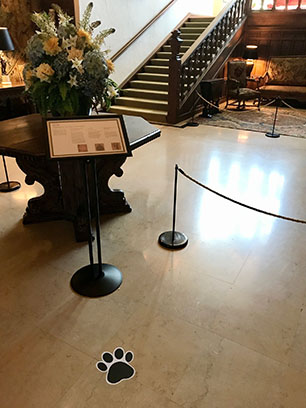
Rough Point
We directed other questions to our guide staff, all of whom would be the most exposed, and therefore most vulnerable, members of the museum team. We sent out a survey asking our guides about their plans to return and what would make them feel safe. We learned that many were uncertain, but they were pleased to see that we had been planning for their safety. Over the season, most returned. About a month or so after we opened to the public, we asked guides if our safety procedures actually made them feel safe. Thankfully the overwhelming majority of them said that they did, and we were fortunate to work together as a team for the entire season without anyone contracting COVID-19.
But, of course, all the planning in the world is meaningless without its implementation, and here too NRF was deeply fortunate to have a talented and committed team of professionals who joined together to make our reopening a reality. Moving all of our ticketing online was a bumpy process, and I wish I could describe it here, but the truth is that our managerial team took care of such details (for which I am eternally grateful), and they know far more about this process than I do. Our preservation crew helped to build pieces that created greater safety such as Plexiglas barriers for our check-in team. Our house cleaning team, who already were important contributors to the health and safety of our museums, staff, and visitors took on additional responsibilities to make sure that our spaces were routinely clean and safe. Our guides also pitched in to help with cleaning our spaces and ensuring that visitors wore masks. And our Marketing Manager made extensive use of our website and social media to keep virtual visitors, and those who visited us in person, informed about all of our offerings. In short, everyone at NRF worked together as a team to make our opening possible.
And yet, I soon came to realize that forces beyond our control had a great deal of final say about our opening. I still remember the day that I realized that, despite our detailed planning, reopening our museum (or any museum for that matter) was more of a governmental than operational decision. I was attending one of NEMA’s first Virtual Town Hall meetings in response to the pandemic when a colleague called on all of us to reach out to our respective Governors to let them know the significance of museums for the local economy and community. My heart sank. Having spent nearly two decades working at a museum in California, I assumed that contacting state officials in Rhode Island would be as difficult a process as it was in the Golden State (it is worth noting that museums across California remained closed for over a year). Fortunately, that was not the case. Within a day or two of that NEMA Town Hall, our Executive Director had reached out to state officials, all of whom were available and communicative. While, at first, the state had no clear guidance concerning reopening, let alone whether museums would be categorized like a retailer (which would be good) or a concert venue (which would have been very bad), over time they developed fairly clear plans. And yes, in Rhode Island, museums were thought of along the lines of a regulated big box store as opposed to a crowded performance venue.
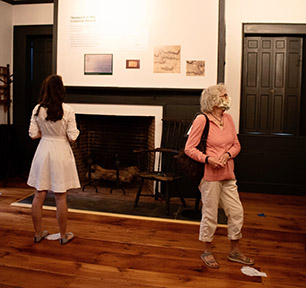
Whitehorne House Museum
All of our planning, implementation, and discussion with the state paid off in late June of 2020, when Rhode Island went into phase three of its Reopening RI plan and we opened our grounds to the public. A few weeks later we reopened the interior of Rough Point and a week after that, we reopened the Whitehorne House Museum to the public. It was an extraordinary accomplishment—one that, in any other year, would have been commonplace and ordinary…simple, really. But 2020 was a year in which nothing was simple, and so the opening of our spaces was, quite literally, a momentous event made possible by the careful thought and combined efforts and support of the wonderful staff who make up the Newport Restoration Foundation. I am sure that my NEMA colleagues will, in this issue, share similar stories of similarly committed and creative colleagues. After all, museums tend to attract some of the most deeply committed and creative people I know. I, however, am fortunate to work in my particular corner of the New England museum landscape, which is filled with our extraordinary collection of professionals, all of whom made our openings possible, and I am pretty sure that I will remember their hard work and dedication for as long as I live.