

Essential Leadership: Investigating the Future of Museum Governance
By Dan Yaeger, Executive Director, New England Museum Association
Governance is always on the minds of museum leaders. It permeates and influences a museum’s organizational culture. It can create institutional angst. It requires diligence, patience, and finesse. And one thing is certain. A museum cannot be truly successful without a successful board.
Last summer, NEMA took up the subject of governance as part of a workshop series entitled “Essential Leadership: Investigating the Future of Museum Governance.” The series, undertaken with the sponsorship and participation of U.S. Trust/Bank of America, attracted the participation of more than 100 museum CEOs and board members in six locations around New England.
This event was the outgrowth of many conversations I’ve had with museum leaders, all of whom expressed the desire for NEMA to convene a discussion around the subject of the field’s governance. It seems this is a topic of great concern for many in the museum community. How do we build effective boards? Where do we find the next great board leaders of tomorrow? These are questions that many institutions are raising about their particular museums, but strong boards benefit the entire field as a whole. So we decided that NEMA should address the subject as a field-wide priority.
The events last summer were a continuation of our leadership workshops over the prior two years. Participants in the workshops took on the role of the management team of “Museums, Inc.,” a fictional multinational nonprofit corporation that operates the world’s 55,000 museum “franchises,” and were tasked with developing a strategic plan for the entire global museum field.
The Museums, Inc. experience has accomplished two important things over the past three summers. The first outcome has been important discussion on topics critical to the future of our field. We’ve identified key problems and pathways to finding solutions on a field-wide level. The second important outcome is that many participants have been inspired to inaugurate changes in their own museum practice on a local level. We couldn’t have asked for more.
So our setup for last summer’s governance sessions went like this. Participants in each of the workshops took on the role of the board of directors of Museums, Inc., called into a retreat to examine the current state of governance in the museum field and develop a plan to cultivate the ideal board of the future. Here are some of the real-world trends we had our groups consider.
Board service at nonprofit institutions like museums seems to be in a state of flux. As baby boomers are retiring en masse, they are finding more time for volunteer activities including board service. That’s the good news. The bad news is that soon the baby boom cohort will be retiring from the board room too, leaving nonprofits scrambling to find qualified replacements from Gen X, Millennials, and Gen Y.
Unfortunately, there is evidence to indicate that these generations do not consider board service to be as noble a calling as it was to their parents and grandparents. People are not joining institutions as before and are somewhat loathe to plug into formal power structures such as boards, preferring instead to serve institutions through shorter-term task forces and event work.
Another trend we considered is that the skill set required of board members is evolving. Writing checks and attending meetings is no longer the ticket to entry. A complex regulatory environment, new technology, new management paradigms, increasing globalism, and increasing competition are changing the core competencies of the ideal board member. The question is: who can fulfill the ideal?
Finally, the question of diversity hovers over all we do. Museums today struggle to find sustainability through relevance in their communities. Unfortunately, that relevance is often challenged by the composition of their boards and staff, which often do not reflect the growing multiculturalism of their communities. According to Boardsource, nonprofit boards have made “almost non-existent progress in recruiting ethic and racial minorities;” more than 80% of all nonprofit board members are Caucasian, a group that makes up just 60% of the general US population. Because boards have such a big influence on the culture of the institution, homogeneous boards tend to make the museum more insular while diverse boards pave the way for openness. And openness is necessary in many cases to the museum’s long term survival. Board diversity is one of the big issues today and will continue to be for some time to come.
As part of the “Essential Leadership” workshops, NEMA conducted a survey of participants to determine how boards were working at their institutions. Our survey elicited responses from 46 workshop participants. A breakout of their roles reveals that almost half are museum CEOs, 30% are board members, and 24% are staff at museums.
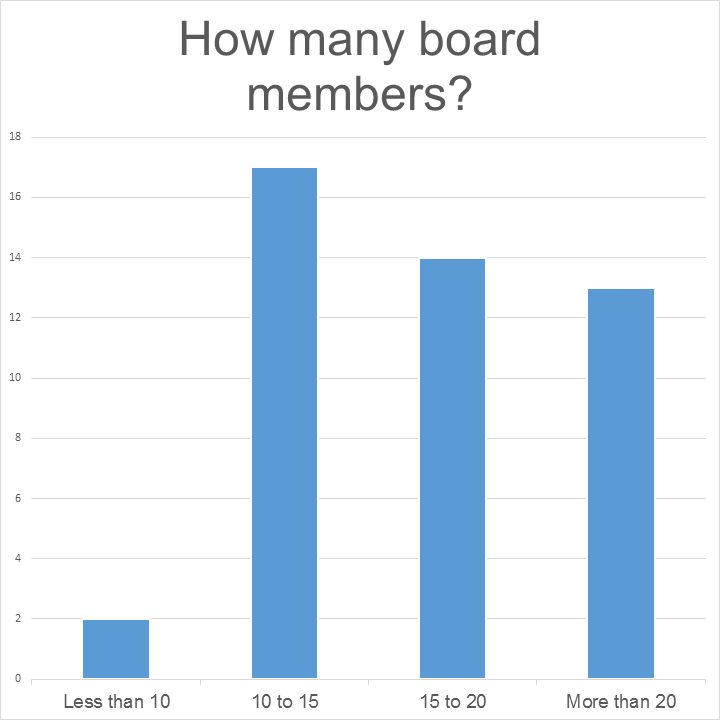
It appears that most of our respondent’s museums favor a large board membership. Just two of our museums reported a lean and mean board of less than 10 people. 37% have boards of 10-15 people, 30% have 15-20 people, and 28% weigh in at more than 20 board members. Some of our discussion during the workshops was how inefficient many boards are and how the numbers of board members might contribute to that inefficiency. Many of our participants indicated that they have made efforts to shrink the size of their board, but there is often great inertia and pressure to keep the status quo.

A solid majority of our respondents – 70% – report that their boards have term limits, which indicates that they follow general best practices for nonprofit governance. In our workshops some of the museums that do not have term limits defended them, saying they work for their museum by retaining those people most committed to the museum. Many, however, also recognized that lack of term limits makes their institution more conservative and insular.
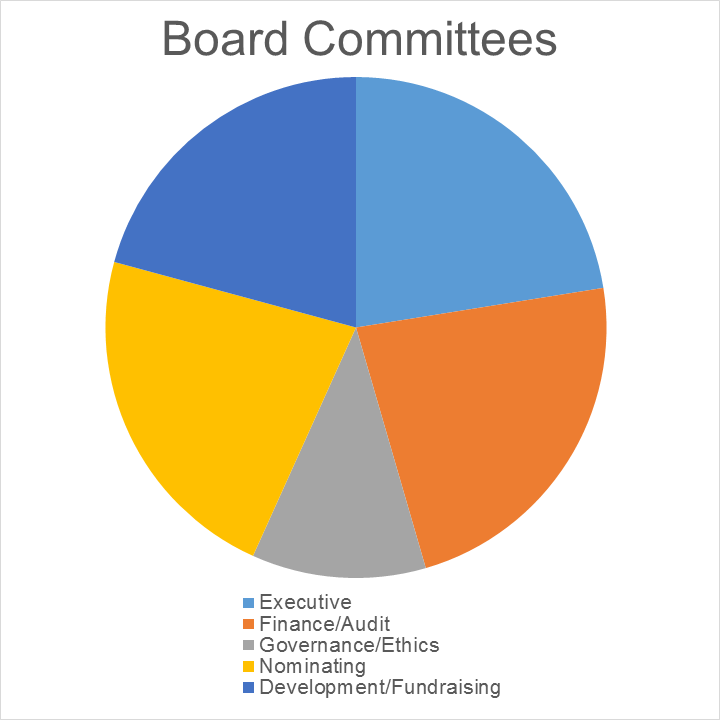
When asked what committees their boards employ, more than 80% of our respondents indicate the four most traditional: executive committee, finance/audit, nominating, and fundraising. Only 43% say they have a governance and ethics committee. Anecdotally, though, our workshop participants said those functions were often addressed through their nominating committee.

One trend we’re seeing with boards is that more and more work is done through ad hoc task forces or study groups rather than in formal committees, and our survey seems to bear this out. 61% of our respondents say they employ these informal, task-oriented groups for things like special events, strategic planning, capital planning, and so on.

Of the various activities in which boards engage, it seems that annual review of investment performance is number one, followed by evaluating the CEO each year, providing orientation to new board members, and approving the museum’s annual Form 990. Only 26% of boards employ a consent agenda to make their meetings more efficient, the same number that take an annual retreat. And the least popular activity is performing an annual board self-assessment – only 11% of our respondent’s boards do that.
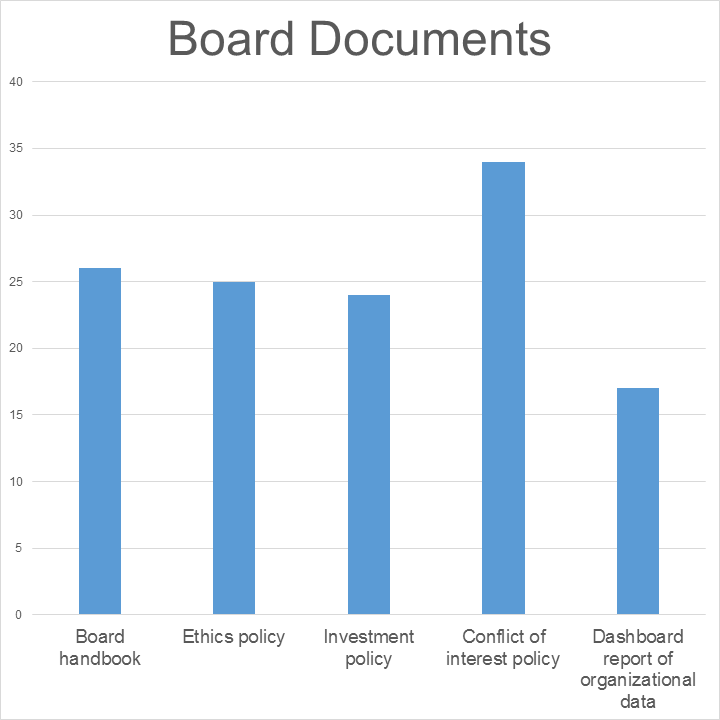
Almost three quarters of our respondent’s boards maintain a conflict of interest policy, the most popular of all board documents. More than 50% of our boards use a board handbook, and have ethics and investment policies. Fewer boards have moved to using a dashboard of institutional data – just 37% – but we know this is trending upward to increase board efficiency.
As mentioned above, board diversity is incredibly important to institutional relevance, and our survey confirms that our boards are not doing a very good job at it. Just 16% of our respondents say their board reflects the diversity of the communities they serve. We have a long way to go here.
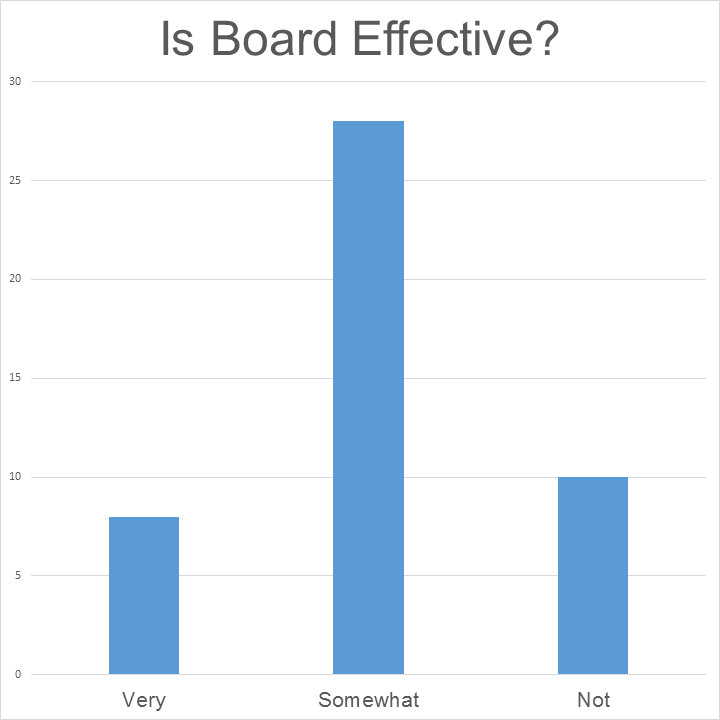
Perhaps the most surprising thing about our survey is its honesty. Only 17% of our respondents say their board is very effective. The rest, 83%, say their boards are somewhat effective or not at all. Of course, effectiveness is in the eye of the beholder, but it is clear that there is a lot of room for improvement with their boards.
So what is the future of museum governance? Our “Essential Leadership” workshop participants shared many predictions. Museum boards of the future will do more of their business online and virtually; face to face meetings will become rarer as technology improves. Governance structures will change so that small, temporary, task-oriented groups will take the place of traditional standing committees. Fundraising will always be an important aspect of board work, but it will be in the greater context of “resource development,” in which introducing collaborations and opportunities is as important as raising cash. And NEMA may have a role in the board of tomorrow, according to workshop participants, by providing board training and acting as “matchmaker” between potential board members and museums.
Plenty of food for thought and fuel for future discussions.