
Managing “The Grandchild Effect": Fostering Intergenerational Volunteer/Staff Relationships in Museums
By Amanda Goodheart Parks, Ph.D., Director of Education, New England Air Museum
As anyone who has spent any amount of time in our field knows, volunteers play a vital role in helping museums fulfill their missions. In a world of ever shrinking budgets and ever increasing visitor expectations, volunteers provide important and meaningful service to their organizations. From leading tours and staffing the front desk to performing collections care and archival research, volunteers donate their time and expertise in support of museums, making them an invaluable asset to individual organizations as well as the field at large. According to a 2006 American Alliance of Museums study, for every paid staff member in the museum field, there are six volunteers.[1]
Maintaining successful volunteer/staff relationships is therefore an important priority for museums both big and small. However, as with many facets of museum work, some things are easier said than done, especially when generational differences between staff and volunteers come into play. What are the ranges of inter-generational workplace dynamics in museums, and what strategies exist for building successful working relationships between museum volunteers and staff of all ages?
For the first time in modern history, five generations of American workers are engaged in the workplace. From the Silent Generation to Generation Z, Americans born in nine different decades are interacting with one another at work. While generational comparisons are by no means a new phenomenon— Socrates is said to have given a version of the classic “Kids today!” critique in the 5th century B.C.E.— modern generational theory stems from the work of early twentieth century sociologist Karl Mannheim. According to Mannheim, people are greatly influenced by the socio-historical environment of their youth. This environment, and the shared experiences that come along with it, give rise to social cohorts that in turn influence events that shape future generations.[2]
In recent years, generational theory has been widely adopted within the workplace as well as within popular culture. A Google search of the phrase “generational differences” will bring up a variety of hits ranging from HR reference guides to generational personality quizzes. (For the record, I routinely score somewhere between a Gen Xer and a Millennial on said quizzes, highly apropos given my birth year). Within the context of generational theory, the five generations currently involved in the American workforce can be categorized into the following cohorts:
- The Silent Generation (born between 1929-1945)
- The Baby Boomers (born between 1946-1964)
- Generation X (born between 1965-1980)
- Millennials (born between 1981-1996)
- Generation Z: (born between 1996 and the present)
Although the field of generational research has been criticized for its use of stereotypes, in general, differences between these generations within the workplace can be summarized using the following chart developed by the Federal Occupational Health Agency.[3]
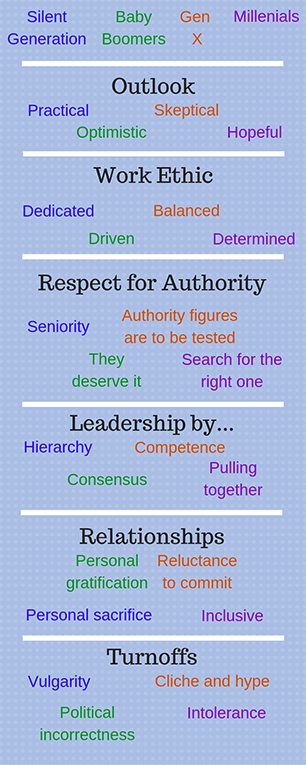
Note: Generation Z is excluded from this list as the oldest members of this generational cohort are just beginning to enter the workplace, leaving researchers with limited data from which to draw conclusions.
In the museum field, these generational differences not only influence workplace culture, but relationships between museum staff and volunteers as well. Despite continued efforts by many museums to recruit and retain volunteers from all walks and stages of life, most museum volunteers are retirees age 65 or older, i.e. members of the Silent or Baby Boomer generation. Meanwhile, according to a 2015 Pew Research Center study, 68% of American workers are Gen Xers or Millennials, individuals ranging from their early 20s to their early 50s.[4] These generational differences can lead to tensions between museum volunteers and staff. They can also lead to strong, meaningful workplace relationships. I know this because I’ve experienced both scenarios first hand.
I was 25 years old when I first became involved in museum volunteer management, 40-50 years younger than the cohort of volunteers with whom I worked. While most of these volunteers were an absolute joy, some found it very difficult to accept me as an authority figure. I recall one instance where I overheard two such volunteers discussing how I was the same age as their grandchildren, and therefore couldn’t possibly be qualified to manage the museum’s volunteer program. At first glance, this could easily be taken as a personal affront. (I’ll admit, that’s how I took it at first). However, after talking it over with one of my colleagues-- a late Boomer/early Gen Xer who has since become a dear friend and mentor-- I realized these volunteers might simply have been trying to make sense of me within their generational world view. To them, authority figures are synonymous with seniority, something I, being the same age as their grandchildren, clearly did not have in my role at the museum. Although my relationship with these individuals eventually grew into one of mutual respect, I’ve come to learn that this “Grandchild Effect” is a common source of tension between Millennial and Gen X staff-- many of whom have graduate degrees and years of experience in the field-- and their older volunteers.
However, it is important to note that generational stereotyping goes both ways. For example, in my current role at the New England Air Museum I work with over one hundred volunteers, most of whom are retired men from the Silent and Baby Boomer generations, though some of my oldest are members of the Greatest Generation, i.e. individuals born before 1929. Given my prior experience with inter-generational workplace dynamics, when I first arrived at the museum, I assumed the volunteers would be resistant to switching from signing up for volunteer shifts in person on a weekly basis (as they had done for many years) to a weekly email blast that included all upcoming volunteer opportunities. Based on this assumption, I kept the old system in place for over a year. It wasn’t until several volunteers came to me suggesting we switch to an email-based system that I realized I had been guilty of generational stereotyping. I wrongly assumed that because my volunteers were older, they would resist changing to a new, technology-based system.
Experiences like these have helped me realize generational differences between museum staff and volunteers are not a challenge to overcome, but rather an opportunity for personal and professional growth. With this in mind, I’ve compiled my top five recommendations for fostering successful inter-generational work relationships among museum volunteers and staff:
1. Know your audience: If you’re new to volunteer management or are working with volunteers from a generational cohort you’ve not encountered before, read up on generational theory and its impact on workplace dynamics.
2. Push beyond the stereotypes: While theory is important, it’s certainly not everything! Get to know people on an individual basis so you’re not tempted to fall back on generational stereotypes.
3. Establish a culture of mutual respect: Lead by example, respecting the life, work, and content area expertise of all your colleagues, no matter their age.
4. Find a mentor: Seek out colleagues who belong to a different generational cohort than you who are willing to give you guidance and support.
5. Don’t forget your common ground: Remember, you're all here because you believe in the mission of your museum. Let that be the foundation upon which your volunteer/staff relationships are built.
Whether you’re a Boomer or a Millennial, the Silent Generation or Gen-X, fostering strong inter-generational relationships among volunteers and staff will not only help fulfill your museum’s mission, but help strengthen the museum field as a whole. And that’s something we all can support, no matter what generation we belong to.
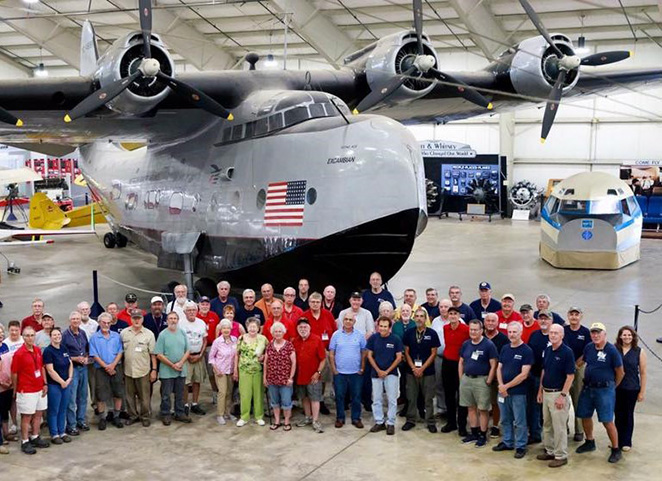
Photo Caption: New England Air Museum volunteers at their annual Volunteer Appreciation Picnic.
[1] 2009 Museum Financial Information, American Alliance of Museums, as quoted in Elizabeth Merritt, “Volunteers and Museum Labor,” Center for the Future of Museums, October 18, 2016.
[2] Karl Mannheim, The Problem of Generations, in Peter Kecskemeti, ed., Essays on the Sociology of Knowledge (London: Routledge and Kegan Paul, 1952), p.276-320.