
Beyond the Winning Score: The Sports Museum as a Lens for Broadening Understanding
By Douglas Stark, Museum Director, International Tennis Hall of Fame
"Before I am an athlete, I am a black woman. And as a black woman, I feel as though there are much more important matters at hand that need immediate attention, rather than watching me play tennis. I don't expect anything drastic to happen with me not playing, but if I can get a conversation started in a majority white sport, I consider that a step in the right direction." Naomi Osaka, 2020 US Open Women’s Champion
At the recently completed US Open in Flushing Meadows, New York, Naomi Osaka, who eventually captured her third Grand Slam championship, found her voice. Previously, she was viewed as a young, top-ranked player with a bright future and some signature victories.
That all changed in 2020.
In each of her seven matches, she wore a face covering/mask displaying the name of a different Black victim of alleged police or racist violence in the United States. Names included Breonna Taylor, Elijah McClain, Ahmaud Arbery, Trayvon Martin, George Floyd, Philando Castile, and Tamir Rice.

Naomi Osaka
"I feel like the point is to make people start talking," Osaka said in an interview. "I'm aware that tennis is watched all over the world, and maybe there is someone that doesn't know Breonna Taylor's story. Maybe they'll like Google it or something. For me, just spreading awareness. I feel like the more people know the story, then the more interesting or interested they'll become in it."
Throughout the summer of 2020, the sports community was front and center regarding the Black Lives Matter movement. Whether through masks or apparel displays or boycotted games, the players, coaches, and executives took a leadership role in forging dialogue and shedding light on important societal issues.
Sports has the unique ability to bring people together and thus can be used to discuss larger topics associated with history, civics, science, literacy and other disciplines. Sports museums should exist as more than a repository of the great objects and moments; they should reflect the work of thought leaders in their specific industries. Sports museums, their exhibits, and educational programming can leverage their unique way of bringing people together while functioning as the trusted source of education and information. As such, museums have a platform to create deeply relevant material that illuminates the intersection of the sporting past with the present, and inspires a better future.
Within the global tennis and Newport communities, the International Tennis Hall of Fame (ITHF) in Newport, Rhode Island is assuming a leadership role in chronicling, interpreting, educating and forging partnerships regarding the importance of Black tennis history—both historically and in the present-day climate. The stories of historical figures and momentous events are being curated to share knowledge of history in a way that will be engaging and accessible to a broader audience. Tennis is the catalyst by which we are developing a comprehensive program with several initiatives regarding Black tennis history.
First, beginning in the fall of 2019, the ITHF began discussions to create a project that will document the global Black tennis history experience. The purpose of the ITHF Black Tennis History Research Project is to compile a history of Black tennis reflecting diverse players of color worldwide who have embraced the sport of tennis and have achieved major success while overcoming significant barriers. The research will focus on the history of Black tennis in broad geographic areas, including Africa, Europe, Central America/South America/Caribbean, North America and Asia/Australia/Pacific. Each of these regions have been identified as a rich source of history contributing to the growth of Black tennis starting with the indigenous population in Australia representative of the first emigrants from Africa more than 70,000 years ago. The intent of the ITHF Black History Research Project is to be inclusive of those individuals and organizations whose commitment to Black tennis have facilitated the opportunities for today’s players. The project will recognize that players develop, in part, because they are able to stand on the shoulders of those who came before them and in part because they receive support from their coaches, clubs, tennis organizations and events, schools, colleges and media and personal networks. These contributors will be acknowledged for their important roles in the growth of Black tennis, social justice, and racial equality. The organization’s goal is to develop a digital production suitable for presentation on the ITHF website and promotion via email and social media. Marking the project’s capstone, the Tennis Channel will collaborate with the ITHF to present the history of Black tennis.
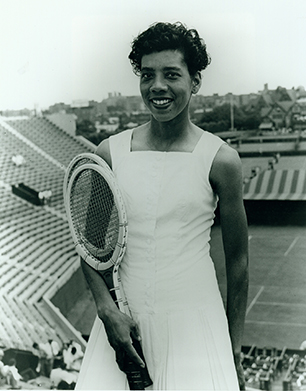
Althea Gibson, Forest Hills, 1956
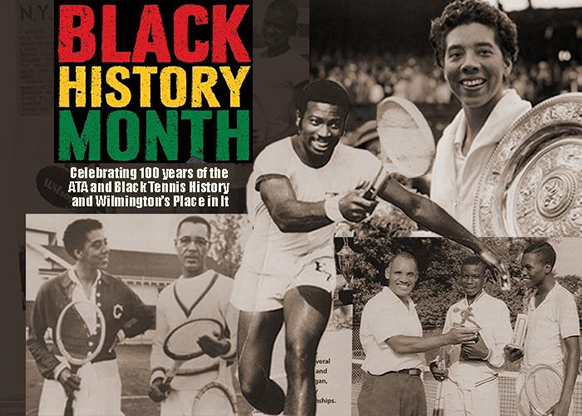
Second, the ITHF is developing a digital exhibit on its website that will provide comprehensive material and information relating to the Black tennis history experience as documented in our collection. This is based primarily on an exhibit, Breaking the Barriers: The ATA and Black Tennis Pioneers, that was developed for the 2007 US Open. Central to the exhibit are the origins and history of the American Tennis Association (ATA), established in 1916 to promote the sport of tennis and to help Blacks gain access to tournament tennis. The ATA was the first Black sports organization in the United States. While the accomplishments of Althea Gibson and Arthur Ashe are an important part of the exhibit, there are other stories to include—notably, the influence of their early mentor, Dr. Robert Walter Johnson. The exhibit also showcases the unheralded champions of the ATA before tennis was integrated; names in the spotlight include Jimmie McDaniel, Dr. Reginald Weir, George Stewart, Tally Holmes, Gerald Norman, Oscar Johnson, Lucy Diggs Slowe, Ora Mae Washington, Isadora Channels and the Peters sisters, Margaret and Roumania. The website intends to incorporate the exhibit, stories, oral histories, and primary sources to serve as a resource and historical guide to the accomplishments of Black tennis. Our hope is to continue to add material to this digital exhibit, expanding upon the stories that already exist while adding news ones such as Black tennis in Newport and in Rhode Island at large.
Awareness among the museum staff that our collection does not adequately document the Black tennis experience globally has been a welcomed by-product of developing this exhibit. Memorabilia relating to Hall of Famer Arthur Ashe and current players Venus and Serena Williams are present in our collection, but the larger, broader history of Black tennis is underrepresented. Our collections plan now highly prioritizes the documentation of Black tennis. Our hope is to build a more representative collection that documents Black tennis globally— key figures and moments as well as the stories of those who were unable to realize their dreams because of systemic racism. Included within this collection process are the masks worn by Naomi Osaka.
Third, in 2020, the ITHF received a Rhode Island Council for the Humanities (RICH) Major Grant for a storytelling performance on Black tennis and social justice for the Newport schools. This built off the work of a 2019 Mini Planning Grant awarded by RICH. Entitled, In Your Court: Black Tennis and Social Justice Then and Now, the grant continues a partnership between the ITHF, the Rhode Island Black Storytellers (RIBS) and Thompson Middle School (TMS) in Newport that implements these storytelling performances related to Black tennis. This project is designed to improve students' understanding about Black tennis history, and foster a greater appreciation of social justice issues in modern society. Leveraging the stories, life lessons, and values of the sport from notable champions will provide a greater understanding of social justice and equality issues, along with the historic processes that enabled such progress in American society. Students will be able to trace the relationship of these stories to contemporary issues and figures such as Serena and Venus Williams in both the sporting and societal environments. Students will prepare to recognize and confront injustice as informed citizens, by increasing their awareness of black tennis pioneers and the historic and contemporary importance of social justice. They will be able to correlate issues that historical African American tennis figures faced with those of present-day minorities and recognize that any form of social injustice is detrimental to society. The ITHF aims to show this performance in the Newport schools in February 2021.
In implementing all these projects, the ITHF seeks to not only enhance the civic life of Rhode Island students, tennis fans, athletes, and historians, but to also infuse a sense of identity for all people (regardless of age, race, or gender). The ITHF is one of Newport's oldest cultural institutions and inhabits a unique place at the intersection of the past, present, and future. The Hall of Fame is uniquely positioned to leverage the stories of its Hall of Famers to tell the story of American and global history and to make those connections relevant to contemporary society. Through its programming and outreach, the International Tennis Hall of Fame desires a more involved role in the community and working with the schools and children in developing a greater understanding of the history of tennis and its impact. Providing the necessary tools to research and understand the history of tennis and African American pioneers of the game stands as one of the organization’s primary goals. Additionally, the ITHF intends to enhance its position as a community resource that facilitates difficult discussions and dialogue around current events and societal issues. Finally, a more general but important outcome of this increased awareness of the history of black tennis history and social justice is to foster a more informed and involved citizenry that leads to healthy participation in society and democracy.
Sports museums can become relevant beyond storylines that climax at the winning score or final play. In fact, as museums take this next step towards relevancy, they will fulfill a longstanding and deeply impactful obligation, one that allows society at large to find a safe place to discuss contested and universally applicable narratives. Becoming and staying relevant is not a one-step process; rather it is part of a larger, well-rounded approach to governing an organization, realizing a mission and vision, engaging the community, and addressing current topics. Sports museums, as well as history museums with sports related exhibits, can help foster education and discussion that promotes a safer, more inclusive, and lasting sporting culture.
At the International Tennis Hall of Fame, we remain encouraged by all that stands to unfold from our newly developed, multi-pronged plan to document, interpret and educate a global audience on the history and impact of black tennis history.