Teen Guides: A Roadmap to Cultivating Diverse, Equitable and Inclusive Museums
By Katy Sullivan
Editor’s Note: We recognize that many front-facing departments and positions in museums have been the most adversely affected by the pandemic shutdowns. While the long-ranging effects of COVID are yet to be determined, we hope that as museums build back in anticipation of returning visitors, museums will consider the opportunities to increase staff diversity and community relevance through programs such as the ones detailed in this article.
Nina Simon[1], Stephen Weil[2] and so many others tell us that the future of museums depends on the ability to matter to individuals. Yet, right now, it seems that museums fail to matter to enough people. According to Colleen Dilenschneider, only 16% of people in this country visit cultural institutions, and most of those individuals are white, wealthy and aging.[3] Many people do not feel comfortable in museums and do not see others in that space who share their background or physical appearance. Museum staff and volunteer demographics fail to reflect the demographics of our communities. Is it any wonder why people don’t feel comfortable? As Nina Simon says, “If you walk into a museum for the first time, and everyone you see is white, and you are not white, you will notice.”[4]
A Prototype for Building Diverse, Equitable and Inclusive Museums
While many strategies exist to build relevance and make museums matter to more individuals, reimagined tours demonstrate the tremendous potential of authentically engaging museum outsiders as partners in delivering visitor programming. When the people leading tours look different from traditional docents, the perception of who represents the museum and how objects are interpreted becomes more broadly inclusive. The presence of new guides transforms visitor experiences, the lives of tour leaders, and the institution itself.
Teen Docents
For three decades teens have been transforming museums into more relevant places. Research proves that partnering with teens to deliver tours and other educational programs not only benefits participants, but also makes museums more diverse, equitable and inclusive.
- Teen programs have the potential to change demographic patterns of museum visitation. Research shows that teen program participants, who are overall more demographically reflective of the general population than typical museum visitors, are more likely to become regular museumgoers.
- Teen program alumni become agents for building relevance in museums. Research shows that as adults they overwhelmingly value community, collaboration and diversity. In fact, many alumni go on to run youth programs in their communities.
- Teen programs open museums up to authentic engagement with more diverse partners. Proximity breeds understanding, empathy and appreciation. When teens work in a museum, the institution and the people in it become more open and welcoming.[5]
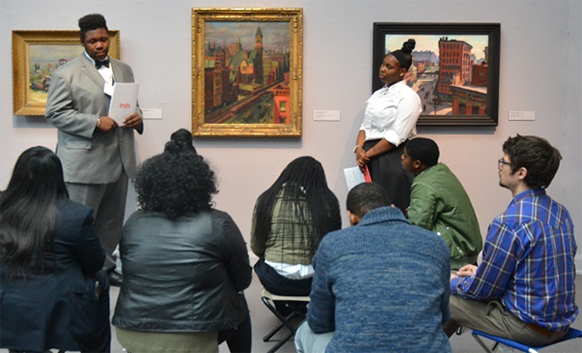
At the Pennsylvania Academy of Fine Arts (PAFA), high school students develop and lead tours for their classmates. The Museum’s recruitment strategy intentionally seeks out student guides with diverse lived experiences and backgrounds. PAFA partners with schools that lack access to museums and selects student docents based on their interest and ability to participate, rather than their grade point average or other academic qualifiers. The Museum empowers guides to engage audiences using a student-centered training program and a tour structure that builds docents’ skills and confidence. Students share authority with the Museum, providing their own perspectives on works in the collection and encouraging their audience to engage in conversation. Teens use art as a springboard to talk about issues they care about, fostering personal meaning-making for their peers. Tour participants and leaders alike, learn to view the Museum as a place where all voices are valued equally.[6]
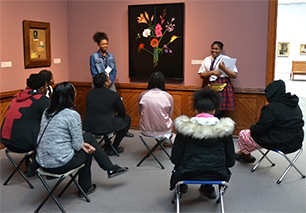
The Teen Docent Program at the Ogden Museum of Southern Art provides another example of using guided tours to elevate new voices. All of Ogden’s student docents attend New Orleans area public schools. Most of them have spent little or no time in a museum. Student docents earn a stipend and have the opportunity to work throughout the summer and on weekends during the school year. By compensating student docents, the Museum makes participation possible for kids from diverse socio-economic backgrounds. Like the PAFA program, Ogden focuses on instilling a sense of confidence and agency in their docents, empowering them to meaningfully engage audiences. The Ogden Teens not only lead tours at the Museum, they also bring the museum out into the community. Working with a professional artist, the teens develop a puppet show inspired by a work in the collection and perform the show at local libraries and hospitals. Teens write a story and script, thinking about how they can bring the art to life and make it meaningful for their audience. During the show they encourage audience members to contribute to the story, sharing authority with their audience, much like the Museum has shared authority with them – ultimately creating personal meaning for all.[7]
This type of authentic partnership not only benefits the teens and the audience, it transforms the museum. According to program director Ellen Balkin, “Having teens in the museum to be ambassadors for the programming that we have, to go out into the community, helps to change the perception of what museums are and what museums have become or are becoming.”[8]
These teen docent programs share several relevance-building principles. Museums recruit guides and docents with a range of backgrounds and lived experiences, providing them with individualized training and support. Tour leaders learn how to foster personally meaningful experiences for participants. They feel empowered to share their lived perspectives and encourage visitors to contribute to conversations. These common principles provide a framework for understanding the elements and impacts of existing teen docent programs, while also offering a pathway for creating more relevance-building tour models.
Key Principles of Relevance-Building Tours
- Seek out guides with lived experiences and backgrounds not often found in museums. This fosters a sense of belonging for more people and expands the notion of who belongs in a museum. Tour guides represent the museum in the mind of the visitor. When new people speak for the organization, the museum’s identity becomes more expansive.
- Empower guides to engage audiences. Leading tours is hard work that requires specific skills, particularly when guides have limited prior experience with museums. Successful tour programs require that museums understand the needs of their guides and provide them with the necessary support, training and resources.
- Foster personal meaning-making. Education theory points to the need for individualized learning. Yet, many tours sound like art history lectures. For people who don’t have an art history background (and even some that do) it can be difficult to make a meaningful connection to the object during one of these tours. Reimagined tours focus on creating connections for visitors.
- Share authority and value multiple perspectives. In reimagined tours, guides’ and visitors’ points of view and experiences share authority with curatorial information. Guides share personal stories related to objects and encourage participants to engage in conversation using works as a springboard. Valuing individual contributions alongside factual information creates a sense of shared ownership, transforming museums into more just and equitable places.
The future success of cultural organizations depends on their ability to engage a wider audience. By authentically elevating new voices as tour leaders who share authority with participants and institutions, reimagined tours engage people who haven’t yet found their place in museums. Teen docent models foster a pervasive sense of belonging. They transform the museum into a welcoming and equitable space where people with a wide range of backgrounds and lived experiences use art and objects as a springboard for making both personal meaning and connections with each other. As more individuals find relevance in museums, a positive cycle begins where those newly minted insiders join other supporters as ambassadors in an ever-growing circle of engagement. People develop a widely shared understanding of museums as spaces where all voices and perspectives are valued equally.
[1] Simon, Nina. The Art of Relevance. Museum 2.0, 2016.
[2] Weil, Stephen E. Making Museums Matter. Smithsonian Books, 2002.
[3] Dilenschneider, Colleen. “Active Visitors: Who Currently Attends Cultural Organizations?” Know Your Own Bone, 23 Jan. 2019, www.colleendilen.com/2019/01/23/active-visitors-currently-attends-cultural-organizations-data/.
[4] Simon, Nina. The Art of Relevance. Museum 2.0, 2016, pp. 66.
[5] Linzer, Danielle and Mary Ellen Munley. Room to Rise: The Lasting Impact of Intensive Teen Programs in Art Museums. Whitney Museum of American Art, 2015.
[6] Murray, Kristina. Personal Interview. 27 Feb. 2020.
[7] “2015 Teen Docent Program.” YouTube, uploaded by Ogden Museum of Southern Art, 18 Nov. 2015, www.youtube.com/watch?v=k552AU8n2HY.
[8] Caraska, Claire, and Kris Wilton, editors. “After the Bell Teen Convening 2016 / Education Report.” ICA Boston, icaboston.org/sites/default/files/PDFs/Teens/ICA_2016_TeenConveningReport.pdf. Accessed 1 Mar. 2019, pp. 24.
Images: Student Docent presentations (by and for Belmont Charter students), in PAFA’s Historic Landmark Building galleries, April 2018
Katy Sullivan recently completed a master’s degree in the field of Museum Studies at Harvard University. With a particular interest in the convergence of education, equity and financial sustainability, her research focused on how museums can create programs that build sustainability by authentically engaging more diverse audiences.