
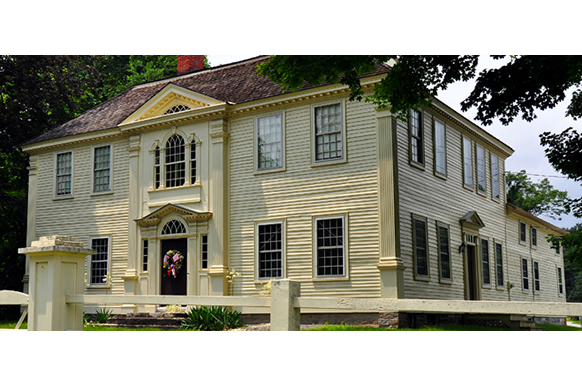
A Clean Slate: Clearing Room for the Complete Story
By Joanie DiMartino, Museum Curator & Site Superintendent of the Prudence Crandall Museum
“What happens when the artifacts in the collection hinder how the complete story is told?”
This was the main question staff found themselves asking as we embarked on a significant reinterpretation at the Prudence Crandall Museum, located in Canterbury, CT, and operated by the State Historic Preservation Office (SHPO).
Canterbury lies in the Northeast corner of Connecticut, known as the “Quiet Corner,” it is also part of the National Park Service Last Green Valley Heritage Corridor. The Museum is the original site of a higher education female academy and boarding school for African American young women founded by Crandall in 1833. In the fall of 1832, Crandall, the white principal of the Canterbury Female Boarding School, was approached by a young African American woman named Sarah Harris who asked to attend the academy. When leading citizens protested the integration of the school and parents threatened to withdraw their students, Crandall closed her school and reopened on April 1, 1833 for African American students. Her students came from several nearby states. Connecticut responded by passing the “Black Law,” which prevented out-of-state African Americans from attending school in Connecticut towns without local town approval. Crandall was arrested, spent a night in jail, and faced three court trials before the case was dismissed on a technicality in July of 1834. Two months later, a local mob attacked the school, forcing it to close. Many of the students went on to become educators and social justice leaders in their communities. Some, like Julia Williams Garnet, garnered national attention for her anti-slavery activism. The school became a private residence in 1834 until purchased by the State of Connecticut in 1969. Now a National Historic Landmark, it opened as a Museum in 1984.
In mid-2017, a new Director of Operations for SHPO was hired, and conversations began around a revised mission and vision for the museum. I was hired as the new curator of the site a year later. A looming structural renovation process and a new vision opened the necessary space to consider a different interpretation and museum experience upon reopening.
In the past the first floor of the museum had been exhibited as a traditional historic house: partial-period rooms with historic furniture and the usual accompanying items such as candles, tea sets, vases, faux food, and reproduction clothing. These rooms also housed display cases and moveable wooden exhibit panels. A fourth room served as a gift shop selling books, historic toys, candles, soaps, postcards, and other souvenir items. Also on the first floor was a ten-minute close-captioned introductory video for visitors to watch before the tour.
The second floor of the museum housed traditional exhibits: two semi-permanent (one was titled “Lives and Legacies: Prudence Crandall’s African American Students”), one temporary/changing, an installation of a “period dormitory,” and a research library that housed a few rare, some old, and mostly secondary books. None of these exhibits were accessible to visitors unable to use the staircase.
The museum shared a chronological narrative of the life of Prudence Crandall, and the tumultuous seventeen months that she ran her school for young African American women. Along with Crandall’s story, guided tours focused on 19th-century learning, architecture in Canterbury, CT, and abolitionist activities by mostly white Americans. Research had been done on the students of the Canterbury School, but it was predominantly genealogical, and not shared as part of the first floor guided tour. Programs included historic crafts, teas, and other aspects of life in the 1830s. Staff were dedicated to telling Crandall’s story, presenting an annual scholarly seminar, but overall lacked the resources and support needed to explore the complex narrative.
Crandall’s story, however, is much larger than the events that occurred in Canterbury from 1833-1834. The school was the site of racial and gender violence, and Crandall’s trial served as the first systemic court case for African American citizenship, thirty years before the Civil War. The events that happened here not only made national and international news in the 1830s, but served to galvanize the burgeoning Abolitionist movement (Crandall opened her school for African American students in April of 1833 and the American Anti-Slavery Society formed in December of that same year). The court cases the followed served as precedent for Dred Scott, impacted Brown v. Topeka, and laid the framework for the 14th Amendment to the U.S. Constitution. Above all, the inequities experienced by the students of Crandall’s school are still painfully similar to those experienced by BIPOC students in the 21st century.
I kept the tours and programs the same the first season I was hired so that I could get a sense of the visitor experience. However, I realized quickly that the history of this site, difficult as it may be to hear, had a direct connection to the trauma experienced by Black and Brown communities today, as eloquently examined by the Black Lives Matter movement. And even more meaningfully, that telling this story will continue the work towards achieving educational equity that Prudence Crandall herself and her students advocated for during their lifetimes.
As we listened to visitors, gauged reactions, and looked deeply into the history, we were charged with reviewing the mission. The old mission, of a standard “preserve and interpret” variety, felt stale. We developed a new mission statement, Through its story, the Prudence Crandall Museum, site of the Canterbury Female Boarding School, confronts the struggle for equity in education, places the school in the context of the history of the worldwide fight for Civil Rights, and encourages its audience to engage in civic dialogue and activity; and a vision statement, A world where all people have equal and equitable access to education everywhere.
We also created a tag line: Equality evolves through education. The reworking of our core mission even included discussion on changing the name of the museum itself—now a much more poignant conversation given current events. While the official new name has not yet been announced, we are fully committed to this process.
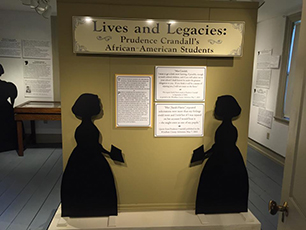
Exhibit of school students on the second floor of the museum.
The winter of 2018-2019, staff brought in an independent consultant to assist with room usage and storage ideas in the interim before renovations. With suggestions from the consultant, we moved the first floor displays around to resemble school rooms, and left the second floor the same, as it could be self-guided. We hired Capture, LLC to film a 3D tour of the complete museum, so that we could offer virtual tours of the second floor to visitors unable to use the stairs. While this helped to ground the story more completely in education, it too was not entirely accurate, as we know from primary documents that Prudence Crandall held classes on the second floor.
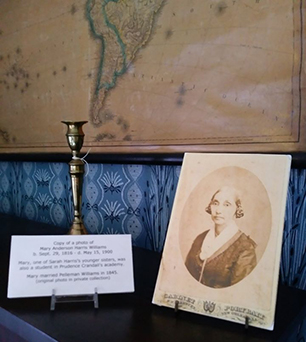
Close up of the photo of student Mary Harris Williams as an adult moved to first floor room.
We also added more about the students themselves to the first floor exhibits. A photo of Mary Harris Williams came down from the second floor, and quotations were added that were written anonymously by the students for William Lloyd Garrison’s The Liberator newspaper. We placed a photo of a sampler attributed to Sarah Harris next to an actual one stitched by Crandall. Giving the students equal interpretive time (and not just letting visitors discover them on the second floor) increased the length of the tours, but was worth it, because visitors responded very positively as the students were given names and faces, and their legacy was explained.
To gauge visitor reactions, we administered a survey for visitors to complete at the end of their experience. We offered an inexpensive book as an incentive (Dover reprints of African American authors), and seven percent of visitors that summer filled out the survey. This was by no means a scientific survey, but it did allow staff to gather enough information to inform new directions for interpreting the museum. In short, visitors were creating their own connections to issues of today—their own ‘personal meaning-making,’ and bringing the students’ experiences to the forefront of the story allowed for those connections to happen.
Throughout that summer of 2019, seasonal worker Erica Ciallela and I had many in-depth conversations about potential themes for a new visitor experience, and Erica researched the students as she inventoried both our library and artifact collection. We found, essentially, that we had very few artifacts that belonged to Prudence Crandall or the students, and most of the items that we have are general household items from the 1800s, which do not offer the content or context to explore the history of educational equality.
And this gets back to my original question: “What happens when the artifacts in the collection hinder how the story is told?” Most of our items fit a traditional historic house interpretation, but we are a National Historic Landmark because of the short time the site was a school that pressed for justice through equity in education for African American women. Interpreting the site with collections that do not allow for the voices of students such as Sarah Harris and Maria Davis does no justice to the critical importance of the site and its history. If there are no items in the collection that speak to the students and their roles as catalysts, as agents of change in their own lives, then a critical piece of the story is missing. When we cleared the rooms to prepare for the renovations, and we looked closely at the collections, we saw just how clearly the old adage, “Your historic building is your most important artifact,” applies to our site.
Over the past two years, staff at the Prudence Crandall Museum have attended workshops and conferences on interpretive planning, and on presenting difficult and untold histories (including one offered by NEMA). We’ve read articles about implicit bias and adding non-white, non-European voices into museum interpretations. We have listened to our colleagues offer advice about negotiating difficult history in a traditional space. We’ve made some decisions as well. Based on visitor feedback, we determined that when we reopen our gift shop will only sell items that support our mission and the stories we share. In addition, our research library is underused, has few primary source materials to share and takes up valuable space. Reopening the site without the library will allow for more exhibit space to tell the complete story.
Just as we had arrived at the place where we began to reach out to scholars and focus groups with our themed mind maps and new mission for discussion, the deaths of George Floyd and Breonna Taylor brought an urgency to the demands for social justice for Black and Brown people. Staff strongly felt that it was time, given the history we are surrounded with every day, and the progress we had already made, to make a statement and share the upcoming changes planned for the museum. We said clearly that Black Lives Matter, that Black Education Matters, and that:
“The Prudence Crandall Museum is committed to addressing what is one of the root causes of systemic and institutionalized racism: inequality and inequity in education, and plans to do so by utilizing the story and the legacy of the Canterbury Female Boarding School to share the complete history of the school, the students, the teachers, the supporters, and the impacts their stand on behalf of equal access to education for African Americans had on American society and culture during their lifetimes and beyond—well into the 20th- and 21st- centuries.”
These are human rights issues today, as they were in 1834. We want to be transparent. The story of the school, and the racial violence that occurred on the site has not changed. The way we share the story with the public will change. Moving forward, as we hone the method of interpretation, there will be training throughout the process for interpreters (volunteer and paid) and staff on engaging visitors in difficult history and dialogue. The Prudence Crandall Museum is applying—with our three other SHPO museums—for membership in the International Coalition of Sites of Conscience. We are in the process of drafting a proposal for an IMLS “Museums Empowered: Professional Development Opportunities for Museum Staff” grant to enhance the depth and breadth of the deep cultural justice learning that will challenge systemic racism in our operations and interpretation. We don’t yet know what the new museum experience will entail, but we do know we will respond to our present to envision our future as we acknowledge our past.
Secretary of the Smithsonian Institution Lonnie Bunch III was interviewed in a July 2, 2020 New York Times article on the social justice role of museums. He quoted the late African American historian, John Hope Franklin, “[Y]ou need to use African-American history as a corrective, to help people understand the fullness, the complexity, the nuance of their history.” By clearing out these rooms and cleaning our interpretive slate, the site of the Canterbury Female Boarding School makes space for the African American voices integral to its history, as we embark on a journey to a truthful telling of the full and complex, valuable and human story.