
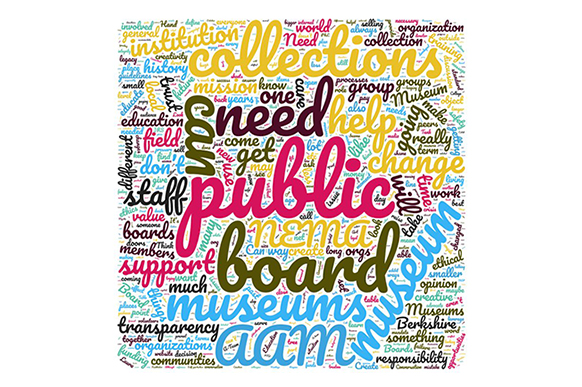
The Deaccessioning Dilemma: How Can We Support Standards AND Museums in Crisis?
Recap of the Think Tank Session held at the 99th NEMA Conference, October 27, 2017
Earlier this year news broke that the Berkshire Museum, a NEMA institutional member located in Pittsfield, Massachusetts, intended to deaccession and send to auction more than 40 works of art, including two Norman Rockwell paintings donated by the artist himself. According to the museum, proceeds from the auction would enhance the museum’s endowment and fund a “new vision,” which would include tech-driven exhibits focusing on science and natural history.
The news sparked a firestorm of controversy within the museum field because the Berkshire Museum is admittedly flouting the field’s standards, claiming that the deaccessioning is necessary to overcome a structural deficit and ensure the museum’s survival. Response to the news quickly demonstrated that there is a continuum of opinions in the field when it comes to the applicability of professional standards, especially those concerning deaccessioning.
On the one hand, there are those who believe that deaccessioning rules promulgated by national associations like American Alliance of Museums (AAM), Association of Art Museum Directors (AAMD), and Association for State and Local History (AASLH), hold the field to high standards that contribute to accountability and public trust. When museums break these ethical rules, they believe, public trust erodes and donors who support museums with their funds and collections become hesitant to provide that support in the future. Accordingly, AAM and AAMD released a joint statement condemning and censuring the Berkshire Museum.
On the other hand, there is the hard reality that museums sometimes succumb to the temptation of selling their objects in order to address financial setbacks, embark on new initiatives, build endowment, or other activities proscribed by museum field ethics. The realists in our field acknowledge this fact, some insisting that it is the primary duty of a museum’s board and staff leadership to ensure that particular museum’s financial well-being at all costs. Institutional survival, they say, takes precedence over retaining artifacts.
NEMA’s statement on the Berkshire Museum’s actions, released in August, took into account the full range of reactions from the field it represents. In the statement, NEMA strongly supports professional standards, but acknowledges the reality of unethical deaccessioning. Instead of censuring the Berkshire Museum, NEMA committed itself to fostering dialogue and helping advance conversation about the evolving role of museum collections held in the public trust, defining the role of standards in a rapidly-changing museum community, and suggesting realistic options that aid museums as they face significant challenges.
To that end, NEMA scheduled a “Think Tank” session at its fall conference in Falmouth, Massachusetts, to answer the question “How can our field support professional standards AND keep museums from being tempted to monetize their collections?”
The Think Tank
“The Deaccessioning Dilemma: How Can We Support Standards AND Museums in Crisis?” was held on 9 a.m. on Friday, October 27, 2017, the final day of the 99th NEMA Conference. Approximately 140 people participated in the session.
NEMA originally introduced the Think Tank session format at the 2014 NEMA Conference in Boston. The format is designed to be an interactive and dynamic session that sparks lively discussion about field-wide issues and seeks practical solutions from those participating. Facilitators are meant to spur the audience toward new ideas and meaningful insights that contribute to NEMA’s thought leadership. Prior Think Tanks at NEMA conferences have addressed the subject of diversity in the museum field, how museums can be more socially responsible, how museums can better communicate their value, and an investigation into museum field internships.

Session moderator Laura Roberts began this year’s Think Tank with a recap of the Berkshire Museum situation (click here for a transcript of Laura’s remarks), an explanation of the session’s ground rules, and a reminder to participants that the objective was not to re-litigate the museum’s actions, but to suggest ways to simultaneously uphold standards and help museums experiencing extreme financial difficulty.
Laura then led the participants in a conversation about the issues and questions about how deaccessioning standards apply to museums in crisis. These issues, recorded on easel pads, informed the next session activity, table discussions. The room was organized with tables of ten, each assigned a facilitator to help keep the small-group conversations focused and productive. After a half hour, Laura reconvened the session and asked each table to report their findings.
Issues and Questions
Issues and questions raised during the Think Tank fell into four primary categories: the relative value of objects and institutions, ethical standards, the public and community, and the museum field.
The values question seemed to be inspired by the notion that, in the case of the Berkshire Museum, a small number of objects (particularly the Norman Rockwell paintings) are in the minds of some people more important than the health and future of the institution itself. Here are a few typical questions in this category:
• What is more important: the institution or the collection?
• Is our obligation to our mission or to our founders’ vision?
• What do people value in an object?
• Can one object be more important than the institution itself?
Questions about standards seemed to probe whether they are (or should be) absolute or relative:
• How have standards changed over time?
• What happens when you run out of room for collections? When your institution has accessioned things they shouldn’t have?
• If your mission changes, can you deaccession to meet changing direction?
• What is the role of tradition in collections? Does hewing to tradition keep us from growing?
• Do standards impede our creativity?
Community relations and museums' place in the eyes and lives of the general public factored into the discussion as well:
• If we are supposedly public institutions, why do we receive relatively little in public support?
• How important is public opinion factor to our decisions?
• Do we have an ethical responsibility to our community?
• What does it mean to retain public trust?
Many questions were inward-facing, considering aspects of the museum field itself that have an impact on the deaccessioning issue:
• How much does peer pressure matter?
• How can we support our peers instead of censuring them?
• Do we have too many museums?
• Are we too competitive to help each other?
• Do we need to earn more (and raise less)?
Solutions
Ideas for solutions coalesced into six main categories:
• Board Training
• Public Relations
• “A-Teams”
• Failure
• Relaxation of Standards
• Alternatives to Auction
Board Training
Many of the table discussions revolved around the need for much greater training for museum boards. Participants said that, in general, board members often do not have an adequate understanding of how museums operate, the nuances of museum work that differ from those in other types of organizations, and an awareness of how their particular museum fits into the context of the wider museum field. Boards, of course, hold the ultimate power in a museum and have the legal responsibility for its financial welfare. But if they are not fully versed in museum field standards, they may not recognize the full consequences of their decisions when it comes to deaccessioning, such as the erosion of public trust, negative public relations, loss of standing and collaboration within the museum community, and potentially a negative impact on future donations. They also may not be aware of alternatives to deaccessioning or resources that may be employed to mitigate financial distress.
Where should this board training originate? Some participants suggested that museum associations such as AAM or NEMA should develop board orientation curricula that address these needs. But many participants also suggested that there needs to be much greater communication between the museum’s professional staff and the board, and that the staff (which presumably knows the standards) should be more assertive when it comes to providing boards with information on museum field standards and why their museum should abide by them. One potential solution is to encourage museums to recruit current or former museum professionals to their boards.
Public Relations
The general public is also unaware of how museums operate and what’s at stake in questions of deaccessioning, participants said. In the case of the Berkshire Museum, much of the negative public comment is focused on the mistaken assumption that the museum has a legal and ethical obligation to keep its collection (especially the Rockwell paintings) in the Berkshires. While in this instance the legal challenges are still in the courts, deaccessioning is a standard collection management technique, practiced by museums worldwide.
Session participants said that the museum field needs to do a much better job educating the public about the difference between ethical and unethical deaccessioning along with the legal rights and responsibilities of museum boards to ensure the financial health of their institutions. The public, they said, also need to know how difficult it is to operate a museum, especially in communities that do not or cannot support the institution financially. The field needs to advocate more effectively for its fellow museums.
However, participants also observed that even if a museum is legally justified in selling artifacts to buttress its financial position, it needs to take into account the negative public relations that may ensue. Museums must be vigilant about building public trust by acting transparently (a word repeated often during the session) so that its community and constituencies understand the facts behind its actions.
“A-Teams”
One idea that resonated with Think Tank participants was to organize rapid-response advisory boards or task forces (nicknamed “A-Teams”) that a museum could engage when it faced difficulties. These “A-Teams” could address a variety of issues such as deaccessioning, financial crisis, business planning, governance predicaments, natural disasters, and the like, providing the museum with immediate, confidential, nonjudgmental support from qualified professionals. The hope would be to create a permanent infrastructure of support that would help identify problems before they start and offer tangible solutions once trouble begins.
Think Tank participants suggested that these “A-Teams” could be composed of museum peers who volunteer their time to assist fellow museum professionals and/or independent museum professionals. Some people suggested that national and regional museum associations such as AAM or NEMA could be coordinating entities for the teams. Some suggested that NEMA’s professional affinity groups (PAGs) might be an appropriate conduit for organizing the teams.
One major concern with the idea was how these “A-Teams” would be funded. If they were to have an impact field-wide, the “A-Teams” would have to be affordable to every museum. There was some discussion about encouraging IMLS and other funders to create a way to subsidize this idea.

Failure
Many Think Tank participants noted the emotional turmoil surrounding the field’s response to controversies such as those presented in the Berkshire Museum case. Deaccessioning in particular seems to engender passionate responses, which sometimes pits museum professionals against one another privately and publicly. This, it was suggested, inhibits the field’s ability to find reasonable solutions to the problem. As one participant said, “Beating up on the Berkshire Museum is like shooting ourselves in the foot. We could all be rising and winning the war instead of battling against each other.”
From this conversation emerged an interesting solution: we need to re-examine and redefine what our field considers to be “failure.” Museums facing financial crisis or other difficulties are potentially afraid of reaching out to their peers for support and assistance because of the intense negative stigma of failure. This may then cause the museum to become reflexively inward-focused rather than avail itself of resources from the wider field. Museums in difficulty can be absorbed with fear: of the loss of public stature and of peer respect, of the “witch hunt” or bullying that can transpire when the public (and museum field) fixate on negative news, of being perceived as being a “loser.”
In order to destigmatize “failure,” participants suggested several ideas. First, we need to find new language as substitutes for words like “crisis” or “failure,” which might help museums admit that they need help earlier in the process. We need safe words for discussion and safe spaces in which to hold the discussions. It was suggested that NEMA conferences are an example of those safe spaces, where museum peers can tackle difficult topics without fear of judgment. Related to the “public relations” solution discussed above, some participants suggested museums have more Town Meeting-style discussions within their communities to allow the public to be more engaged with their museum’s difficulties instead of expressing judgment.
Finally, participants suggested that the field needs to create a more productive dialogue around what it means for a museum to go out of business. Associations like AAM and NEMA could publish a “decision tree” for museums that would help them manage adversity (perhaps using as a model the AASLH white paper “When a History Museum Closes”). Such a decision tree would include advice on how to create consortia of museums for collaborative support and processes for how a museum can/should responsibly distribute its collections in the event that the museum reaches the end of its life span. Current standards need greater clarity by providing guidelines for deaccessioning with respect to saving an institution. One participant noted that “we need to think of deaccessioning as a responsible collections plan.”
Relaxation of Standards
Some participants believed that one solution to keeping museums from flouting standards is to relax the standards. In the case of deaccessioning, they observed that the current “direct care” rule in the AAM Code of Ethics, approved in 1993, was itself a relaxation of standards that were approved in 1991, which stated that the proceeds from deaccessioning could only be used for acquisition of collections. According to the AAM white paper “Direct Care of Collections” published in 2016, the rule was revised because “Nearly three-quarters of museums objected that this restriction was excessively limiting and an impediment to fulfilling their respective missions.” The rules, participants observed, are determined by the field’s needs at a moment in time.
Today, museum field paradigms are shifting. Visitor tastes and interests are changing, which means the role of the museum collection is changing. In order to maintain relevance in their communities, museums need to respond to these changing interests and re-tool their mission and collections if necessary, potentially using the proceeds from deaccessioning to help fund new initiatives more in line with their new directions.
The work of the Active Collections movement (activecollections.org) was cited as a starting point. This ad hoc group of museum professionals has published a manifesto claiming that, especially in history museums, collections have evolved such that millions of artifacts do not support the museum’s mission and, therefore, should be deaccessioned. While the Active Collections folks do not offer an opinion on the “direct care” rule, they indicate that the controversial ethical standards around deaccessioning must be changed to make it easier for museums to do it.
Some Think Tank participants questioned whether standards can ever be applied in an absolute, “one-size-fits-all” manner and pointed out that there are in fact differences (sometimes conflicts) in deaccessioning standards based on discipline. AAMD’s strict rule that proceeds from deaccessioning must go towards acquiring new collections is different from AAM’s more flexible “direct care” standard, which is further refined by AASLH, which allows historic structures to be accessioned as part of the collection and permits deaccessioning proceeds to fund structural preservation.
Some participants took this observation a step further and suggested a relativistic approach in which individual museums should be allowed to decide without prejudice what the standards mean to them. In this case, it might be useful to have the oversight of a museum association or authority that could offer case-by-case exceptions to the rules if a museum can demonstrate a situational need for the rule to be relaxed. Approval of an oversight entity that relaxes the standards might give the museum some financial breathing room, while at the same time maintaining a sense of public trust.
An interesting twist on this idea was to frame the discussion of the use of deaccessioning proceeds around the concept of “an asset buys an asset,” meaning that an artifact (which is an asset) can be deaccessioned to pay for another type of permanent asset, such as contributing to an endowment, indirect care of collections, buildings, conservation, and preservation. Stated this way, public trust could be maintained by assuring donors and potential donors that their support goes toward long-term sustainability rather than short-term (and short-sighted) bailouts.
Alternatives to Auction
This final category is sort of a catch-all for solutions that addressed ways in which museums might realize financial value by deaccessioning an artifact, but still keep the artifact in the public trust by avoiding the auction route.
One idea was for museums to find sponsors for individual artworks or artifacts, similar to the way they offer naming sponsorships to galleries, buildings, endowed chairs, and so on. This “adoption” approach would possibly give the museum funding for general operations or other initiatives while keeping the object in the museum’s collection, thereby staying within field ethical guidelines.
Collaboration was a significant focus of discussion at the Think Tank. Some participants suggested that museums form strong regional or disciplinary alliances that might provide cooperative services and resources that could help the financial stress of cohort members. If these groups were to pool or leverage financial resources, there might be a way for museums to “trade” objects in order to keep their collections aligned with their mission.
Related to this, some participants believed that consolidation and merger was a valid way of preserving a collection, if not the institution itself. Participants cited the recent consolidation of the Fruitlands Museum in Harvard, Massachusetts, with the larger, state-wide Trustees of Reservations. Unable to sustain itself on its own, the Fruitlands elected to merge with the financially stronger Trustees, which promises to keep the collection and mission alive. Similarly, participants mentioned the merger of the Higgins Armory Museum with the Worcester Art Museum in 2013 as well as the responsible process currently being engaged at the American Museum of Textile History to relocate its collections to other museums as it winds down its operations at the end of its life span. In these two cases, the institution itself went out of business, but the objects in the collection remained in the public trust at other institutions.
One final solution to keep museums from going to the auction house comes under the heading of advocacy. Participants commented that one of the main causes of unethical deaccessioning is financial strain. The Berkshire Museum case is demonstrating how difficult it is for an institution to remain viable when its community is no longer willing or able to support it financially. Donor bases are eroding around the country for a variety of reasons, including competition with the unprecedented expansion of the nonprofit sector generally, as is the case in the Berkshires.
Participants suggested that the field as a whole, led by AAM, NEMA, and other museum associations, needs to advocate for more public funding and more useful funding (the phrase “non-sexy funding” was used) from IMLS, NEA, NEH, and foundations. Grant funding is all too often limited to special projects, usually on a matching basis, which do not provide much economic benefit to the museum’s operations. Likewise, philanthropy is often maximized through capital campaigns that require the museum to expand its real estate or its programming rather than pay for day-to-day operations. Collectively, we need to educate and advocate for more flexible funding so museums can remain viable. Otherwise, the temptation to monetize the collection will continue.
Next Steps
The Think Tank at the NEMA conference was the first of what will hopefully be many opportunities for the field to weigh in on the “deaccessioning dilemma” and provide ideas for solutions. On December 14 – 15, AAM will be convening a two-day session called “Don’t Raid the Cookie Jar: Creating Early Interventions for Deaccessioning Crises” at the Harvard Museums of Science and Culture in Cambridge, Massachusetts. On Wednesday, January 31, NEMA will feature the “deaccessioning dilemma” as part of its monthly Lunch with NEMA webinar series. These and other field-wide discussions will hopefully provide critical mass to creating action steps toward solving the challenge of supporting standards AND supporting museums in need.