

NNOCCI is Changing Public Discourse and You Can Too!
By Hannah Pickard, NNOCCI Network Manager
Effective climate action requires productive public discourse and civic engagement. But we know that Americans are overwhelmed by climate change, and being overwhelmed leads to disengagement. Even though 70% of Americans believe climate is change is happening now, 64% are never or only occasionally talking about it1. This is something we need to change, and as museums we have the perfect position to model, engage and train the public to have more productive conversations and see themselves as heroes, protectors and responsible citizens. 61% of Americans visit informal science learning centers (ISLCs) each year, and we get visitors from every state!
But can one institution change public discourse alone? No! A collective problem requires collective action. Enter NNOCCI – or the National Network for Ocean and Climate Change Interpretation. NNOCCI is a generative social impact network of individuals and organizations in informal education, the social sciences, and climate sciences. We are currently working in 170 institutions in 38 states. We share a commitment to using evidenced-based communications methods and providing the social and emotional support needed to engage educators and climate scientists in this challenging topic. By working together we develop the knowledge, techniques, community and confidence needed to empower our visitors. And by speaking about climate change in the same ways across the country we are changing public discourse to be positive, productive and solutions-focused.
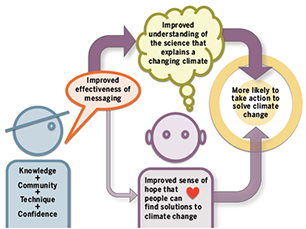
Fig.1 This diagram shows how our training program works. Our evaluation shows that as a result of increased feelings of self-efficacy and hope, alongside the benefits of social support, NNOCCI members become significantly more likely to talk about climate change with their audiences and peers. In turn, their audiences are significantly more likely to understand climate change, feel increased hope for climate change solutions, and increased intentions of taking community-focused actions for climate change solutions.
Our evaluation shows that we are empowering visitors at a national level too. When comparing visitors of ISLCs with NNOCCI-trained staff to visitors of ISCLs without NNOCCI trained staff, the NNOCCI visitors were more likely to:
• encounter climate change information
• express hope and confidence about their ability to talk about climate change
• believe that talking with friends, family and engaging with politicians about climate change is effective
• talk about climate change with others
• engage in more personal and civic actions to resolve climate change
When comparing ISLC visitors in general to non-visitors nation-wide, the ISLC visitors are more knowledgeable about climate change and are more likely to take action to address climate change. This shows that we have a primed audience and we should help those visitors understand their roles as heroes in the climate story2.
So how do we do it? What does a productive conversation look like? First, we need to give up talking doom and gloom and start talking about hope and civic action. Productive conversations on climate change explain why it matters, what’s going on and shine a light on what is already being done about it. By arming people with a solid understanding of the mechanisms we empower consideration of multiple solutions and offer a roadmap as to how to get involved in solutions that matter.
Here’s how you start:
Connect with people over our shared value of wanting to safeguard the people and places we love. While we all come to care about climate change for different reasons, most Americans deeply hold this value of protection. If you’re a museum interpreter, you talk to strangers most of the day. Knowing that you both care about protecting the things you love is a very important tool in your tool belt. Here at the Aquarium, we believe that it is our responsibility to safeguard the people, places and animals we love from harm. Protection means actively reducing risks to our community, like from the impacts of climate change. Fortunately, we already have tools to start tackling climate change, and so we can act now to handle the problem before it gets worse.
Explain what’s going on. And no, don’t get bogged down in all the data. Try this tested metaphor. When we burn fossil fuels, like coal, oil and natural gas, we emit excess carbon dioxide into the atmosphere. In the atmosphere carbon dioxide acts like a blanket trapping in the world’s heat. The excess heat is like thickening the blanket, and is throwing our climate system out of balance.
Connect the mechanism to one impact. (Read: this is NOT the time for a laundry list of impacts. Lists are overwhelming, and again disengaging). For example, here in New England the extra heat is leading to more extreme precipitation events. As the planet warms, more moisture evaporates. The more evaporation, the more moisture is in the air, leading to more intense storms. Flooding from these storms is affecting our transportation system and disrupting our daily lives. Reducing our reliance on fossil fuels is key to ensuring our thriving community.
Wrap up with what we are doing about it and invite people to talk to others. This piece of the story is crucial to instilling hope and empowerment. You want to highlight an energy efficiency or renewable energy action that is happening in your town, county or state. You may also recommend joining a local environmental group working on a project– we all need peer support to be climate heroes and we do not need to reinvent the wheel. And you want to encourage folks to talk about climate change with others, just like how you both chatted now. Fortunately, just like you and me, many people are concerned about climate change and want to protect their communities from harm. It starts by getting more people involved in the conversation, which is something we can all do. But it doesn’t end with talking; we can join to make bigger changes that will make it easier for us all to participate in climate-friendly actions. For example, many municipalities in Massachusetts have started offering Community Electricity Programs. Citizens came together to use bulk buying power to negotiate a better price for green-sourced electricity. Because of their collective action, all residents are automatically enrolled in plans that have a percentage of solar electricity, and the option to join a plan with 100% renewable energy at a fair price. One way to participate is to join a local environmental group and help accomplish bigger projects as a team.
So try this out, and let us know how it goes! We are here to support your journey to being a more effective climate communicator. We offer online and in person trainings give you the tools and the community you need to be a changemaker. Tweet at us @_NNOCCI, find us on Facebook or email nnocci@neaq.org. Join us on www.climateinterpreter.org to get more tools, activities and resources for having climate conversations with visitors.
1Climate Change in the American Mind May 2017, Yale Project on Climate Change Communication http://climatecommunication.yale.edu/publications/climate-change-american-mind-may-2017/
2 Swim, J., Geiger, N., Fraser, J. & Pletcher N. (2017). Climate Change Education at Nature-based Museums. Curator: The Museum Journal, 60(1), 101-119.