
Standing Out, Standing Together: A Case Study in Community Partnerships
By Joseph Sette, Former Director, Wiregrass Museum of Art and Dana-Marie Lemmer, Director & Curator, Wiregrass Museum of Art
Five years ago, we had an opportunity to host an outdoor show of David Hayes sculpture. Having just started my tenure as museum director our team worked very hard in establishing an exhibition schedule along with the needed resources and funding to support the upcoming year. As with all museums everything was linked to a budget and our installation schedule was already set and approved for the year, so when this opportunity came calling we had to think of other ways to make this happen. As a small museum we just didn’t have the extra means. That’s when I picked up the phone.
A Collaborative Model for Funding and Support
I knew that we could gain support from the various community organizations and the City of Dothan if we approached them with the idea of sponsoring one or more sculptures. The sponsor was able to select their sculpture and location. This formula made the show possible. My experiences in the military and running commercial businesses prior to being hired as director taught me the importance of teamwork and collaborating for success. I was not surprised at how far the collaborative effort went, and how eager our community partners were to get involved. The relationships established between the museum and community leaders made it easier to make those calls. This opportunity was a perfect example of how to integrate art into the community, share the cost of a large-scale show and make a lasting impression.
By gaining sponsorships for each of the 20 pieces to include the City of Dothan, Wallace Community College, the Dothan Area Botanical Gardens, Troy University, civic organizations and our own Board, we installed sculptures in many of our city parks, both local institutions of higher learning, our well regarded botanical garden, and the museum grounds. We worked with the City and the community to create our first ever sculpture trail: the experiment became a model that was successfully recreated in subsequent years following the Hayes show.
For their investment, major community organizations participated in a year-long celebration of sculpture curated by our staff. This extended the Wiregrass Museum’s programming well beyond our walls and touched residents and visitors we would not normally see. It also served to bolster Dothan’s well-earned reputation as a robust regional leader in arts and culture.
There were immediate commercial benefits. Dothan, Alabama enjoys unusual prosperity. Thanks to our rich soil, we are known as the Peanut Capital of the World, but we have become much more, as much of our regional economy is driven by education, healthcare and transportation. Midway through the exhibition, the City of Dothan welcomed a trade delegation from China. Our visitors came away impressed with the visual cultural amenities of a city ten times our size.
Stroll around Dothan, and you will see art everywhere. We are proud of our murals, our painted Peanut sculptures in front of various businesses and public buildings, our numerous arts festivals, and of course the Wiregrass Museum of Art’s own programming. This collaboration added an exclamation mark to what we have been doing all along by placing large steel sculpture in and around where people live and work. Community leaders were delighted.
The museum was also able to cross-pollinate with our two colleges through artist lectures, in-class discussions, and volunteer student involvement in the final preparation of the artwork. Wallace College also made space available in their central garage to use as a staging area before the individual sculptures were trucked and installed to their locations.
Local school groups have always been a mainstay at the Wiregrass Museum of Art. What made this show different is that the students could now see museum-quality artwork on Main Street, at their local residential park, by the Civic Center, and near their own schools. As with traditional exhibits within our walls, we were blessed with enthusiastic volunteers who became ambassadors in the community for the museum.
The collaboration showed all that is best about Dothan: a small, prosperous community that understood how critically arts and culture drove our quality of life. Better yet, we created a model that has been repeated and continues to serve the community.
Planning and Logistics
This exhibition required considerable planning. This is where our staff came in: we were fortunate to have the talent of our (then) curator Dana-Marie Lemmer, who was familiar with the artist’s work and reputation. She worked closely with the artist’s family to select and organize our the first ever city-wide exhibition of sculpture. We worked closely with our partners at Wallace Community College, Troy University, Dothan Area Botanical Gardens, and the City to identify the most appropriate locations in the area. We examined sight lines, pedestrian traffic, residential density plus opportunistic spaces to plan a fun, “beefy” show. The exhibition earned some nice press mentions and plenty of good will for the museum.
The museum and our partners looked carefully at sighting. At the Dothan Area Botanical Gardens, one sculpture looked as though it was growing in a stand of trees, another sprang from a large rock by a pond, and a third hung from a tree. At Wallace Community College, artwork was placed in centrally located green areas and included student help for the installation. Troy University’s sculptures held court in the center quad before the main administration building, where the campus got the most movement. In downtown Dothan, one large sculpture looked like just another pedestrian, except that it was eight feet tall, painted black, and built of steel. Another guarded the entrance to the downtown Civic Center. Our museum sculptures were arranged across our exterior grounds and provided around the clock programming for the public to easily pass through and observe.

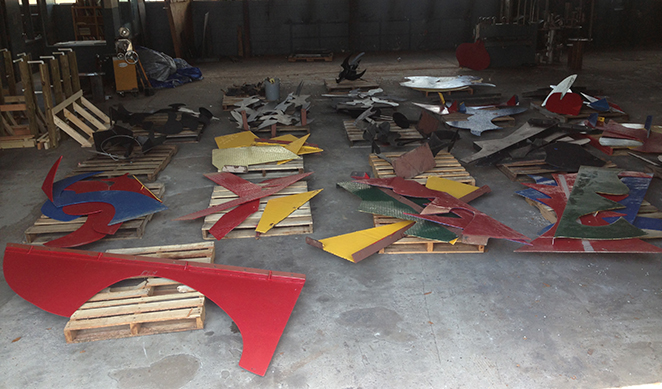
The logistical realities of mounting a large outdoor show can be challenging. In many ways, this project was challenging, but this is where collaboration helped again. Because the exhibition came directly from the artist’s family, the sculptures were in excellent condition. Also, the artist designed his pieces to be easily taken apart and shipped as flat steel plates. One or two people could easily handle each component piece. This meant no need for cranes or forklifts. Because the sculptures went together with off-the-shelf nuts and bolts, assembly under the family’s supervision was rapid. Thanks to our partner Wallace College, the museum had access to a large, dry garage that we used as a staging area for unloading the truck then sending individual sculptures out to their locations. A volunteer crew of college students from Wallace College helped with touch-up. Grounds people at each of our partner locations helped with installing and securing the work. Employees from the Department of Leisure Services helped transport and install the downtown sculptures, and art handlers at the museum took care of the pieces on our grounds. The entire installation went up in two days.

While planning the show, we looked at insurance. The artist’s corporation covered both installation and de-installation through their own liability policy (the museum furnished their certificate of insurance to the city). Each partner then added a rider to their existing policies to cover their artwork for one year. This is another example of how working with other entities allowed us to mount an exhibition that would otherwise be outside of our budget.
Leadership in the Community
Each partner showed enthusiastic leadership from the top. The presidents of each of our colleges attended the exhibit opening at the museum. So too did our mayor and other elected officials. The entire Board was present, as were community leaders. In short, the project served as a lively means to tie the community more tightly together. The only note of sadness was the artist’s absence as he had died earlier that year. His son John spoke on his behalf.
I was told that David Hayes felt strongly about placing sculpture in public places. He wrote that “It may be difficult to get people to walk into a museum or an art gallery. If you put the art where they already live, where they will pass by it on their way to work or to school, they can see and interact with it on their own terms.” Based on his son John’s talk at the opening, I feel that the Wiregrass Museum of Art did just that: placed artwork where people live, work, and play.
What was the impact of this collaboration on our community? I think the show’s curator, Dana-Marie Lemmer, expressed it well:
“With the ability to transform a municipality, these sculptures act as a unifying thread in the community. Passersby will encounter works while walking downtown or through various public parks, while playing tennis, or visiting local gardens and university campuses. Regardless of personal backgrounds, this public art serves as a great equalizer, offering each person a unique encounter on their own terms. Cities and communities gain value through public art, whether cultural, social or economic. Providing access to the visual arts to those that would not normally enter the museum walls, this display serves as outreach through the visual arts. Public art, which is freely accessible, adds meaning and uniqueness to our communities. Sitting easily in their chosen environments, the sculptures inspire creative thought and exploration in viewers who may speculate as they choose about what the forms represent.”
Perhaps most gratifying were the comments I heard from members of the community. Moms, small business owners, students – all let me know how pleased they were to have sculpture in their neighborhoods. I saw small children walk up to the artwork with glee. I saw young people picnicking in the park near the art. Email and social media comments to the museum went up nicely, as did attendance (which is always free).
Our staff understood the unusual challenges we faced to keep our work and programming captivating, lively and relevant. Good programming is hard. It’s expensive. Keeping ahead of our changing community and demographics demands insights that we are not always accustomed to. A project like this, worked out in collaboration with interested, animated community organization literally brings our museum to the people. In the museum business, as in any not for profit established for civic good, there is never enough money. Passing the hat on a large, collaborative project, where groups as disparate as a community college or a botanical garden can work out a complicated, exciting year-long, downtown art trail turns the difficult into the possible. We carefully noted best practices and recorded what worked (and what didn’t), so that the project was replicated in subsequent years. This is what makes it so wonderfully gratifying.
Long Term Effects
Since the David Hayes exhibition, the Wiregrass Museum of Art has completed a number of additional projects in the public arena, all planned and executed with collaboration at its core. The museum has hosted international artist Alex Brewer (aka HENSE) for a mini residency in which he mounted a site-specific gallery exhibition, as well as three public murals. Tim Kerr, an Austin-based artist, was sponsored by the museum to work with the Hawk-Houston Boys and Girls Club (now the Hawk-Houston Youth Enrichment Center) to paint a mural, celebrating their mission, and the history of the neighborhood it sits in. All exhibitions are centered around the goal of providing a platform for artists to experiment with their practice, share their stories with our community, and to serve as a voice in the regional dialogue on contemporary art.
The community benefits of working collaboratively are enormous. Residents and visitors enjoy museum quality artwork in their neighborhoods. A small museum with a restrained budget can bring in a big-city show. Bonds forged with community leaders serve to propel future projects. Our museum expanded its footprint well beyond its walls to the entire city, plus we had great fun doing it.
