
Intangible Histories: Making Meaning from Memory
By Erika Kiessner, GSM Project, Montreal
Last November, we led a conference session for NEMA on intangible histories. This panel was the culmination of recent conversations about decolonizing museums and telling the stories of those who are traditionally underrepresented. At GSM Project, a design firm focused on helping museums create impactful exhibitions, I've had the opportunity to talk with many of those blazing the way forward with a different kind of exhibition. We are starting to see exhibitions that are based not on artifacts and objects, but ones that tell stories drawn from oral histories, archives of correspondence, personal journals and articles, in short, the memories of the people who lived through the events.
Exhibiting these intangible histories is a potent way to bring overlooked stories to light. After all, the answer to ‘who leaves a record?’ tells a story of power. If a person's possessions are to be preserved they must first have the means to own things, and also the power to say that they are worthy of keeping. It is said that history is written by the winners, but our understanding of it is also too often informed by the owners.
So we do not root these new narratives in concrete things, but rather in the words of the people telling them. We use their retelling to piece the story together. It is a different way of presenting history because, in a way, tangible history is straightforward and concrete. Here is an object. It is made of these materials, in this place, around this time. We might not know who made it or why, but there are records and traces of the where and the how and the when that can be seen and examined and understood by visitors. The facts of the object, as we know them, are visible.
Presenting stories without artifacts calls for a new kind of storytelling and new techniques for conveying our content.
Three esteemed members of the field agreed to speak on the subject: how they have completed projects that tell these kinds of stories, and how the visitors responded to that telling.
We looked at how to express three different stories, each with different blanks that needed filling, different details that needed expanding, and different degrees of inference or even fiction used to portray the lives and experience of the people being presented.
Questions arise in my practice about how to faithfully extrapolate from incomplete or disconnected stories. How do we orient these stories as practitioners in a field that favors objects and concrete evidence? How do visitors understand intangible stories? What can be evoked and what should be manifested?
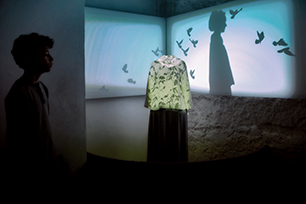
Sally Hemings room in the Monticello house.
The first case study we looked at described the Sally Hemings room in the Monticello house. Marie-Claude Baillargeon, a Creative Director at GSM Project explained the exhibit and some of the thought process that went into making it. A recent renovation of buildings at Monticello revealed Sally Hemings’ personal room. The people of the Jefferson Foundation saw this as the ideal place to tell the story of this very important woman. GSM Project worked with them to create an immersive, multimedia experience in the room itself. Unfortunately, there are not a lot of materials about Sally Hemings herself. There are records of her purchase and of the birth of her children, but much of the information about her is biased or lost. The Jefferson foundation chose to use the words of her son Madison Hemings as the single source to tell her story. He wrote about her as a mother and a well-rounded person. Augmenting this sense of her as a person, the design included a dress model, bringing her presence into the room at key moments. Using media, sound and video and the room comes to life. The key to this exhibit is how using Madison Hemings’ words keeps the experience hewing as close as possible to the source material. It stays as true as it can to the record of a real witness. Even in the media, since there are no surviving images of Sally herself, silhouettes and patterns are used to evoke her without creating artificial representations of her. These representations, along with the poetry of Madison Hemings’ words build an emotional connection between the story of Sally Hemings and the visitor.
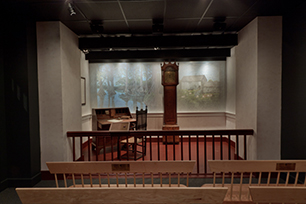
Free and Safe exhibit, Rokeby Museum
In a second case study we heard a story of the Underground Railway that took place at the Rokeby house. Jane Williamson, Director Emerita, Rokeby Museum described the exhibition Free and Safe, the story of Simon and Jesse, two slaves escaping through the Underground Railroad. The exhibition chronicles their time at the Rokeby house that is documented in the letters and materials of the Robinson family. The exhibition uses diverse means to share the story. Images, audio, and recreations using actors bring these historical figures to life. The facts of the story of Simon and Jesse are laid out in the archive of correspondence that the family kept. However, some of the events are extrapolated from a timeline of letters, and certain conversations are inferred. These events and conversations are presented to the visitors in a blend of authentic and imagined. A live action play was presented in the theatre. The sets were meticulously created and included objects from the collection. Scenes were imagined by the staff, scripted and then presented with actors playing the parts of the historical figures. This serves to complete the stories and bring the history to life in a way that feels tangible, despite the events being constructed, not from source material, but from the understanding and empathy of the exhibition creators.
Silver Wings and Golden Scales, Florence Griswold Museum
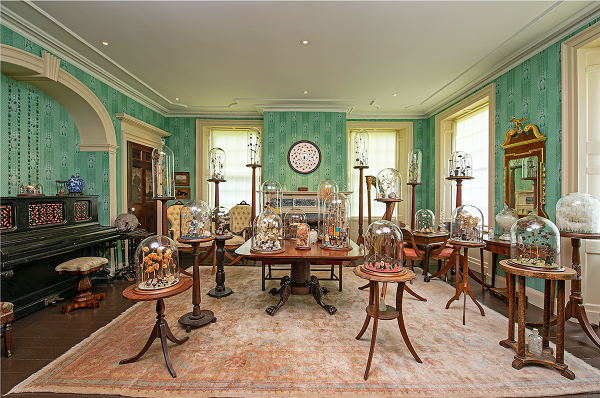
The third example introduced fantasy into the mix as a way of highlighting a history of environmentally conscious artists. David D.J. Rau, Director of Education and Outreach at the Florence Griswold Museum in Old Lyme, CT, shared their contemporary insect installation “Silver Wings and Golden Scales” by artist Jennifer Angus. Angus opted to write a fictitious “missing” chapter of the art colony’s history that recounted an insect-themed party the artists hosted one summer night in honor of the cicada migration. Hundreds of large exotic insects were pinned in fancy patterns on the walls of the central hallway reminiscent of Victorian wallpaper. Intricate insect scenes under a multitude of glass domes filled the front parlor and many insect-infused jelly jars lined the pantry shelves. Although completely fantastical, the over-the-top party was in keeping with the antics of the historic artists and brought attention to the environmental concerns facing us in the present day. Within the display, excerpts from Angus’s tale replaced the period rooms’ usual interpretative texts to draw viewers into the narrative emotionally and experience the historic house like never before.
Each case engages the mind of the visitor in a different way. With Sally Hemings, the exhibit uses the codes of theatre, sound and light to evoke her. It resists opportunities to stray from the source materials, letting the visitor’s imagination fill in the missing elements.
In Free and Safe, the museum blends verified facts with plausible fictions to bring depth and character to the story of the people in the Rokeby house. Visitors see these people come to life and actors give them personality and voice, making them more real than the materials alone would allow.
In Angus’ art installation, the visitor is taken on a fantastic journey that, despite being total fiction, resonates with the spirit of Florence Griswold and her coterie of artists. Visitors, viewing this fantasy party get a vision of the life and joy of the group, who lived, worked and created in that house. This vision gave them a taste of the experience of being there; perhaps as powerful as the authentic artifacts found in the house itself.
These three examples offer different possibilities for approaching designing exhibitions around intangible histories.
In Marie-Claude’s example, visitors and especially the descendants of Sally Hemings were pleased with how the words of Madison Hemings were honored and how effective that was at telling her story.
In her case, Jane told us that visitors felt that the figures of Jesse and the Robinson family really came to life through the exhibition.
Through the fantasy story of David’s exhibition, visitors delighted in a different way of experiencing Florence Griswold’s house.
In these three different contexts, a story without artifacts can be told in a way that is compelling and lively. These examples serve to illustrate that visitors trust museums to provide them with the tools they need to understand a narrative. And that visitors are eager to hear and experience new kinds of storytellin