Museums and Climate Change
By Dan Yaeger, Executive Director, New England Museum Association
Only a few years ago, it seemed that many people perceived climate change as an issue on the distant horizon. It was abstract, theoretical, something for future generations to wrestle with. Now, climate change is undeniably upon us, with crazier-than-normal weather “events,” ever more urgent atmospheric predictions and increasingly emotional political dialogue.
The topic has vaulted to a high priority in our national conversation. Museums, especially those in New England, are answering calls to advance the conversation in meaningful ways.
First, there is the call for museums to engage in climate change education. Education, naturally, is what museums do, so in many ways this has long been a strength in making them allies to the greater environmental movement. Several New England museums have been at the forefront of producing exhibitions about the science and risks of climate change. The Harvard Museum of Natural History, for example, has presented Climate Change since 2004 and last year upgraded the permanent exhibit with the latest scientific information about the warming climate, global and local consequences and how to deal with the effects of fossil fuel emissions.
The MIT Museum has also been a leading voice in climate change education, with its 2012/13 exhibition Rivers of Ice: Vanishing Glaciers of the Greater Himalaya and public programs such as the MIT Conversation on Climate Change moderated by museum director John Durant.
More recently, climate change has appeared in exhibitions beyond science museums. The Fairfield (CT) Museum and History Center staged the 2016/17 Rising Tides: Fairfield’s Coast, Past to Future, which explored how littoral Connecticut is coping with sea level rise and planning to protect the coast. Peabody Essex Museum last year presented Nature’s Nation: American Art and Environment, which it claims is the “first exhibition to trace environmental awareness in American art over the last three centuries.”
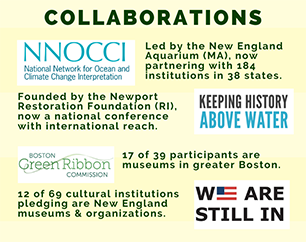
In addition to educational efforts, museums are being called to participate in climate change advocacy and encourage their constituencies to action. Several global collaborations have formed to advance the advocacy agenda: the Canada-based Coalition of Museums for Climate Justice, the international Museums & Climate Change Network, and the National Network for Ocean and Climate Change Interpretation.
The broadest network enlisting museum field support is We Are Still In, which was formed in 2017 by a group of mayors, governors and business leaders after the Trump administration pulled out of the Paris Climate Change agreement. The coalition has since doubled in size to 3,500 organizations that have signed onto the effort, all of whom are declaring their commitment to the global pact. 69 museums and cultural institutions are part of the coalition, including 12 from New England (NEMA being one).
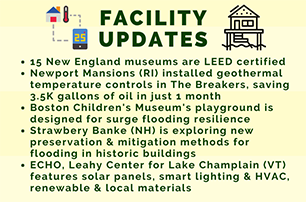
Facilities and operations are another way museums are being called into the climate change arena. LEED certification is virtually de rigueur for new museum construction, as illustrated by projects over the past few years at the Boston Children’s Museum, Isabella Stewart Gardner Museum, Harvard Art Museums, Clark Art Institute, Mattatuck Museum, and Shelburne Museum. Municipalities such as the City of Boston are pledging to reduce their carbon footprint to zero by 2050, encouraging museums and other civic institutions to correspondingly reduce theirs through facility retrofits and adoption of sustainable practices.
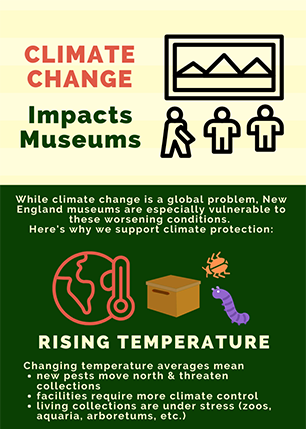
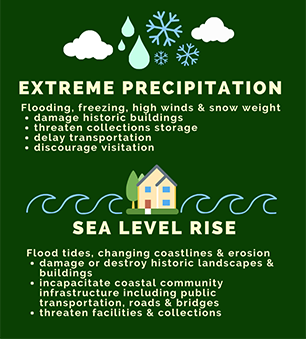
So far, museums have engaged with climate change as either a social responsibility (helping the greater good through education or advocacy) or an institutional improvement (green practices can save money and burnish the museum’s image). However, the acceleration of climate change impact is now causing museums and cultural institutions to realize they face an existential threat. Maps depicting future sea level rise illustrate just how New England’s museums and cultural heritage are jeopardized by even conservative estimates.
In Boston, for example, anticipated 2050 average sea levels will be 1.5 feet higher than in 2000 and as much as three feet higher by 2070. This means that museums such as the ICA, New England Aquarium, U.S.S. Constitution Museum and Boston Children’s Museum are likely to experience catastrophic inundation. Freedom Trail sites and those along or near the Charles River, including the Museum of Science, MFA, and Gardner will be faced with regular storm surges. Virtually the entire city will be impacted through disruptions in access during peak tidal conditions.
A positive sign is that museums are awakening to these hard truths and are stepping up to search for solutions. Boston’s Green Ribbon Commission, a group of business, institutional and civic leaders working with the city to develop shared strategies for fighting climate change, has enlisted a task force of cultural organization leaders. This group has been providing valuable input into the city’s plans for mitigating sea level rise and other climate change challenges and is helping to expand awareness of the issues to the local museum field.
In 2016, the Newport Restoration Foundation, which operates Doris Duke’s Rough Point mansion and other historic properties, convened a symposium called “Keeping History Above Water.” The event attracted a nationwide audience of historians, preservationists, climate experts and museum people to address the risks of sea level rise to coastal communities and their cultural treasures. The symposium has since expanded nationwide.
As a result of these efforts, coastal museums are beginning to plan for the worst. Portsmouth’s Strawbery Banke Museum is particularly affected, with many of its historic structures built on the site of Puddle Dock Pond, which was backfilled during the early 20th century, but is now threatened with inundation. In the 18th-century Shapley-Drisco House, for example, high tide reaches regularly into the basement. The museum is a critical player in the city’s Coastal Resilience Initiative, which is exploring ways the area can adapt.
At its 2019 conference in Burlington, Vermont, NEMA hosted a session on “Museums and Climate Change.” This Think-Tank session asked participants in attendance to identify the primary issues and brainstorm potential strategies for action, several of which could involve the NEMA professional community:
- Create a database which inventories New England cultural assets and museums that are vulnerable to the effects of climate change.
- Work with other museum associations to develop and refine standards for museum facilities and practices.
- NEMA should host a meeting of museum leaders to continue the climate change discussion and build a pathway to solutions.
- NEMA should create a community of practice for museum professionals to support the climate change agenda.
- Create a list of “green vendors” in the NEMA Marketplace to encourage climate-mindful purchasing.
- Create a program for recognizing museums for green practices, exhibitions, education programs, etc.
- Engage in climate advocacy alongside general museum advocacy.
- Encourage the expansion of efforts such as Boston’s Green Ribbon Commission to engage museums and communities throughout New England.
- Follow up the Think Tank with annual conference sessions on climate change and environmental issues.
NEMA has plans in the works for several of these items which we anticipate will be undertaken in 2020. If you have further ideas or would like to plug into the climate change issue with us, contact the NEMA office.
A special thanks to the facilitators who led the discussion at the Museums & Climate Change Think Tank: Tom Denenberg (Shelburne Museum), Phelan Fretz (ECHO), Matt Kirchman (ObjectIdea), Annie Lundsten (Boston Green Ribbon Commission), Kelsey Mullen (Providence Preservation Society), Laurie Pasteryak (Fairfield Museum).
The following graphics were created for Museums Advocacy Day 2020
New England Museums are Leaders - download the full graphic here.
Climate Change Impacts Museums - download the full graphic here.