We’re still here… at home.
By Mackenzie M. Padula, Programs Coordinator & Interpretive Manager, Castle in the Clouds, Historic Lucknow Estate
February 8, 2021
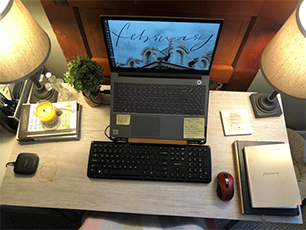
We’re rapidly approaching the first birthday of New Hampshire’s first stay-at-home order related to COVID-19. Reflecting on the past year, I have been lucky enough to work from home in my museum’s off-season – this change in scenery took some personal adjustment when we first when into lockdown in March and again when we shifted to a work-from-home model after our season ended in October. Here are five things that help me stay focused, motivated, and organized:
1. Power 5.
Adapted from Andy Frisella’s podcast, the MFCEO, I started implementing my Power5 into my daily routine. Each morning I come into my home office space, flip to a fresh page in my notebook and list the top five things I need to complete on that day. These five tasks should help me to get closer to my career and development goals, or closer to project completion. My list varies based on what I’m working on but they can include publishing a blog and social media post, working on a continuing education class for an hour, or doing research for a new virtual endeavor the museum is working on. I try to work diligently until I finish these five things. If I complete all five then the day is considered a win, if not it’s a loss but over time (and in concert with my competitive spirit) I’m winning more than losing and I’m making gains in my development and to-do list.
2. Scheduling my day.
This has been massively helpful to my work-from-home productivity. Having a schedule takes away the mental energy of having to figure out what to do. It, also, leaves a record of what you accomplished, which is helpful when all the days feel like Groundhog Day. Monthly, I break down my goals into tasks and I schedule these along with recurring meetings. Daily, after I write out my Power 5, I look at my calendar and schedule these tasks into my day. I always try to give myself less time than I think I would need, otherwise I tend to get distracted and suddenly it’s taking me twice as long to complete a task that should’ve taken 45 minutes. Additionally, when I schedule the task, I name it as what I want to accomplish (again, saves brain power down the line), for example, I would schedule the task as “Decide on medium for virtual activity” rather than just “Virtual Library”. This is much more decisive and directed meaning I don’t need to wonder what I meant, or where I left off on the project prior.
In my calendar, I set reminders on the tasks and meetings for 15 minutes before and at the time of the event so that I can do my best to stay on track. If I’m immersed in a project I won’t sweat running into my next “appointment”, but generally, I aim to show up for myself and stay on the schedule. I also plan mental breaks into my day where I can read, peruse social media, take a walk, etc. If I were in the office, I would be able to have some “water-cooler” chat, go to a different building, or run an errand but at home my socialization is limited. Taking these mental breaks is crucial to my creativity and my ability to deliver the best product. The key is balancing them; don’t schedule 85% of your day as a mental break and call it a workday.
3. Limit the clutter.
At any given time, I’m reading five books and have a dozen projects in the air, clutter seems attracted to my desk and home office. Additionally, my home office seems to act as the household dumping ground for anything that we want to hide if/when people come over. Some rules I follow to limit the clutter are: 1) I try to take time each day to take the trash out of my office, 2) I don’t leave my desk at the end of the day until I put away everything I took out. As someone who sprawls out when working (I’ll take up a full 12-foot table if it’s available), having a smaller desk forces me to limit what’s in my space, I simply don’t have room for clutter because I won’t have space for my notebooks and files. Doing everything you can to make your space works for you is key to enhancing your productivity – make the space comfortable, warm, and inviting. You’re spending eight hours a day here.
4. Show up on purpose.
This one can vary for everyone – for me, it means taking 15 minutes to prepare for each meeting and coming into the workday with a mindset that bolsters connectivity and collaboration. For me, it also means getting dressed as though I’m going into the office. Additionally, I take the time to make sure my background communicates who I am and that I am leaning in and being present to my meetings and tasks on hand.
5. Not being too hard on myself.
Life happens. Quarantine is hard. People have spouses, kids, and family members home with them that wouldn’t interrupt the meeting if you were in office. People have pets that want to bark at the mailman, who seems to always time deliveries with your most important meetings. Some days you are not mentally or emotionally able to give it your all based on what’s going on in the world right now. Be transparent with your bosses about what is going on and what you need. Do your best, and don’t worry about the rest – it’ll work itself out.