
Accessibility and Education in Museums
By Hannah Goodwin, Manager of Accessibility, Museum of Fine Arts, Boston
Museums think about a wide range of audiences – school groups, adults of many ages, families, college students, neighbors, tourists, people with different backgrounds, etc. Many museums also think about a variety of experiences, which include more formal, informal, guided and self-guided. Creating choices for visitors appears to be part of museum strategy, so why not extend that strategy to visitors with disabilities as well? Providing visitors with options and variety positions museums perfectly to be flexible, responsive, and open-minded, all important aspects of creating an accessible and inclusive institution.
People with disabilities cross every other demographic one can think of: all ages, all ethnic and cultural backgrounds, all religions, etc. Personal preferences in topic and approach among people with disabilities vary, and different learning styles cut across the whole range of visitors. This may seem obvious, but it is important and worth stating as assumptions can doom a quality visit. In addition, this is an era of change and the number of people with disabilities is growing. The demographic shift related to the aging Baby Boomers alone has, and will continue to have, a significant impact on how museums respond to their visitors. Through this we are currently seeing and forecasting an increase in the number of people with changes in physical, sensory, and cognitive ability over the next several decades. The many years we have been at war also have unfortunately had an impact, with high numbers of military veterans returning home with disabilities. The number of young people being diagnosed with Autism Spectrum Disorder is on the rise, as is the number of those with learning disabilities. These new numbers don’t change the need for an institution to create good accessible experiences, but they do make the need more visible and possibly more urgent.
Where to begin? Does all of this mean museums need to create new and separate programs? Not necessarily. In fact, ideally visitors with disabilities will benefit from the opportunities offered other visitors. The intent of the Americans with Disabilities Act (ADA), which turns 25 this summer, was not to create separate experiences, but rather to give people access to existing ones, to allow people to participate in an equitable manner. This is consistent with other Civil Rights legislation.
Wait a minute, no “special” programs? Special programs are a common way to approach making museums accessible for people with certain disabilities. For example, there are a growing number of programs for individuals with Alzheimer’s and Autism, to name a few. And there is a place for such offering. However, they should be part of the solution to including people of all abilities in a museum, not the only solution. Ideally, every visitor will get to choose how they experience museums.
Creating an Inclusive Experience
First off, I am defining an inclusive experience as one that is designed to welcome as many differently abled people as possible, to accommodate a wide range of participants, and to be prepared for the need to add or change to accommodate a particular visitor on request.
In order to have an experience that is inclusive, whether it is self-guided or guided, there needs to be a basic foundation of accessibility in place. A basic foundation includes access to the physical space (including bathrooms), access to essential information (including for those who are blind, low vision, deaf, hard of hearing, have different ways of learning), a place to go with questions, and staff who are comfortable with all visitors, which usually requires training. The staff training may vary depending on the situation, but could include communicating with people with disabilities, using assistive listening devices, describing things for a visitor who is blind, working with children who have Autism, and any number of other things.
Here are two examples of general, but different, museum experiences and how they might become more inclusive:
A drop-in guided tour for adults: leaves at a particular time, anyone can come, is an hour in length.
- The docent includes elevators rather than stairs in his/her route.
- Assistive listening devices are available for visitors who wish to use them or even for the whole group if the tour is in a loud or crowded area. If these devices are not available, the docent always faces the group when speaking, asks if people can hear them, allows people to move closer.
- The docent paces the tour to the group rather than their own comfort level as some people on the tour may not be able to move quickly, even if they have no visible disability.
- The docent is aware that some visitors may have difficulty seeing and so chooses language that is specific and visual rather than general – “Looking at the red square in the upper left hand corner of this painting” rather than “Over here” and pointing.
- The docent is aware of any wheelchair users in the group, and assists in making sure their visual path to the object is not being blocked.
- The docent defines terms that are not commonly known, speaks in a clear but concise manner, and repeats key pieces of information, benefiting visitors who are not fluent in English, may not have a lot of experience with the topic at hand, or may have different learning styles.
- A multi-sensory element is added to the tour.
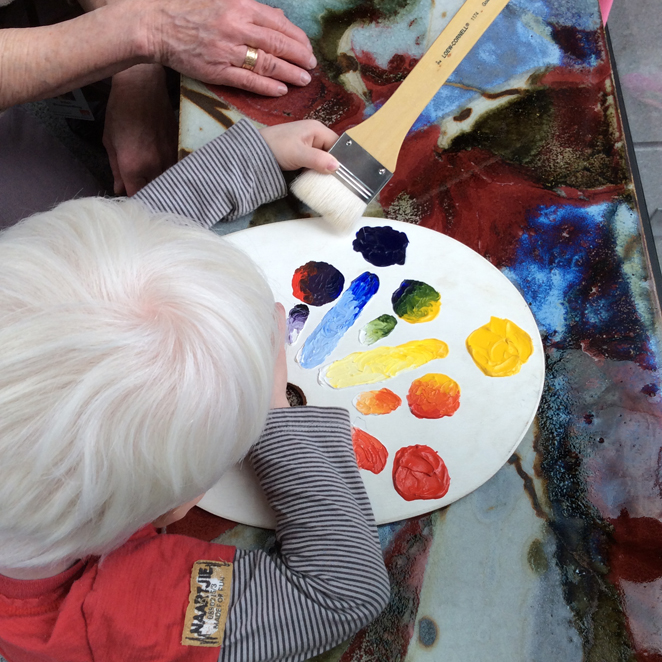
A hands-on activity for children, perhaps making art in a gallery.
- The activity and instructions are both multi-sensory.
- Verbal instructions are supported by visual step by step instructions, which would benefit children who are deaf, children who don’t speak English, children on the Autism spectrum, and visual learners.
- The set-up is designed to accommodate children using wheelchairs or other mobility devices, rather than staff scrambling to accommodate or make room at the last minute.
- There are tactile materials that support related museum content and build understanding.
- Key written materials are offered in Braille and large print.
- There may be American Sign Language interpreters available to sign as needed.
- The activity has multiple entry points- a collage activity could include cutting, tearing, and pre-cut and torn pieces.
- Staff would be trained to respond to visitors with a range of abilities.
Separate or specific programs
Let’s return to the idea of creating a program designed with a very particular audience in mind. The benefits of separate programming are numerous. A program tailored to people with memory loss and dementia may allow someone to come and enjoy the museum experience in a more meaningful way. Likewise a program for a person with Autism may provide that visitor the information, reassurance and experience to feel comfortable in the museum environment. In both of these situations, those separate programs may build familiarity and comfort with museum, and allow the visitor to come back on their own or with a friend or family member. In addition to these examples, a program tailored to people who are blind may allow for a deeper experience with a particular type of exhibit. A group of cancer survivors may benefit from being with a guide who is completely flexible, who has scouted all the seating, who knows where the elevators, drinking fountains, and quieter galleries are. In all of these examples, something is gained that is not only good in that moment, but has the potential to open up the museum in other ways through the act of assisting the visitors in getting to know the institution and what it offers.
Another benefit to having programs that are designed specifically to work with visitors with disabilities is that you create a team that then becomes a resource for making other programs more inclusive. For example, if a school group tour with a student who is blind is coming to the museum and the exhibits are primarily visual, they will likely need some help if the student is going to have a rich experience, and one similar to their peers’. The docent can incorporate visual language, and may already have some touchable materials to share with the group. However, for the student to be truly included in this experience, they will need someone who can describe with expertise, and who comes with a “tool kit,” possibly multi-sensory materials (tactile materials, reproductions, sound, etc.), all of which will likely benefit some of the other students on the trip.
In short, everyone has the right to enjoy a museum experience. As museums continue to become more accessible and inclusive, word will get around and more people will come, and the museums will enjoy a rich and diverse audience.
(Photo courtesy of the Museum of Fine Arts, Boston)
