
Behind the Curtain: Visible Storage in the Historic House
By Tania Batley, Curator-Collections Manager Lefferts Historic House, Brooklyn, New York
Historic houses often feel like poor relations to museums. To our eyes, museums have the resources, staffing and means to engage their audience. Historic houses are under-resourced, under-staffed and wish they could engage more with their audience. But, there are ideas from the museum sector that historic houses can emulate and one of these is visible storage. Lefferts Historic House in Prospect Park, Brooklyn, New York created a visible storage area for their collection and the reaction from our visitors is overwhelmingly positive. Surprisingly, the process of creating visible storage is easier than thought and continues to impact exhibits and other areas in the house.
Lefferts Historic House is a remnant of the Dutch settlement of New York. In 1660, Pieter Janse Hegewort, from whom the Lefferts family is descended, built the original house. Pieter established his family as farmers in the neighborhood of Flatbush where the land was fertile and supported the growing Flatbush community. The Dutch settlers intermarried and continued to prosper. In 1776 during the Battle of Long Island, the house was burned down by the Americans to prevent it falling into the hands of the advancing British forces. In 1783, Peter Lefferts rebuilt the house, incorporating some salvaged parts of the original house. His descendants lived in the house until 1910, and in 1918 donated the house to the city of New York. Due to city road construction, the house was moved about one mile and half from its original location, to Prospect Park and managed by the Brooklyn Museum (then known as the Brooklyn Institute of Arts and Sciences.) In the mid-1920s, the Brooklyn Museum handed stewardship of the house to the Daughters of the American Revolution (D.A.R.) The D.A.R. held their meetings in the building and managed the house as a historic house museum open the to the public. This continued until 1997 when the house, with its contents, was given to the Prospect Park Alliance, the non-profit organization that provides the ongoing care and long term stewardship of Prospect Park in partnership with the City.
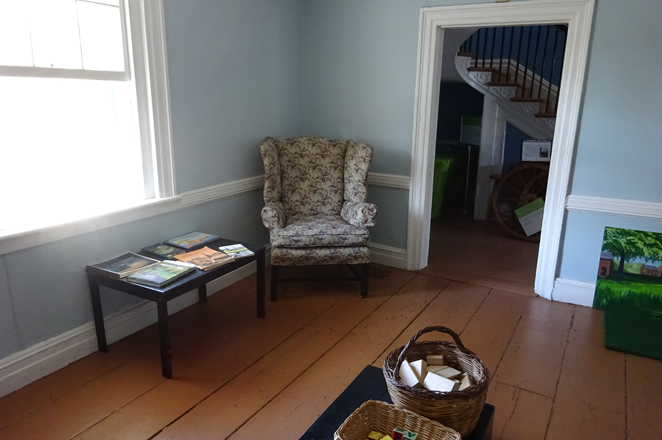
Over the years, the Prospect Park Alliance developed the house as a children’s museum, with engaging public programs for families. The house has two period rooms, one on the ground floor, interpreted as an 1820 parlor and the other on the second floor, interpreted as a bedroom. The ground floor includes a quiet area for reading and a large play area modeled as a kitchen, with interactive exhibits and touch collections. Outside, there is a large garden with a wigwam, a wagon and water pump. During the warmer months, 19th century toys such as hoops and stilts are placed in the garden for children to play with. The house attracts over forty thousand visitors a year.
As with many historic houses, our collection is eclectic, containing everything from early English ceramics, to numerous cradles, several spinning wheels and even modern chairs. The collection also includes textiles, metalwork, silver, agricultural tools, ephemera and books. There are one thousand objects in the collection, housed largely in cupboards and rooms on the second floor of the house. The second floor also contains an area for exhibits and a large open storage area.
A curtain previously hid the large open storage area, which had not been reorganized for several years. Shelving took up a lot of floor space, and objects in boxes from an earlier inventory project needed to be re-housed to improve their storage conditions. A water leak from the roof some years earlier only added to the disarray. Collectively, we decided to re-organize this area. We began by removing the storage boxes and re-cataloging and re-housing objects. We removed the shelving and utilized it in other storage areas. This process brought to light objects that could be used in future exhibitions. We grouped similar objects together in other storage areas, making collections inventory much easier. This part of the project took almost a year and left us with the remaining larger objects still needing attention.
A comment by a member of staff who said, ‘I hate that curtain,’ prompted discussion and thinking about how the second floor open storage area is presented to the public. At a staff meeting, we reviewed feedback from visitors and staff and discovered that visitors, staff and volunteers wanted to know what was behind the curtain. Sometimes, a visitor wandered into the storage area and moved objects and the curtain often was pulled down. As a curator I visit museums for inspiration and the idea for visible storage came from a visit to the Brooklyn Museum, New York. The fifth floor of the museum held the Visible Storage-Study Center, a 5,000-foot storage area with the collection on view under appropriate temperature, humidity, and light levels. As a small historic house, Lefferts Historic House did not have the funds to re-create a similar area, but never the less I thought it might be possible to create a scaled down version of visible storage.
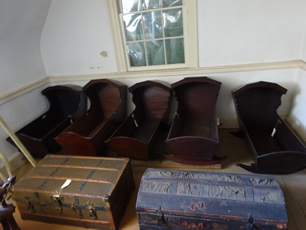
Wall of cradles.
At the beginning of 2014 as a three-person team, we started the visible storage project. After removing and putting aside the curtain, we removed the larger objects from storage, re-cataloged and cleaned them. We each took turns cleaning the floor thoroughly and making the room ready for its new look. Collectively we decided to present the room in the most visually appealing way possible. We lined up larger objects such as cradles against the back wall, in front we placed several trunks and along another wall we put a row of chairs; we grouped together the collection of spinning wheels, yarn winders and flax wheels. Other smaller objects we arranged in groups. As we moved objects, one of us would stand at the entrance of the room to evaluate the room’s visual appeal. We moved a 1930s wing chair downstairs to the quiet area and this would be rotated with other modern chairs in the collection. After several hours, the room was ready. We placed a large sign ‘Visible Storage’ above the entrance and put a stanchion at the entrance of the room. As we surveyed our handiwork, we decided that given that the room contained mostly large objects, on quiet days, visitors with a member of staff could step into the room, to gain a better view of the objects on display.
Visitor reaction to Visible Storage is overwhelmingly positive. Feedback via visitor surveys include comments such as ‘very happy to see it’, ‘loved the high chair and spinning wheel’ and my favorite comment, ‘loved it, not creepy!’ Regular visitors to the house comment that they often wondered what had been behind the curtain and now they knew! Staff report that issues of objects being moved and damage no longer happen. We feel the impact downstairs in the house too: families express appreciation for the wing chair in the quiet area, using it to read to their children. Children too are happy, less likely to run around the house now that there is an area with more seating.
Ultimately Lefferts historic house emulated their larger museum cousins, devising its own version of visible storage. Direct costs were negligible, largely in cleaning supplies, but the rewards were great and visitors remain engaged.
As for the curtain? That mysteriously disappeared, its current fate unknown.