Capitalizing on Collections: Digitization Collaborations
By Kayla Hopper, Outreach Coordinator, American Antiquarian Society
When sitting in the dome-topped reading room of the American Antiquarian Society (AAS) in Worcester, Massachusetts, there’s little sense of what resides on the other side of the unassuming door behind the reference desk. It seems hard to believe that just a few steps away are over four million items housed on twenty-five miles of shelving. The materials represent the printed record of what is now the United States from 1640 through 1876, including books, pamphlets, graphic arts, ephemera, newspapers, and periodicals, as well as manuscripts. As anyone at the Society will tell you, if it was printed between these years in America they either have it or want it.
AAS’s mission is simple: to collect, preserve, and make available for study these collections. AAS’s approach to the latter two goals—preserve and make available for study—has been and continues to be transformed by the digital age. From making collections available remotely to preserving fragile materials to allowing researchers to search and manipulate data in unprecedented ways, digitization has become an essential part of fulfilling AAS’s mission and making those four million items broadly available. But to accomplish digitization on a large scale has required new ways of thinking about how the institution balances its commercial interests with its traditionally academic constituencies. The result has been a strategic initiative to partner with commercial publishers who can create products that are geared toward AAS’s audiences.
Over the course of its more than two-hundred-year history, AAS has had to adapt to any number of changes in library standards and practices, as well as collecting and fundraising strategies. Finding ways to take advantage of new technology has also been part of that adaptive process, and as early as 1955 the Society saw the benefits of new methods of collection reproduction when it entered into a partnership with the commercial publisher Readex (now a division of NewsBank) to begin micropublishing its pre-1821 material, first on opaque cards and later on microfilm. The Society holds two-thirds of everything known to have been printed in the United States before 1821, making it the largest collection of that material in the world. Such a comprehensive collection of early Americana was understandably attractive to Readex, which knew it would have value in the marketplace. But micropublishing the materials would also help fulfill the accessibility part of the Society’s mission by making this unique collection available to scholars on campuses all over the world, not just to those on the East Coast where most of these early materials could be found. AAS did not have the specialized equipment and marketing capacity necessary to make publishing the collection a reality without the commercial publisher, and the commercial publisher did not have a product without AAS’s collections. Thus, a mutually beneficial partnership was born.
Almost a half-century later, in 2002, AAS began working with Readex to convert and reissue the products in digital form based on the latest technologies. By 2006, the success of the enterprise had led to a deliberate strategy on the part of the Society to form partnerships with as many commercial publishers as possible. In the eyes of the current AAS president, Ellen S. Dunlap, the possibilities were great and the benefits obvious. “Given the breadth and depth of the AAS collections, publishers were readily able to fashion a wide variety of excellent online resources, many more than any one publisher could have taken on individually,” Dunlap explains.
Digital copies of collections satisfy both the preservation—a digital surrogate can often be used in place of the original item—and accessibility aspects of the institution’s mission. The more partnerships that could be formed the more material that would be digitized and the more researchers would be able to take advantage of the Society’s collections. Fortunately, AAS has plenty of collections that are attractive to publishers. For example, in addition to its unparalleled pre-1821 holdings, it also holds the most comprehensive collection of American newspapers printed before 1876, a host of genealogy material, and a wide variety of ephemera, all of which have become part of various databases.
Digitized material is not the only mission-driven gain. As an independent research library with an annual budget of about $5 million, AAS is funded by a combination of private donations, endowment funds, and grants. Diverse revenue streams are a must to keep the Society running, to maintain and expand its commitment to housing world-class collections, preservation practices, library services, and programs. Royalties from the digital subscription databases created by these partnerships have been a boon to a variety of mission-centric activities. Curators have been able to acquire collections that would otherwise have been out of reach, such as a massive stock of newspapers that increased AAS’s holdings for Indiana, Iowa, Kansas, Kentucky, and Maine by one-third to a half for each state. An in-house photographer has begun to digitize collections often not covered by the partnerships, such as manuscripts and graphic arts, which are made freely available through the Society’s website. Capital improvements, including renovating a building next to the library to provide housing for fellows and visiting scholars, have also been made possible.
Though the benefits to the approach quickly became apparent, it initially met with some reservations; in particular, academic members of the Society’s Council, or board of directors, expressed regret that the collections couldn’t be digitized and offered to the public for free, rather than behind a “pay wall” in a subscription database. But as Dunlap explains, “eventually all came to appreciate how much we needed partners to accomplish our overall goal of making the collections more widely accessible.” The specialized equipment, staffing, and funds required to do these projects just simply wouldn’t be possible without the commercial partners. Furthermore, other benefits to the public would be incorporated into the digitizing process, such as the cataloging of previously uncataloged material and the creation of links between AAS’s online catalog and the digital content in the commercial partners’ collections, allowing direct access to specific AAS items for researchers at institutions that have a subscription to the databases. Ultimately the Council unanimously agreed that this was an initiative worth pursuing.
AAS does not tackle these complicated contractual deals alone. Recognizing that protecting AAS’s interests required an industry expert, AAS entered into a partnership with Hal Espo, president of Contextual Connections, LLC, in 2006. Since then, Espo has acted as a consultant and agent for the Society, making introductions to publishers and negotiating the terms for each contract. While each contract is different, there are some key goals and non-negotiable items that accompany each agreement. For example, AAS seeks long-term licenses, from five to twelve years, during which the publisher must pay royalties to AAS. AAS also owns the scans that are created—which must be of a certain quality—so that upon the completion of an agreed-upon number of years, all of the scans return to the Society, which is free to use them in any way it likes. (This also helps to mollify concerns over the “pay wall,” albeit on a long-term basis.) Many of the agreements further specify that certain revenue targets must be met in order for the publisher to retain exclusive rights to the material.
A large part of the success of the partnerships is due to the reciprocal relationship between AAS and the publishers. The publishers provide AAS with scanning, marketing experience, and audience research to help target collections that will have value on the market. In return, AAS offers collection expertise, helps determine the scope of projects, and has the final say on which materials are physically stable enough to be scanned. In some cases, AAS’s conservator has even designed cradles and other equipment to enable more fragile material to be filmed with the scanning machines. This close relationship is what makes it possible to balance AAS’s focus on preservation with the publishers’ attention to market trends.
To date, there have been tens of millions of scans made and the Society has netted $13.1 million in revenue from these partnerships, $1.1 million in fiscal year 2015. The costs of doing business—the agent’s fees; up to two AAS staff members to work as digital expediters on the projects; and infrastructure costs, such as setting up the scanning equipment and upgrading network capacities—are taken from these revenues. AAS has partnered with as many as eight different companies, among which are NewsBank/Readex, Ancestry, EBSCO, and Gale Cengage. Out of those partnerships have emerged some extraordinarily useful products, such as “America’s Historical Newspapers,” “Early American Imprints,” “Manuscript Women’s Letter and Diaries,” and “American Broadsides and Ephemera.”
This revenue stream will not last forever. As contracts are completed and the most marketable collections are digitized, these sources of revenue will also diminish. This reality is a large part of the Society’s decision to use these limited-time funds for acquisitions and capital and digital projects that would otherwise be unattainable. But with the end of the revenue stream comes new opportunities as well. As the release of the earliest scans into AAS’s custody grows ever nearer, the question of what to do with them becomes the next hurdle, but one AAS looks forward to undertaking. “Assuming responsibility for the stewardship of these vast digital resources, while also maintaining our commitment to the preservation of the historical originals, will be a challenge,” says Dunlap, “but the opportunities it opens for access by future generations are simply thrilling.”
Images:
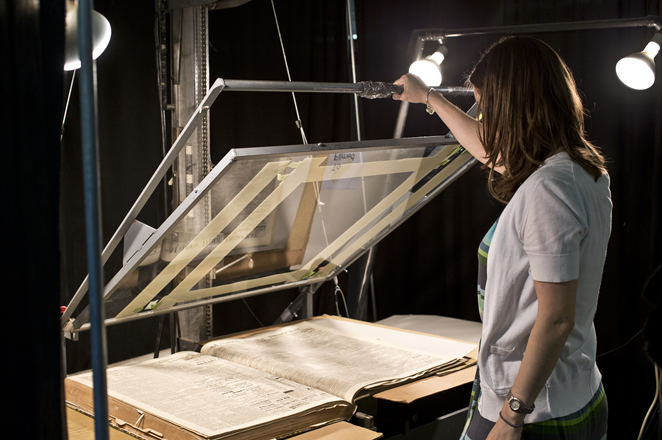
Cover photo: This Planetary camera, owned and operated at AAS by Readex, produces microfilm. The camera is mounted at the top of the boom and can be moved up and down depending on the size of the material. The table also osculates and moves side-to-side to capture medium to very large newspaper volumes.
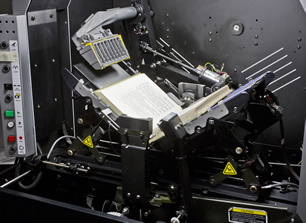
Close up of the Kirtas digital scanning machine, which has a 120-degree cradle with a 2.5-inch vacuum arm with pressurized air to turn the pages automatically. This machine is owned and operated at AAS by Readex.