
Managing Our Collections: NEMA Benchmarking Survey 2016
By Florentina Gutierrez, 2016 Summer Intern, New England Museum Association
Our museum collections are essential to who we are as institutions. The focus and mission of an institution is often built around its collections. However, concerns and priorities for collections may vary by type of institution, operating budget, and collection size, and often, these can be interrelated. In order to discern the region’s current trends, we surveyed NEMA’s Institutional Members.
Responses came in from 95 institutions in all six New England states, largely from historical museums at 86% (including industrial/transportation museums), art museums at 24%, libraries and archives at 18%, and science museums at 5% (including children’s museums, zoos, and aquariums). It is important to note that respondents had the option of making multiple selections, so these percentages add to more than 100%. To analyze the results we examined institutions by three main categories, including genre, operating budgets, and collection size.

Museum Operations: Budgets and Staff
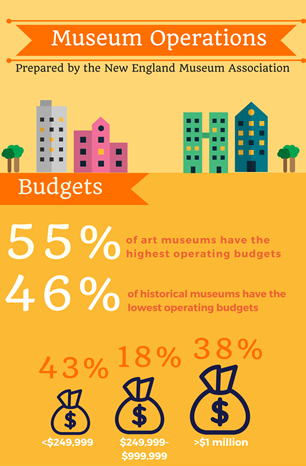

The operating budget of an institution can be a deciding factor as to how much time and energy can be put into taking care of collections. Operating budgets among all respondents varied from less than $50,000 to over $3 million a year. Breaking them down into groups, 43% qualify as small organizations (budgets under $249,999), while 18% are mid-sized ($249,999-$999,999), and 38% are large organizations (budgets over $1 million). Art museums tend to have the highest budgets, with over 55% reporting a budget over $1 million. In contrast, historical institutions tend to have the lowest budgets, with 46% reporting a budget under $249,999.
Operating budgets directly affect staffing levels, including within collections management. Only 51% of all responding institutions report that they have full-time staff whose primary focus is collections management--with 40% of those having one full-time staff member and another 40% having two to three full-time staff members. Fewer institutions employ part-time staff whose primary focus is collections management (40%), and most of those only have one (62%). 10% of the responding institutions were historical museums that reported having only volunteers.
As budgets increase, the number of institutions employing full-time staff also increases, together with the amount of full-time staff. Mentioned earlier, art museums tend to have the highest operating budgets, and most of them have full-time collections staff as well (82%). On the other hand, the amount of institutions employing part-time staff does not vary greatly between budgets; this suggests that it is affordable to employ someone for a part-time position at smaller institutions, and in larger institutions, a part-time staff member may fill in gaps or specialize within the department.
Interestingly, many types of personnel assist with collections management at several of these institutions. Others who have the opportunity to work with the collections include volunteers (73%), interns (61%), and paid staff with other primary duties (54%). Looking specifically at interns, the amount increases with a higher budget; this may point to more staff time to support interns and/or more money available to fund internships. Furthermore, a higher percentage of libraries and archives report offering collections-related internships compared to other institutions surveyed (81%).
Collections and Accessibility

Higher budgets tend to correlate with larger collections, supporting the need for larger staffs. Among those who reported the size of their collection, 30% have a collection size larger than 50,000 objects, and 8% (all historical museums) have fewer than 1,000 objects. A greater part of institutions report a collection size of 1,000 to 50,000 objects (61%)—with 29% having 1,000-10,000 objects and 32% having 10,000-50,000 objects.
For these collections, the top three foci are art or historical artifacts (1800-present day) at 89%, archive materials at 76%, and fashion/textiles at 65%, with a geographic focus that remains local (87%) and American (55%). These results support the idea that New England is a place rich in local history, largely seen through historical artifacts, archive materials, and textiles. Furthermore, it may point to the greater accessibility of “modern-day” objects.
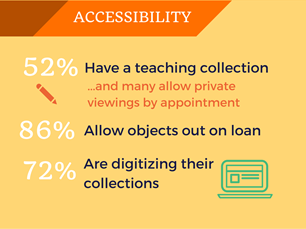
The opportunity to interact with these objects is also not limited to viewing the ones that are on display. At certain institutions, some may have the opportunity to interact more closely with objects through a teaching collection or by a request to view objects in storage. 52% of institutions report that they have a teaching collection, which tends to have a focus on art or historical artifacts (1800-present) (75%)--much like the focus of the collections overall. When seeking to access objects that may be in storage, researchers are the most likely to be allowed to see them (66%), as well as students (49%), professors (46%), and any museum staff (54%). Nonetheless, many added that the general public is allowed to view those objects, as long as they make a request ahead of time and/or have a good reason to do so.
Loaning objects also allows institutions to reach larger audiences. Most institutions report that they allow their objects to go out on loan (86%). Art museums, particularly, also report borrowing very frequently from others (64%). Nevertheless, 57% of respondents report that they rarely borrow from other institutions (once per year or every few years).
What about digital interactions with collections? With advancing technology and higher quality online platforms, it is exciting how some museums are working to connect with online visitors. The availability of online collections seems to be on a steady rise, with 42% of institutions reporting that they have their collections available online and 30% reporting that it is a current project. More art museums have their collections online (55%), followed by library/archives (47%), and history museums (37%). Of those institutions, most have less than half of their collections available (63%), and their primary chosen outlet was their own institution’s website. However, others mentioned also trying platforms such as the Google Art Project, Artstor, and PastPerfect—websites which offer the opportunity to share and manage collections in a location shared with other institutions, in order to enhance teaching, research, and discovery.
It may take some time for institutions to have most of their collections available online. Even so, it will be interesting to see if that changes interactions with visitors, especially as online platforms also provide opportunities to curate and look at objects in extreme detail. [Find out more about digitizing your collection in this issue’s article “Capitalizing on Collections: Digitization Collaborations.”]
Collections Policies
Collections policies guide how we take care of our collections, add or remove from them, and use them to follow our institutional goals. However, creating and updating these policies depends on time, staff, and the size of the collection. Most responding institutions have a collections policy (91%), with 49% reporting that theirs has been updated within the last three years. Of these, art museums are the most likely to have updated it within the last year (30%). 90% of institutions also have an acquisition plan, 94% have guidelines on deaccessioning objects, 85% have a loans policy, and 79% have a code of ethics. However, only 47% have an emergency plan, which suggests that this perhaps should be a priority for institutions going forward. [NEMA provides access to many policies and procedural documents on the Museum Document Exchange, a members-only benefit. To access examples of disaster action plans, deaccessioning guidelines, and more, click here. We are also looking to continuously update this resource. If you are interested in sharing your museum’s documents for the benefit of our greater community, please see the link above to find out how.]
| What collections policies do institutions have? | |
| Acquisition Plan | 90% |
| Code of Ethics | 79% |
| Collections Policy | 91% |
| Emergency Plan | 47% |
| Guidelines on Deaccessioning Objects | 94% |
| Loans Policy | 85% |
Another important document concerned with collections management is a condition report. Institutions report completing condition reports generally when objects are accessioned (63%), when they go out on loan (63%), or when they return from loan (55%)—periods of time when assessing the condition of objects is especially important. They are often completed by a curator (39%) or registrar/collections manager (38%), and some are completed by directors or other museum staff.
Collections Concerns
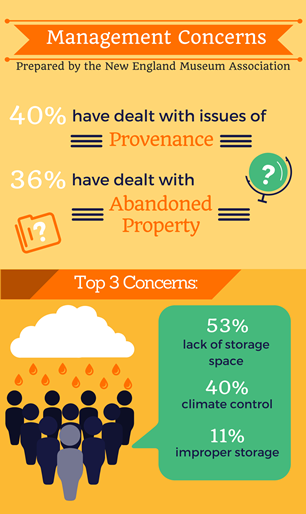
An important issue concerning museum collections is that of provenance. When many museums started collecting, proper records for the origin of objects were not always kept, and numerous objects came to a museums’ hands as looted and stolen objects. Today, as new laws emerge and various groups seek to regain some of those lost objects, museums find that some objects in their collections may not have been acquired legally. Of our respondents, 40% report that they have dealt with provenance issues. Although some institutions research the possible origins of the objects, others choose to label them as “found in the collection,” earmark them to look into at a later time, or go through the process of deaccessioning them. The chance that an institution has faced provenance issues increases with the size of the collection, with 75% of those who have a collection size above 500,000 facing the problem.
Another common issue is that of abandoned property, including unclaimed loans or undocumented property. 36% of respondents report that they have dealt with abandoned property at their institution [For more on abandoned property in this issue's article Found! Abandoned Property in the Museum]. Many are curre
ntly in the process of dealing with these objects, while others specifically say that they are trying to contact an owner or follow their state’s abandoned property law. The chance that an institution has dealt with abandoned property also increases with the size of the collection, but only slightly. Since objects most likely to have been looted, stolen, or loaned and forgotten are art pieces, a higher number of art museums seem to face both issues of provenance and abandoned property (45% each).
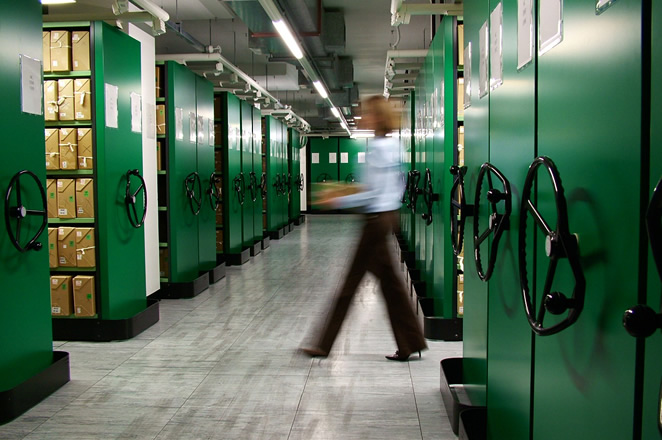
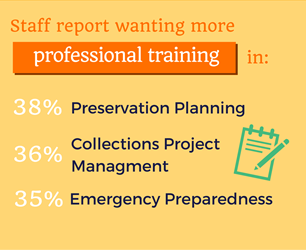
When asked what other concerns institutions face regarding their collections, respondents reported a general lack of storage space (53%), climate control (40%), and improper storage (11%). Only institutions with less than 1,000 objects reported having almost no concern for storage space. In regards to what they would like more personal training in, respondents were most interested in improving their knowledge of preservation planning (38%), collections project management (36%), and emergency preparedness (35%).
Museum Accreditation

The American Allegiance of Museums (AAM) accreditation program is a rigorous undertaking; the process itself can be beneficial to an institution, as can the status completion affords. According to the AAM website, there are 1055 accredited museums nationally, 140 of which are in New England. In our survey, 25 museums, or 28% of respondents have completed accreditation and 4% are currently in the process. Museum workload, funding and staff time are all factors in completing the process, and our results confirm that as operating budgets increase so does AAM accreditation, and AAM accreditation also seems to be sought more by art museums (48% of accredited respondents).
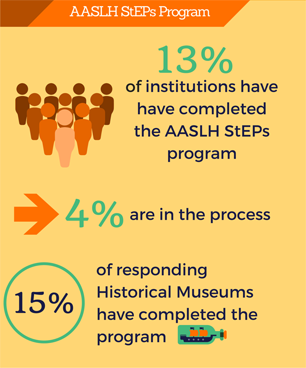
In a similar vein, most responding institutions have not participated in the American Association for State and Local History (AASLH) Standards of Excellence Program (StEPs), which offers smaller institutions the opportunity to go through a similar process to that of AAM accreditation. Though New England boasts a high concentration of StEPs participants compared to nationally (45 participants in Connecticut out of 141 nationally), only 13% of our survey respondents have completed the process and 4% are currently in the process. Unlike AAM accreditation, the amount of institutions that have completed the StEPs program does not increase with higher budgets. Instead as designed, it is the institutions that tend to have lower budgets, such as historical museums, which complete the program (15%). [For more information on the StEPs program, be sure to attend their NEMA conference session in Mystic, CT this November.]
Final Thoughts
Overall, the survey results reflect the deep care museums already take of their collections in this region, across budget size and discipline. The survey also highlights opportunities for growth. There is a clear need for fundraising efforts directed towards collections care, specifically in terms of staffing and storage space. Furthermore, some of the concerns raised by the survey suggest possible opportunities for sharing professional expertise; in creating emergency plans, dealing with stolen or abandoned property, and other professional development. See the compiled list below of resources for collections management shared by your colleagues to begin!
Useful Reading and Resources for Collections Management, Sourced from the 2016 Benchmarking Survey:
- Active Collections*American Alliance of Museums (AAM)
- American Association for State and Local History (AASLH)
- Association of Academic Museums and Galleries (AAMG)Association of Registrars and Collections Specialists (ARCS)
- Boston Area Collections Coalition (BACC):
- Buck, Rebecca A., and Jean Allman Gilmore. MRM5: Museum Registration Methods. 5th ed. N.p.: ALA Editions, 2011. Print.
- Canadian Conservation Institute (CCI) Museology and Conservation
- Connecting to Collections Care
- COOL Conservation Online
- Danielson, Elena S. The Ethical Archivist. N.p.: SAA, 2010. Print.
- East Asian Painting Conservation Studio
- Found in Collections
- Gawain Weaver Art Conservation
- Image Permanence Institute for Preservation Research
- Library of Congress, Collections Care
- Malaro, Marie C. A Legal Primer on Managing Museum Collections. Washington, D.C.: Smithsonian Institution, 1998. Print.
- Museum-L
- National Park Service (NPS)
- Northeast Document Conservation Center (NEDCC)
- Free Resources: https://www.nedcc.org/free-resources/overview
- Registrars Committee of the American Alliance of Museums (RC-AAM)
- Reibel, Daniel B., and Daniel B. Reibel. Registration Methods for the Small Museum. Walnut Creek, CA: AltaMira, 1997. Print.
- Smithsonian Museum Conservation Institute
- The Society of American Archivists (SAA)
Image Credit: By The National Archives (United Kingdom) - CC BY 3.0, https://commons.wikimedia.org/w/index.php?curid=16635316