City Science: the Science You Live
By Betsy Loring, Director of Exhibits, EcoTarium
“[T]he City Science exhibit is awesome! As a municipal engineer, I loved it. The displays hit so many municipal engineering topics in a way that both kids & adults could appreciate….I’m reaching out to all the water professionals I know to tell them they need to check it out!” - Kerry Reed, P.E., LEED AP, Senior Stormwater & Environmental Engineer, Town of Framingham.
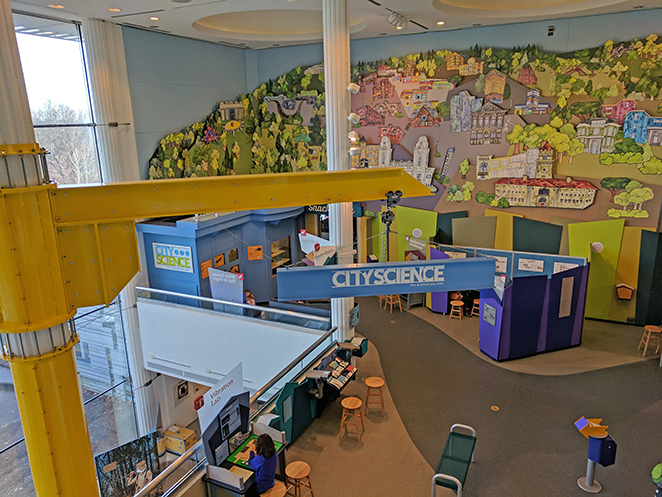
With its newest permanent exhibit, City Science: the Science You Live, the EcoTarium in Worcester, Massachusetts is finding fans beyond its usual base of family visitors and educational groups. In 2,500 square feet, the exhibit’s 27 components explore seven themes: City Animals, Neighborhoods, Engineering Lab, Mapping It Out, Health Lab, City Systems, and Changing Landscapes. Combining internally-developed interactives, live animals, and specimens from the museum’s natural history collection, City Science provides visitors with the opportunity to experiment, engineer, and observe the science that is happening all around them.
In-Kind Support in Abundance
The list of in-kind contributors to City Science runs to 120 individuals, organizations, and university classes. Several local professors used the exhibit topics as themes for term projects in classes such as “GIS Applications for Urban Sustainability,” “Environmental Sociology,” and “Why Global Warming Matters.” These class projects identified research and literature that the exhibit team used in early exhibit research, and yielded several exceptional student interns. Local business and public sector professionals also lent their expertise and time to help museum staff prototype interactives on everything from bridges and sewers, to pollution and trains. Worcester municipal professionals, especially in the Department of Public Works & Parks, were especially enthusiastic partners offering tours of city facilities, and providing items for display in the exhibit including an actual traffic light, sections of city water pipe, and a sewer inspection robot.
Perhaps the most valuable in-kind donations were people’s thoughts, feelings and questions about cities in general and Worcester in particular. Again and again, museum staff asked “What makes Worcester ‘Worcester’?”; “What would you change about the city?”; “What does Worcester feel like?” In 2010, when very early exhibit research began, only the most ardent enthusiast could envision that Worcester would later land on Forbes’ “Best Cities to Raise a Family” or host an international street art festival.
People’s answers to these questions reflected their complicated affection for Worcester and their frustration with its inferiority complex, leading to concerns even among museum staff about whether the exhibit would ultimately be alienating to visitors. But it was the very complexity of these answers, where people agreed and disagreed - and the civic conversations that arose as a result – that guided content and design decisions throughout City Science. For example, people’s divergent answers about the sounds of Worcester led to the development of two interactives: Neighborhood Soundscape and Noise Pollution. Even the question “Do you live in the city, the suburbs, or the country?” led to such surprisingly rich conversations that the concept was incorporated into interactives, providing an introductory framing question which increased on-topic engagement, especially with children.
The public’s most visible Worcester stamp on the exhibit is the 60-foot long Worcester Cityscape inspired by the pop-up bookworks by artist Natalie Draz. The Cityscape features structures that symbolize science stories, as well as buildings and features identified by local residents as quintessentially “Worcester.” While City Science has a distinctively Worcester veneer, it is grounded in STEM explorations that are relevant to any U.S. city as well as urban areas across the world.
Families Learning Together
During formative evaluation and prototyping, the exhibit team drew upon the Adult-Child Interaction Inventory (developed by Lorrie Beaumont for the Boston Children’s Museum) to ensure that interactives elicited a variety of roles that caregivers can play in their child’s learning. One interactive, Director of Traffic, however, seems to have uncovered a role unnoticed by other museum practitioners: “the Heckler.” As families work to find the ideal timing of traffic lights to prevent gridlock in an intersection, good-natured ribbing such as “Look how mad you made the drivers!” is not an uncommon occurrence.
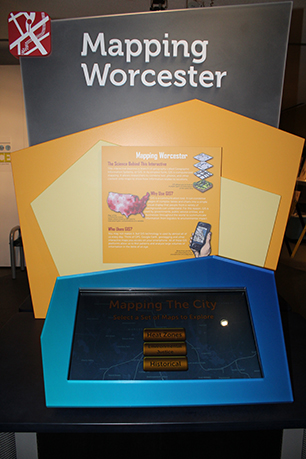
More seriously, in City Science, families are discovering as much about each other’s skills, values and interests as they are about urban planning and STEM. At the Maps as Models interactive, a mother discovered that her three-year-old daughter could use spatial reasoning skills to identify analogous locations in a 3D model and 2D map of the museum floor, saying “I didn’t think she’d get this!”
Another mother, a former urban studies professor, described her experience in a May 4th letter to Worcester Magazine: “In December, my 9?year?old son and I were lucky to get a sneak preview of the EcoTarium’s new exhibit, ‘City Science: The Science You Live.’ By far one of our favorite displays at the exhibit was a hands?on activity to design your own ideal neighborhood….We shared the choices that we made and the reasons we made them. Our visions for a good city were different. My son turned to me and asked, ‘Now, mommy, can we build one together?’” – Joyce Mandell, Jane Jacobs in the Woo.
Reach Beyond the Museum
Magnetic Neighborhood, an interactive designed to help families create their ideal neighborhood, had an additional role in urban planning and learning research. At the heart of a collaboration between EcoTarium exhibit staff and urban planning and biology researchers from UMass Amherst, Clark University, and Loyola Marymount University (From the Lab to the Neighborhood: An Interactive Living Exhibit for Advancing STEM Engagement with Urban Systems in Science Museums. National Science Foundation DRL-1323168) the project tested Magnetic Neighborhood as an embedded evaluation tool to determine whether engaging with interactives on urban ecology topics could impact visitors’ neighborhood designs. In Magnetic Neighborhood, visitors scan their neighborhood and answer the researcher partners’ questions about the design decisions they made, thus contributing to one of the few examples of citizen science in social science research.
Throughout City Science, visitors are confronted with the cost and benefit decisions of urban design and the interplay between the human-built and natural environment. Every day we see visitors changing their decisions based on this interaction. In City Hot Zones, an infrared camera allows them to test different materials and designs to mitigate the urban heat island effect. At the Turtle’s Eye View interactive, visitors learn the impact that their housing development will have on a turtle’s habitat. Children and their families readily substitute smaller homes for large ones and move houses together using what an urban planner would call “cluster zoning” to allow the turtle to move between its summer breeding grounds and winter hibernation site.
This engagement in contemporary urban planning topics has led to the exhibit’s visibility outside of museum circles. The EcoTarium was invited to present City Science to regional and municipal planning professionals, most recently at the Smart Growth Conference of the Massachusetts Smart Growth Alliance. Says Emmy Hahn, Program Coordinator for the state Department of Housing and Community Development’s Massachusetts Downtown Initiative “[In the exhibit], you’re hearing things that planners don’t hear. What you’re demonstrating is that planning can involve all ages.” And on May 8, the Massachusetts Secretary of Energy and Environmental Affairs recognized City Science with the Secretary’s Award for Excellence in Energy and Environmental Education. With encouragement from such quarters, the EcoTarium is seeking the resources to make a smaller traveling copy of City Science, so that audiences across the U.S. can join in the exploration of the urban science hiding all around them.