
Old North Church & Historic Site Reckons with its Past While Charting a Course for its Future
By Nikki Stewart, Executive Director and Catherine Matthews, Director of Education, Old North Church & Historic Site
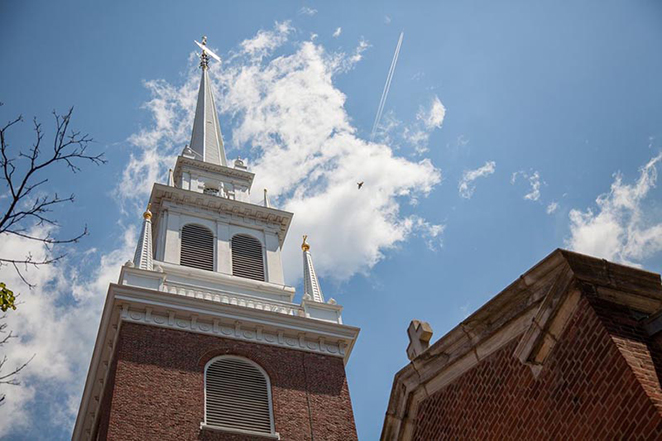
A horrific discovery has been the catalyst for a new reckoning at Old North Church & Historic Site. Like many historic sites in the Northeast, Old North Church, located in Boston, Mass., sits at a paradoxical intersection of freedom and unfreedom. To many, the steeple is an icon of American liberty and independence. Yet, recent research has shown that the church was built in part with the proceeds of human trafficking and enslavement, which filled the coffers of early congregants.
Just as Old North set forth on the path of reckoning with this information, COVID-19 emerged, sending cultural organizations into a period of intense uncertainty and limited resources. Old North utilized the site’s 13-month closure to embark on a strategic planning project to prepare for the church’s 300th anniversary in 2023, and the 250th anniversary of the famous lantern signals that ignited the American Revolution in 2025. The organization has emerged with an inclusive vision and strategies to inspire visitors to engage in brave acts of active citizenship to deliver on the promises of liberty and justice for all. The questions that the Foundation explored through the process can serve as a framework for museums and cultural institutions considering their post-pandemic futures.
Context
The Old North Foundation, which oversees educational programming, operations, and preservation for Old North Church and its surrounding campus, launched a historic chocolate program in 2013 through a partnership opportunity with the Mars Company. Historic chocolate has been a fun, highly sensory, unique way to engage with visitors in small groups. Chocolate humanizes the past and demonstrates how Old North operated within the Atlantic commercial world. The program made sense at Old North because several early congregants were chocolatiers. One of these chocolatier-congregants was a man named Newark Jackson, a sea captain and merchant. After genealogical researchers confirmed his identity and connection to Old North, the program, which has been extremely popular, and chocolate shop were named “Captain Jackson’s Historic Chocolate.”
In 2016, the historian Jared Hardesty published his first book, Unfreedom. In the book, he mentions Newark Jackson and refers to Jackson’s probate inventory, which showed that Jackson enslaved people of African descent. The Foundation contacted Dr. Hardesty, who gave a lecture on the topic at Old North. The Foundation then applied for and received grant money from the Mars Company to continue his research into Jackson’s life and activities. At that time, interpretation shifted to include Jackson’s slave-owning and to name those enslaved individuals. Further research revealed that Jackson was murdered in a mutiny, a fact that generated a historical trail of legal claims and paperwork culminating in the horrific discovery that at the time of his death, Jackson was transporting 15 enslaved individuals, 13 of whom appear to have been children.
Newark Jackson was just one member of a group of smugglers, merchants and slave-traders who had a social nexus at Old North. These men are among the early congregants and benefactors of the church. By the fall of 2019, the Foundation staff and board had entered a period of intense reflection and voiced a public commitment to sharing this history and work to better tell the stories of unheard Black voices connected to Old North Church. A consultant was engaged to develop a site-wide interpretive plan to incorporate this new material and the project kicked off in February 2020 – a month before the pandemic necessitated suspending on-site operations and halting all non-essential expenses.
Old North Church & Historic Site has been hard-hit by the pandemic. In July of 2020, the site reopened for limited operations, Thursday through Sunday. In the first two weeks, an average of 50-60 tickets were sold per day. In contrast, a typical July day in 2019 would see more than 1,000 visitors. On Monday, July 27, the Old North Foundation Board of Directors made the difficult decision to suspend on-site programming through the spring of 2021 and reduce staffing to protect our limited resources. At that time, the staff recognized that the greatest organizational need was a shared vision for the future and a comprehensive strategic plan to ensure that the Foundation can recover from the pandemic and continue to deliver the high caliber programming and preservation that Old North Church deserves.
Strategic Planning
Closing the site to visitors, while devastating financially, provided an opportunity to step back and consider pivotal questions about how to incorporate the work of reimagining our site-wide interpretation into holistic organizational changes. In the fall of 2020, funding to complete a comprehensive strategic plan was secured through The National Park Foundation’s Strong Parks, Strong Communities capacity building grant program. Several key questions that all historic sites should be asking themselves in 2021 were addressed:
Who are we, why does our site’s history matter, and what is our relevance in 2021 and beyond?
Old North Church, like many historic sites, is best known for a single act – one evening in a nearly 300-year history. On the evening of April 18, 1775, church sexton Robert Newman and vestryman Capt. John Pulling, Jr. climbed the steeple and held high two lanterns as a signal that the British were marching to Lexington and Concord “by sea” across the Charles River, and Paul Revere embarked on his journey. This fateful event ignited the American Revolution.
In 1860, with the nation on the brink of the Civil War, Henry Wadsworth Longfellow penned “Paul Revere’s Ride” to appeal to Northern readers’ patriotism. He aimed to rally readers behind the abolitionist cause with the tale of a hero who bravely stepped forward to change the course of history. Once again, a nation was inspired to action. Active citizenship weaves throughout our history and can help visitors contextualize the ongoing struggles to deliver on the promise of liberty and justice for all.
With the support of staff, board members, and volunteers, and the guidance of Paper Crane Associates, the Foundation articulated a guiding vision to move Old North Church & Historic Site forward:
The Old North Foundation envisions a future in which everyone will see their stories, struggles, and hopes reflected in places of prominence and in our shared American history. Everyone will have the knowledge, access, and passion necessary to build inclusive and equitable communities.
How do we contribute to a shared national identity and position ourselves as a site of significance for all Americans?
From the nation’s founding, it has been argued that the United States has self-consciously worked to construct a common identity based on values found in historical examples, such as the Greek and Roman republics, in the works of philosophers like Locke, in dominant-culture theory, or in archetypes inspired by the country’s terrain and expansiveness. The opportunity to shape a national identity inspired artists such as Longfellow, who looked to the literature of other countries and then sought to create stories and legends of American heroes facing American challenges. However, cultural and historical efforts to shape a common identity have almost always marginalized non-white contributions, achievements, and experiences, resulting in a pervasive but rarely recognized assumption that to be American is to be white. Future programming will explore how the country’s founding (white) ideals, myths, and identities translate to our modern, pluralistic society.
Through site-wide interpretation and accompanying curricula for history classrooms across the country, the Foundation will weave together narratives that center BIPOC and female voices and contributions side by side with the stories of Revere, Newman, Pulling, Jackson, and the other white men who feature prominently in the current programming. When examining active citizenship past and present, systemic barriers to active citizenship must be presented for context. At the same time, audiences will be asked: How does a nation adjust to change in its self-perception? How does a nation accept the painful parts of its past in order to move forward?
What business model and organizational structure is necessary to meet our objectives? How will we fund it?
In addition to the above-stated vision, accompanying deliverables of the strategic plan include organizational core beliefs, a refreshed mission statement, and a Theory of Change. The team has also outlined programmatic, operational, and financial goals and priority action steps to ensure progress and accountability. One critical early step is to identify a targeted mix of ticketing, retail, programmatic, and philanthropic annual revenue. Prior to the pandemic, 95 percent of the Foundation’s annual operating support was generated through admissions, group tours, and the Old North Gift Shop. As the Foundation begins to rebuild the organization post-pandemic, substantial staffing and infrastructure investments, and a significant shift in the Foundation’s revenue streams, are critical for achieving financial stability.
In 2018, the Foundation made a transformative shift to its business model, moving from donation-based entry to ticketed admission. Unfortunately, the new price point and visitor experience was only in place for 18 months before the pandemic hit, leaving limited data to serve as the basis for future financial modeling. This year will be one of exploration, as the Foundation tests a new price point, modified upgrades, and a self-guided visitor experience. Rebuilding the business affords an opportunity to test new ideas and re-examine the programming that exists both behind and in front of the paywall.
Conclusion
Museums and cultural institutions now face a three-to-five-year recovery period. This period of regrowth affords an opportunity to ask pivotal questions and envision a future that is unencumbered by pre-pandemic practices. Whether through a comprehensive strategic planning process or a series of self-facilitated retreats, this is the time to build the organization that you want to become.