

The “Who’s and How’s” of Museum Education in New England
By Meg Winikates, Membership and Advocacy Manager, New England Museum Association
This spring, NEMA conducted a survey of the region’s museums and institutions regarding the structure of and support for education in their organizations. This survey highlights the incredible variety of staff size and budgets among the many genres of institution, but also demonstrates the universal commitment to serving a wide range of audiences and offering a diverse set of educational programs, no matter what the size of the organization.
Further analysis of education department structure, funding, and program attendance, as well as complete survey results will be available in NEMA’s education benchmarks whitepaper, forthcoming on the NEMA website this summer.
We Asked. Who Answered?
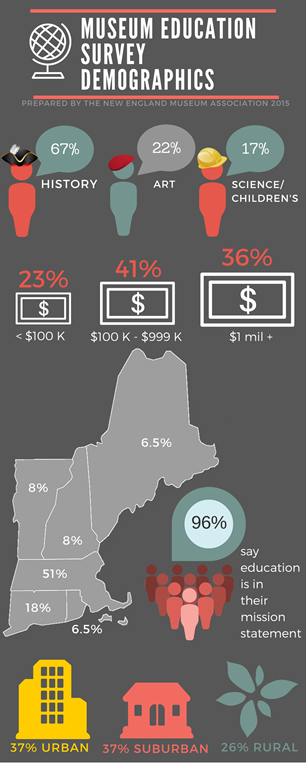
Of the 78 New England institutions that completed the survey, 67% identified as history organizations, 22% as art, 13% as science or natural history, 9% as college and university institutions, 4% as children’s museums, and 22% as assorted other specific or secondary fields (maritime, industrial, anthropology, etc.). 23% of respondents represented institutions with budgets under $100,000 per year, 41% were from organizations of $100,000 to $999,999, and 36% represented museums with budgets over $1 million. 51% of respondents were from Massachusetts, 18% from Connecticut, 8% each from New Hampshire and Vermont, and 6.5% each from Maine and Rhode Island, with 2% reporting in from New York or as region-wide entities. 26% are rural organizations, and the remainder are evenly split among urban and suburban localities at 37% each.
Education receives field-wide vocal support: 96% of respondents said education was written into their organization’s mission statements, and 13% said they also had separate educational philosophy statements. Especially among smaller institutions, some commented that education was seen as the central role of the museum, and was therefore shared out as a duty among all staff, as opposed to being centralized in one person or department. Of the responding institutions, however, 41% said they had education budgets of less than $5,000 per year (not including salaries), and 22% of education staff rely solely on internal funding, without money raised from government or foundation grants.
The People Behind the Programs
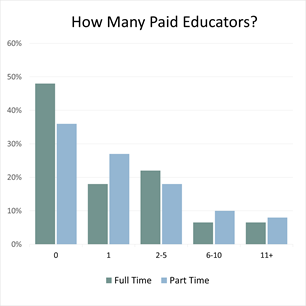
It is clear that educators know how to do a lot with a little: 47% of respondents said they had no paid full-time dedicated education staff, and 40% have between 1-5 full time staff. 7% of respondents have large dedicated departments of 11 or more. 36% of organizations have no paid part-time education staff either, and 45% have between 1-5 part time paid educators. For those without a dedicated education staff, 75% of them said the director was responsible for museum education, 16% said the curator, and others said contract tour organizers, board members or committees, and volunteers did the bulk of their education planning and programming.
Despite this, only 5% of responding organizations said they offered no audience-specific education programming.

Whom Do Museum Education Programs Serve?
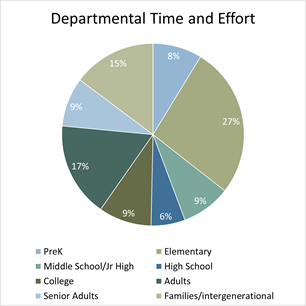
The school-aged audience makes up the bulk of museum programming. In fact, 86% of respondents said they had targeted programs for the elementary school audience, and that on average, those programs represent 40% of their educational offerings. 65% said they had programs for middle schoolers and adults, 61% offer family or inter-generational programming, and 43% have programs specifically aimed at the pre-school audience (especially impressive when you recall that children’s museums made up only 4% of the responding institutions). In total, K-12 programs use an average of 62% of a museum’s educational time and effort according to this survey. A few museums that do not currently offer school-age programming mentioned that they are working on expanding their offerings, and others also highlighted working with special interest groups, such as both the Boy and Girl Scouts.
Accessible programs are also on many museums’ to-do lists. Just under 60% of museums currently offer modifications to their programs or specifically targeted programs for one or more groups with limited access due to physical or developmental issues, language barriers, or illness. The most popular modification is on behalf of visitors with limited mobility, though visitors with developmental or mental difficulties are also served specifically by 26% of responding museums. Several respondents said they were currently working on increasing their offerings, especially for visitors with hearing loss, elder-care programs, and bilingual communities. Others mentioned initiatives not covered by our initial survey, including offering art therapy for grieving children.
Audience Accessibility programs offered,
| |
|---|---|
| Audience | Percent of Museums |
| Limited Mobility | 34% |
| Developmental & Learning Disabilities and/or Autism |
26% |
| Foreign language/ELL | 25% |
| Alzheimers/Dementia & Care Partners | 18% |
| Hearing Loss/Deafness | 18% |
| Vision Loss/Blindness | 18% |
| Other | 7% |
| None | 41% |
Who Delivers These Programs?

Unsurprisingly, museums and organizations with the smallest budgets rely most heavily on volunteers to lead their educational programming. However, 75% of the largest museums responding also use volunteers to lead their programming, and the largest museums are also the most reliant on the energies of interns and fellows, though that could be related to the capacity of their staffs to support ongoing internship and fellowship programs. [For more information on volunteer and intern programs, check out the results of the Quick Take poll here.] Art museums reported an equal mix of reliance (82%) on paid full time, part time, and volunteer staff, as well as a 47% reliance on interns and fellows. By contrast, history museums use more part time (65%) and volunteer staff (63%) than full-time (52%), and science and children’s museums rely most heavily on paid staff, both full time (90%) and part-time (100%), followed by an especially high percentage of interns and fellows (70%) compared to other disciplines.
Many Paths to Learning
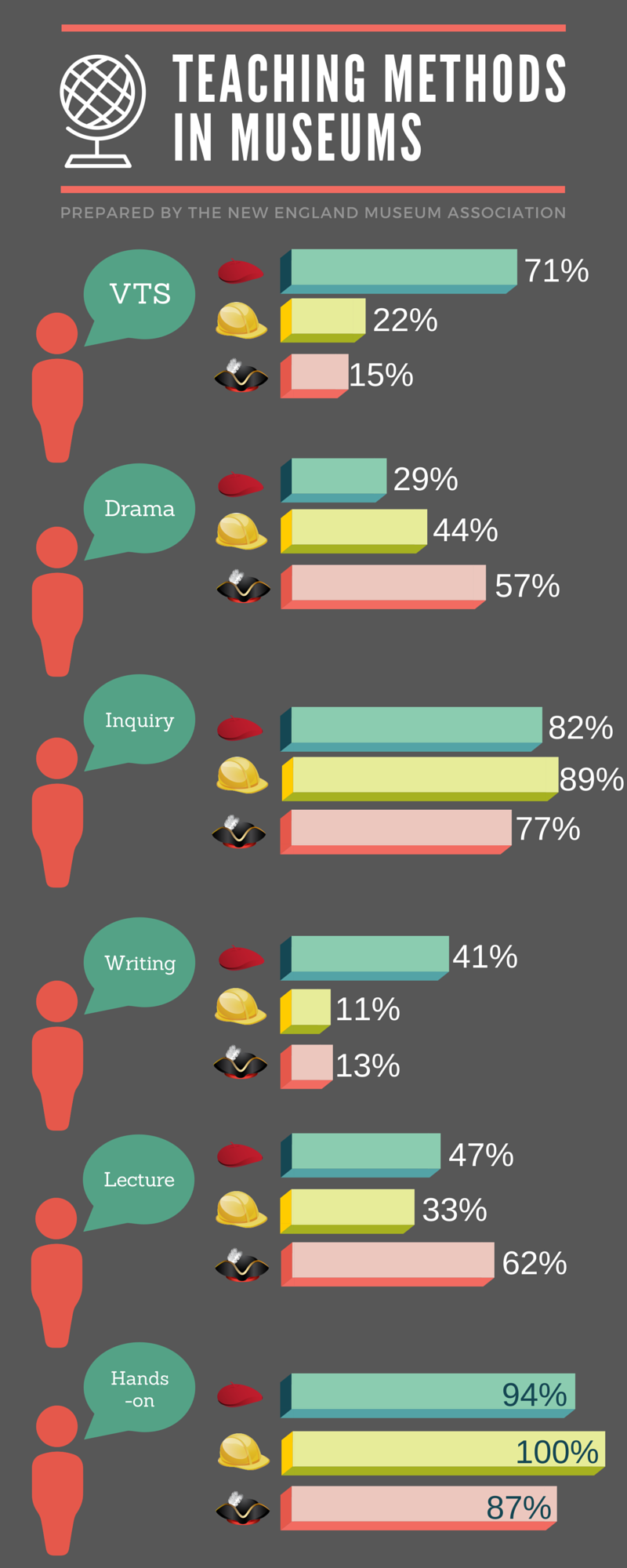 No matter who leads the program, the teaching methods they use remain key to conveying the museum’s educational goals. Inquiry and hands-on exploration, plus opportunities to create, top the chart as most popular teaching methods for museums of all disciplines, especially in the realms of science, natural history, and children’s museums. History museums, the largest pool of respondents, are most likely to use discussion and debate, storytelling and drama, and facilitator-centric classic ‘lecture’ style methods, while art museums use pure Visual Thinking Strategies and its modified versions as well as writing prompts overwhelmingly more than other disciplines. Some art museums also highlighted using drawing for observation as being a separate idea from ‘making’ opportunities, emphasizing engagement with an object in one activity and creativity with the other.
Teachers are Museum Learners Too
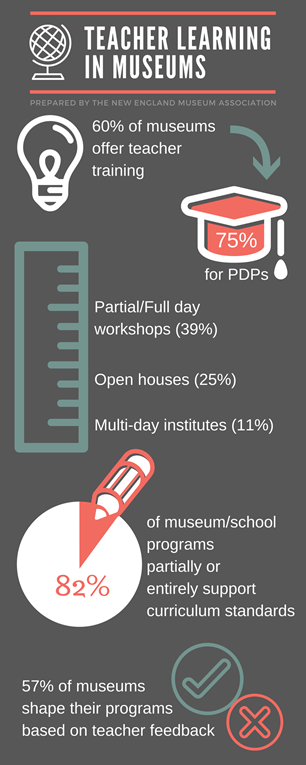
As mentioned before, the school-based audience is a primary target of museum educators’ time and attention, and it has a big influence on the shape of educational programming. 57% of responding institutions use teacher surveys to evaluate their programs, and others mention using student surveys, collecting letters and art from visiting groups, and tracking repeat visitation as indicators of a successful school visit. Some even highlighted their programs being written into local school curriculum, so they can count on being part of students’ experiences every year. Others pay attention to the curriculum in a more standard way: the Common Core appears to be here to stay, and educators across the region have adapted their programs to accommodate. 47% of responding museums said their programs incorporate curriculum standards, and another 35% said at least some of their programs tie to identifiable standards at either the federal or state level. For more about how museums are specifically working with the Common Core curriculum, see Carolin Collins’s article in this issue here.
Museums are also working closely with school teachers in a variety of ways. Nearly 60% of responding institutions offer teacher training, three-quarters of which offer teachers professional development points (PDPs) for attending. These offerings range from partial or full day workshops (39%) to open houses (25%) to multi-day institutes (11%) and an assortment of other options including presenting at teacher conferences and as part of regional training programs, running teacher resource centers, offering training for early childhood and after-school care providers, and even working with teacher training at the university level. Some institutions that do not currently offer teacher training are interested in partnering with their neighbor organizations to co-develop and present workshops to increase their reach and appeal to busy teachers. Others that do not currently offer teacher training remarked that some of them used to, but ‘no one seems interested any more;’ that support, including funding, from the local school systems was vital for sustainability.
Interdepartmental Collaborations
Collaboration happens at all sizes of museums and across all disciplines. Most of the smallest organizations pointed out, when asked to rank how often they collaborate with staff members in other roles or departments, that they were small enough to be all departments in one person, or shared out nearly equally among two to five people, making collaboration essentially automatic to the museum’s function. As one respondent put it, “Well, I am ‘marketing’ and ‘development’ and ‘visitor services’ and my boss the Director/Curator is ‘exhibits’ and together we are ‘overall museum strategic planning.’” Those small institutions that did choose to rank how often they collaborated with particular other roles highlighted exhibits and strategic planning as the areas of greatest overlap, and development the least.
However, among responding museums with mid-sized and larger budgets, interesting discrepancies arise. Among the largest museums, 85% say they collaborate frequently or constantly with visitor services, and 70% each say the same about marketing and strategic planning. Among mid-size museums, the most frequent collaboration is on overall strategic planning (55%), followed by exhibits (52%). At the largest institutions, educators are least likely to be collaborating with the development department, though they are more likely than their comrades at smaller museums to work with development staff (41% constantly/frequently).
That being said, it is clear that many educators have a significant role in fundraising of some sort. 59% of respondents said that educators in their organization were involved in or responsible for writing grants, with another 32% saying that educators solicited in-kind donations, with smaller percentages reporting participation in soliciting corporate, foundation, and individual funds. Just one-third of respondents said their educators had no role at all in fundraising.
Examined by discipline, children’s and science/natural history museums had the highest rate of collaboration with all departments, with 80% of responding museums saying they collaborate frequently/constantly with exhibits, strategic planning, and visitor services, and 70% frequently/constantly with marketing. 56% of art museums reported frequent or constant collaboration with exhibits, 50% collaborate on strategic planning, 44% with marketing, and 38% each for development and visitor services. History organizations report their highest levels of collaboration between education and strategic planning and visitor services (56% each), with exhibit and marketing collaboration opportunities clocking in at 49% each.
Final Thoughts
This survey indicates the breadth of commitment and creativity in education in museums and related institutions across the New England region. Museum educators from institutions of all sizes are focused on serving diverse audiences, on furthering their goals through a variety of methods, and on working with their colleagues, boards, and volunteers on strategy, outreach, and customer service.
Does this survey reflect any of the realities of your organization? Where are the opportunities for better collaboration with other roles in the museum, or which audiences are you interested in targeting with new programs? What neighbor institution might prove a useful partner in teacher outreach or to participate in a staff-training swap to learn a new teaching method? Did we miss something we should ask in our next education survey? Tell us your reactions in the comments below.